





Elon Musk Admits xAI Used OpenAI Model Distillation During Grok Development
The ongoing legal battle between Elon Musk and OpenAI has revealed fresh details about how artificial intelligence companies train advanced models — including Musk’s acknowledgment that xAI partially...

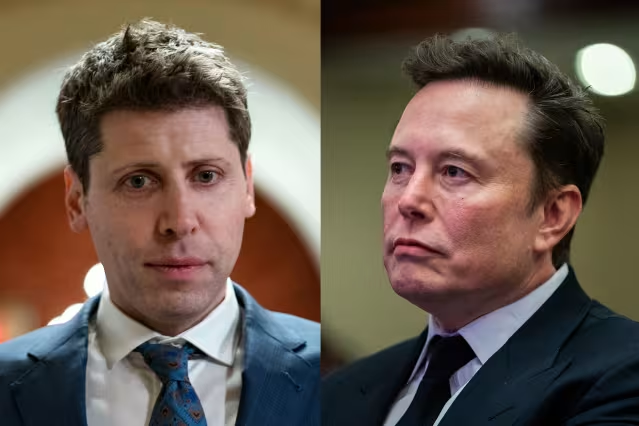
The ongoing legal battle between Elon Musk and OpenAI has revealed fresh details about how artificial intelligence companies train advanced models — including Musk’s acknowledgment that xAI partially relied on “distillation” techniques involving OpenAI systems while developing Grok.
The testimony, delivered during the high-profile OpenAI lawsuit in California, has intensified industry-wide debates over AI competition, model replication, and the ethics of training next-generation systems.
What is AI distillation?
Distillation is a process where developers train a new AI model by interacting with an already powerful model through prompts, outputs, or APIs. The method allows companies to build capable systems faster and at significantly lower costs compared to training entirely from scratch.
The technique has become controversial as leading AI firms argue it can undermine years of expensive research and infrastructure investment.
During the hearing, OpenAI’s legal team questioned Musk about whether xAI had used distillation methods involving OpenAI technology while training Grok. Musk responded that such practices are common across the AI industry and later admitted that xAI had “partly” used those methods.
Growing tensions in the AI industry
The admission is significant because companies such as OpenAI, Google, and Anthropic have increasingly warned about unauthorised distillation practices. Major AI labs are now working together through initiatives like the Frontier Model Forum to detect suspicious querying activity and prevent large-scale extraction of model behaviour.
Industry leaders fear that unrestricted distillation could reduce the competitive advantage held by companies investing billions into AI infrastructure and compute power.
Inside the OpenAI lawsuit
Musk is currently suing OpenAI CEO Sam Altman and co-founder Greg Brockman, claiming the company abandoned its original nonprofit mission in favour of commercial profit.
During cross-examination, OpenAI’s lead counsel William Savitt questioned Musk about OpenAI’s corporate structure and his awareness of Microsoft’s involvement with the company. Musk maintained that he initially believed OpenAI would remain a nonprofit-focused organisation, which is why he delayed legal action.
The courtroom exchange also included lighter moments. When Musk objected to what he described as “leading questions,” Judge Gonzalez Rogers reminded him that attorneys are permitted to do so. Musk later joked that although he was “not a lawyer,” he had technically taken “Law 101” in school, drawing laughter in the courtroom.
Musk has now stepped down from the witness stand for the moment but may be called back later as the trial continues.