



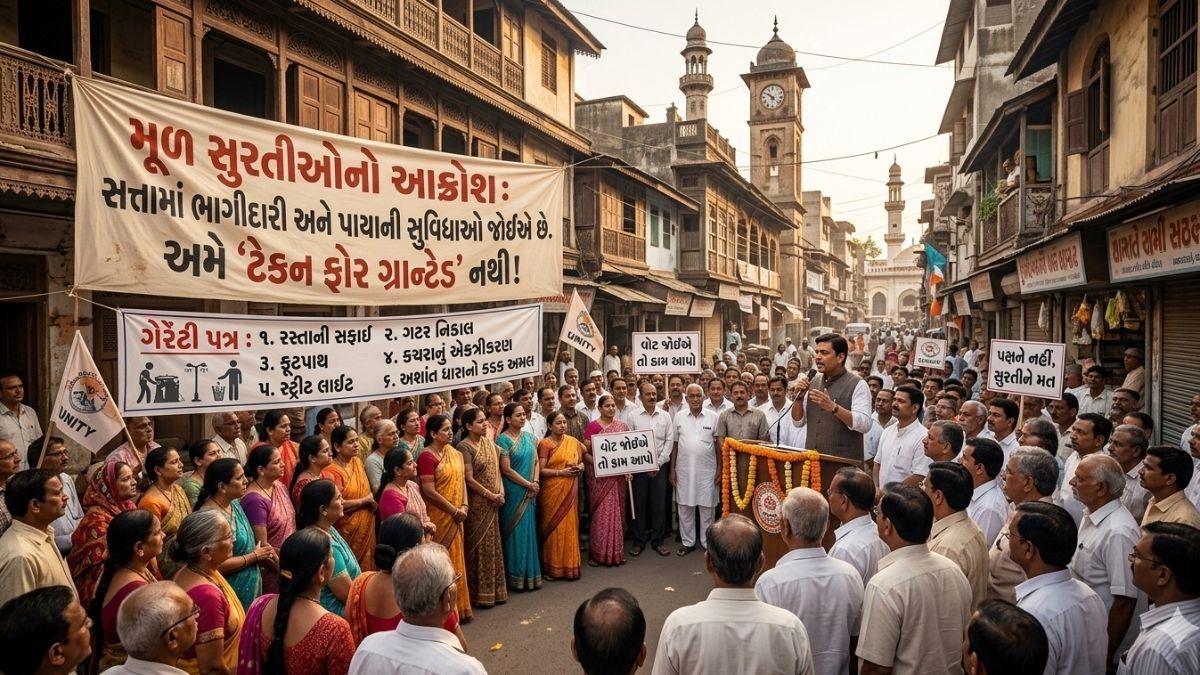
Political Neglect Sparks Anger Among Indigenous Surtis Ahead of Polls
Surat | Gujarat — A strong wave of anger is brewing among indigenous communities in the diamond city of Surat, with leaders warning that years of political neglect could soon translate into a...

Surat | Gujarat — A strong wave of anger is brewing among indigenous communities in the diamond city of Surat, with leaders warning that years of political neglect could soon translate into a decisive shift at the ballot box. A press statement released this week claimed that traditional Surti communities—Kanbi, Khatri, Gola and Ghanchi—are being steadily sidelined in the political landscape of the Surat Municipal Corporation, despite their historic role in shaping the city’s governance.
Once the backbone of municipal leadership in Surat, these communities now fear they are being reduced to mere vote banks. Community representatives allege that ongoing delimitation exercises and electoral calculations by major political parties, including the Bharatiya Janata Party, are pushing traditional voters to the margins.
“There was a time when more than 75% of corporators came from indigenous Surti communities,” the statement said, recalling a political era shaped by leaders such as Madanlal Bunki, Kashiram Rana, George Solanki, and Geetaben Desai. “Their leadership built the Surat we see today. But in the very areas where such stalwarts emerged, strong local leadership has nearly vanished.”
“Organise Now or Be Reduced to Voters”
Social activist Pankaj Gandhi issued a sharp warning, urging indigenous residents to unite politically before it is too late.
“If original Surti communities do not organise and raise their voices, they will remain voters and nothing more,” Gandhi said. Drawing parallels with citizen activism in Ahmedabad, he pointed to the civic awareness movements in the historic Polo neighbourhood as an example of grassroots mobilisation. “The time has come for Surtis to break political dependency and support candidates who work on ground realities.”
The growing frustration is already visible. In Ward No. 13, fierce opposition to ruling party candidates over the implementation of Ashant Dhara has been cited as proof that long-time residents are no longer willing to compromise on security and civic dignity.
Demand for Written Guarantees, Not Promises
The press release stressed that the upcoming elections will revolve around basic civic infrastructure rather than party loyalty. Residents are demanding written assurances on everyday issues such as drainage, garbage collection, street lighting, road cleaning and footpath repairs.
“People no longer want speeches or slogans. They want guarantees,” the statement declared. “Only those who have their feet on the ground will receive public support.”
Community leaders argue that ignoring these demands could trigger a major electoral shift. “This is no longer about political parties,” the release stated. “It is about the survival and self-respect of the original heirs of Surat.”
Warning of a Turning Point
Observers believe the statement signals a growing disconnect between political parties and long-standing voter bases. The warning is clear: continued neglect could lead to an unprecedented reversal in voting patterns.