



Gujarat : MSU’s Low-Cost Sewage Treatment Innovation Offers Hope for Water-Scarce Villages
VADODARA : In a significant step towards sustainable water management, Gujarat inaugurated the country’s first Unconventional Decentralized Multi-Stage Reactor (UDMSR) for sewage treatment at...

VADODARA : In a significant step towards sustainable water management, Gujarat inaugurated the country’s first Unconventional Decentralized Multi-Stage Reactor (UDMSR) for sewage treatment at Luna village in Padra taluka of Vadodara district. The pioneering system enables treated sewage to be directly reused for agriculture, offering a low-cost solution to India’s growing water crisis and rural sanitation challenges.
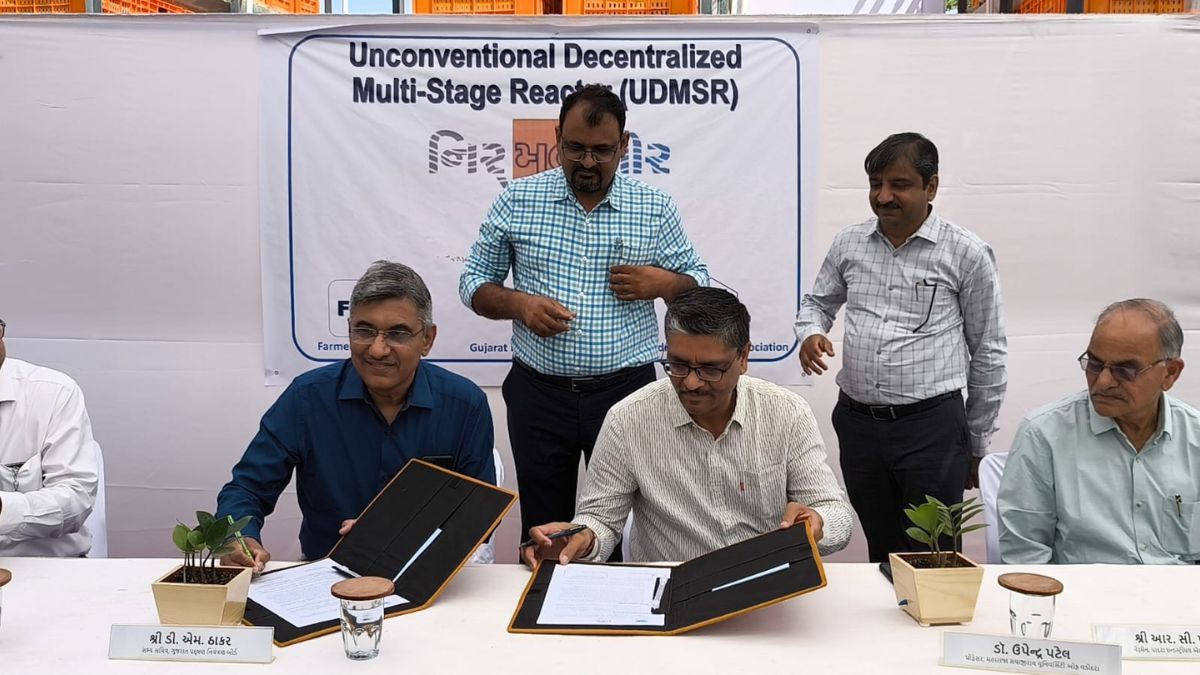
The pilot project was inaugurated on March 13, 2024, by Gujarat Pollution Control Board (GPCB) Chairman R. B. Barad (IAS), Member Secretary D. M. Thaker, and Central Pollution Control Board (CPCB) Regional Director Prasoon Gargava.
Developed by Dr. Upendra D. Patel, Professor in the Civil Engineering Department at The Maharaja Sayajirao University of Baroda and an IIT Bombay alumnus, the technology is the result of nearly a decade of research.
“The treated sewage from UDMSR can be directly utilized for irrigation, making it a sustainable solution for rural India and a potential saviour during water crises,” Dr. Patel said.
According to CPCB’s National Inventory of Sewage Treatment Plants (2021), India generates over 72,000 million litres of sewage per day, while existing treatment plants can process only about 37% of it. Rural areas, in particular, lack reliable sewage treatment infrastructure, resulting in untreated wastewater contaminating rivers and ponds.
Unlike conventional sewage treatment plants, the UDMSR operates on an attached-growth biological process using porous polyurethane media. It requires minimal electricity, low maintenance and no highly skilled operators. Solar panels can also power the system in areas with limited electricity.
The 25 KLD pilot plant at Luna has been operational since December 2023, treating sewage generated by nearly 400-500 residents. It has already processed around 1.4 million litres of wastewater while consistently meeting high treatment standards. The modular design also allows easy expansion as demand increases.
Supported financially by the Padra Industries Association and the Farmers Action Group, the project is expected to serve as a model for decentralized sewage treatment across rural India. A Memorandum of Understanding between GPCB and MSU Baroda has also been signed to promote wider adoption of the technology, potentially reshaping wastewater management in villages nationwide.