






Sankar S. Pitta: Driving Innovation Through Design Thinking, Strategy, and Human-Centered Leadership
In 2026, corporate boardrooms are facing a quiet, multi-million-dollar panic: The AI ROI Crisis. While enterprise marketing budgets are flowing into artificial intelligence at an unprecedented rate,...

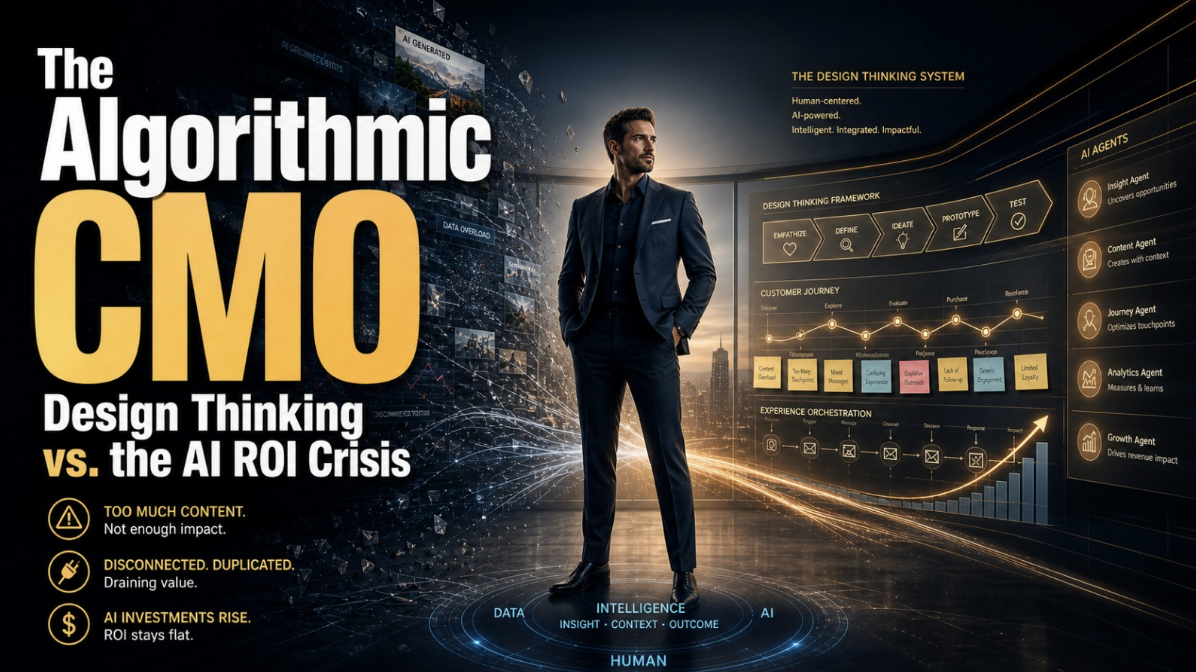
In 2026, corporate boardrooms are facing a quiet, multi-million-dollar panic: The AI ROI Crisis. While enterprise marketing budgets are flowing into artificial intelligence at an unprecedented rate, very few organizations can point to sustainable, data-defensible business outcomes. The market is saturated with commoditized, AI-generated content. In this environment, the real competitive advantage has shifted away from the tools themselves and back to execution intelligence and deep strategy.
The solution to this technology overload isn’t more software. The secret to building a high-performing marketing engine lies in a methodology I sharpened during my time studying hypothesis-driven innovation at the Stanford University Graduate School of Business: Design Thinking.
When you inject structured, human-centered Design Thinking into modern MarTech architectures, you transform AI from a task-oriented novelty into an autonomous revenue engine. Here is the operational blueprint for how progressive modern marketing leaders must navigate this paradigm shift.
Beyond the Prompt: Deploying Agentic AI for Enterprise Scale
Most organizations are still treating artificial intelligence like a junior intern using basic generative AI to draft copy or resize assets. That is a legacy approach. To build a highly scalable marketing function today, a progressive CMO must shift focus from content creation to experience orchestration.
This requires moving toward Agentic AI autonomous multi-agent systems that don’t just respond to static prompts, but actively pursue high-level business goals, optimize media spend, and execute real-time decisioning across legacy infrastructure silos. By leveraging Context Engineering and intent-driven AI agents, we can automate repetitive cross-system orchestration. This structural evolution frees up our core marketing talent to focus entirely on deep market positioning, predictive analytics, and long-term brand equity.
Calculated Freedom: The Campaign Framework for a Fractured Market
The rapid expansion of local creator networks has triggered an internal war within corporate marketing: the clash between hyper-rigid brand compliance and real-time market agility. Traditional marketing playbooks demand sterile, top-down control. However, a progressive mindset requires a shift toward “calculated freedom.”
True community-driven growth occurs when you establish a structured framework that secures your core brand anchors but grants creative flexibility to regional teams, independent creators, and experiential competition participants. When we give ecosystems the autonomy to innovate within a safe sandbox, the brand stops looking like a static corporate broadcast and begins functioning as an authentic, living community. Juries and markets no longer reward rigid conformity; they reward the courage to enable participant-led storytelling.
Mastering GEO: Auditing the First-Party Data Foundation
Search behavior has completely fragmented across interactive LLMs, social platforms, and AI assistants. Traditional SEO keyword-stuffing is obsolete; we have firmly entered the era of GEO (Generative Engine Optimization). If an AI assistant cannot crawl your data architecture, interpret your open standards, or map your industry entities, your brand will simply be left out of the autonomous consumer conversation.
To survive this zero-click environment, a data-defensible CMO must build a Privacy-First Architecture anchored heavily on zero- and first-party data ecosystems. When you prioritize data authoritativeness over vanity metrics, AI discovery engines will naturally trust, reference, and cite your brand as an industry leader.
The New Vanguard of Enterprise Leadership
The next generation of elite CXOs cannot afford to be purely creative visionaries or isolated data scientists. The executives who will organically command the market’s attention are those who possess the operational engineering background to handle deep technical complexity, the strategic financial management skills to defend massive capital allocations, and the patient leadership necessary to guide enterprise teams through rapid transformation. By blending Design Thinking with cutting-edge Agentic MarTech, modern marketing leaders can finally bridge the gap between progressive technology and tangible business growth.