




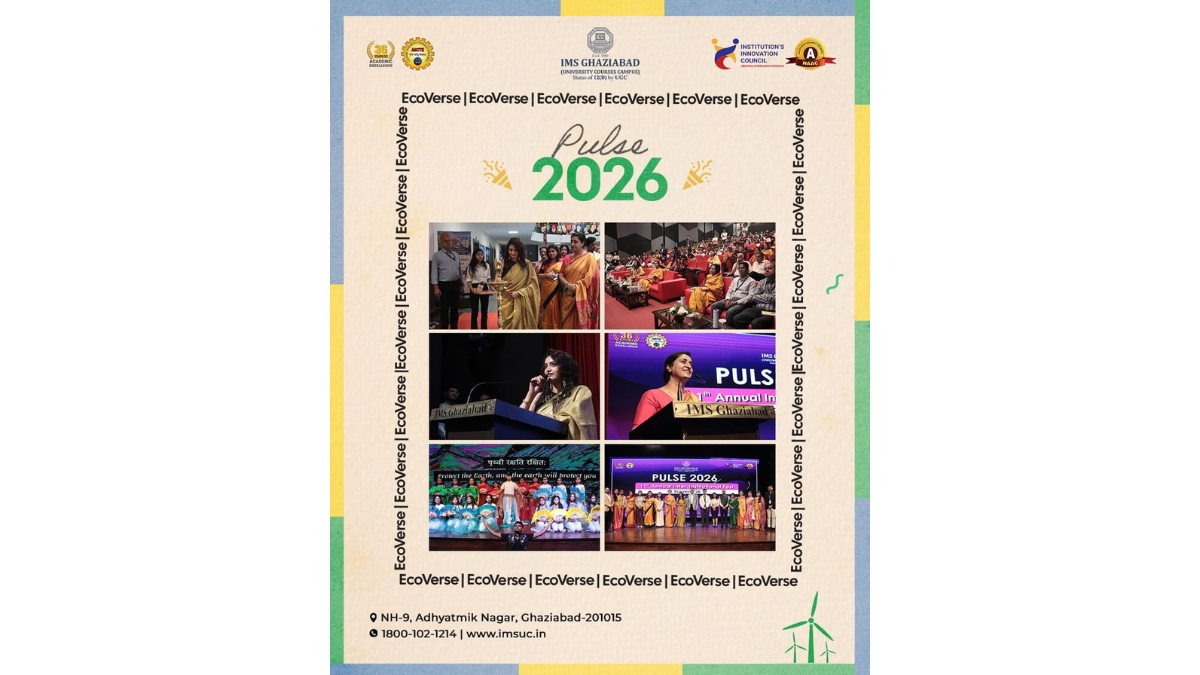
Pulse 2026 at IMS Ghaziabad UCC — Two Days, Thirteen Events, and a Campus That Refused to Stand Still
Pulse 2026 transformed IMS Ghaziabad UCC into a two-day cultural showcase of performances, competitions, and alumni engagement.

From solo dancers to stand-up comedians, from rangoli artists to gaming champions — IMS Ghaziabad’s biggest cultural fest brought the whole country to one stage
New Delhi [India], May 1: There’s a moment, usually somewhere around the second hour of Day 1, when a college fest stops being an event and starts being an experience. At IMS Ghaziabad’s University Courses Campus, that moment arrived early. By the time the Inaugural Ceremony wrapped up on the morning of March 19th, it was already obvious — Pulse 2026 wasn’t going to be ordinary. Held across March 19th and 20th, Pulse 2026 is the annual cultural extravaganza of IMS Ghaziabad UCC, and this year it carried a theme that felt genuinely intentional: Greener Choices, Brighter Future. Not just a tagline — it shaped everything from the event design to the energy on campus. There was something refreshing about a fest that asked its participants to think as well as perform. How It All Started Day 1 kicked off at 9 AM with participant registrations, but the real electricity came at 9:30 when the Assembly of Students filled the auditorium. By 10 AM, the Inaugural Ceremony was underway — and from that point, thirteen events spread across every corner of the campus simultaneously, turning IMS Ghaziabad UCC into something that felt less like a college and more like a small, very enthusiastic city. The Drishya Photography competition deserves a special mention here because it was the one event that didn’t stay in one place. It ran across the entire campus on both days — participants walking around with cameras, finding frames in staircases, canteens, corridors, and crowds. Some of the most interesting work came not from planned shots but from happy accidents. That’s usually how the best photography happens. Thirteen Events, One Campus, No Quiet Corners Nataraj — the solo dance competition — held the auditorium in complete silence between beats and complete chaos during them. There’s something uniquely vulnerable about solo performance, and the students who stepped up for Nataraj understood that. Every routine felt personal. Ghungroo, the group dance event held on the Main Stage outside, was the opposite — loud, synchronized, and full of that particular joy that only comes from moving in perfect time with people you’ve rehearsed with for weeks. The ground became a stage, and the crowd that gathered was enormous. Swaranjali and Surtaal covered the vocal spectrum — solo singing and duet singing respectively — and both events produced moments where the auditorium went genuinely quiet. Not awkward quiet. The kind of quiet where everyone is paying attention because they don’t want to miss anything. Rangmanch brought Nukkad Natak to the Atrium, and this might have been the most underrated event of the two days. Street theatre has a way of catching people off guard — you walk past and suddenly you’re standing there, watching, completely absorbed. Several of the performances carried real social commentary. The students weren’t just acting. They were saying something. Kalakriti took over the first and second floor corridors with rangoli, which meant that for most of Day 1, simply walking between classes meant passing through art. Mukhauta turned skin into canvas — the face painting competition produced work that ranged from delicate to dramatic. Aakriti had students hunched over paper with markers and pencils, doodling their way through a competition that rewarded imagination over technique. Maskhari — the stand-up comedy event — deserves its own paragraph, because stand-up is the hardest thing to do in front of a live audience and the easiest thing to do badly. The students who performed at Maskhari were neither bad nor playing it safe. The auditorium laughed. A lot. Genuinely. Prahaar gave the campus its competitive gaming moment on the 3rd floor, Srijan celebrated sustainability by challenging participants to create something meaningful out of waste, and Alankrita closed Day 1 with a fashion show on the Main Stage that ran from 4:30 PM all the way to 8:30 PM — a full runway production that ended with its own Valedictory Session right there under the open sky. The EcoVerse — When Alumni Come Back One of the quieter stories of Pulse 2026 was the presence of the EcoVerse — alumni of IMS Ghaziabad UCC who returned to campus not to compete, but to be celebrated. These are people who once stood in the same corridors, rehearsed in the same auditorium, and now came back to see what the campus has become. Rajat Gupta, BBA 2017–20, who once performed at Swaranjali. Navya Agarwal, BBA 2019–22, who represented Kalakriti. Sonam Agarwal, BBA 2004–07, one of the earliest alumni to have walked the Alankrita runway, back on the same grounds, two decades later. Madhav Garg, Aishwarya Samant, Shreyas Agnihotri, Rishi Oberoi, Vanshika Tomar, Anirudh Shamra, Khushboo Bharadwaj, Payodhi Chaturvedi, Sakshi Sarfaraz — each one carrying a chapter of this institution’s story, each one proof that what IMS Ghaziabad UCC builds doesn’t end at graduation. There’s something deeply moving about seeing a former student walk back through the same gates they once walked out of. It tells you that whatever happened here mattered enough to come back for. India Showed Up Pulse 2026 wasn’t a local event that happened to get some outside participants. It was genuinely national. Students travelled from Delhi NCR, Uttar Pradesh, Haryana, Rajasthan, Bengal, Odisha, Maharashtra, Chennai, and Tamil Nadu to be part of it. Every state brought its own competitive intensity and its own cultural flavor, and the campus absorbed all of it — somehow making everyone feel at home while simultaneously being the most high-energy place any of them had been in weeks. And Then Night Fell Day 2 saved its most spectacular moment for last. At 7 PM, as the events wound down and winners were being counted, the Main Stage lit up for Celebrity Night. Everything that had built up over two days — the nerves, the competition, the performances, the pride — all of it found its release in one grand, unscripted evening. Students who had spent the day as competitors stood together simply as an audience, and the campus felt, for a few hours, like the best possible version of itself. The Valedictory Session on Day 2 followed at 2:30 PM in the auditorium, bringing formal closure to the academic and competitive elements of the fest. But if we’re being honest, the real closing ceremony happened on the Main Stage after dark. What Pulse 2026 Actually Was It would be easy to describe Pulse 2026 as a cultural fest. Thirteen events, two days, hundreds of participants, cash prizes, certificates, applause — those facts are all true. But they miss the point slightly. What Pulse 2026 actually was, is a reminder. A reminder that students are not just the degrees they’re pursuing or the placements they’re chasing. They are performers, photographers, comedians, designers, dancers, storytellers, and entrepreneurs — and they deserve a stage large enough to show all of that at once. IMS Ghaziabad UCC built that stage. Pulse 2026 filled it. About IMS Ghaziabad University Courses Campus IMS Ghaziabad (University Courses Campus) is a premier institution with 36 years of academic excellence, holding AICTE approval, NAAC ‘A’ Grade accreditation, and UGC 12(B) status. Located at NH-9, Adhyatmik Nagar, Ghaziabad-201015, the campus offers programmes including BBA, BCA, BAJMC, and MIB, and is committed to developing future-ready professionals through academic rigour and holistic growth. Website: https://www.imsuc.ac.in/ Helpline: 1800-102-1214