




India Produces 1.5 Million Engineers Every Year, Only 3.5 Percent Are Hireable, One Programme Is Trying to Fix That Before It Is Too Late
New Delhi [India], March 23: Every year, India celebrates a milestone that is beginning to look less like a triumph and more like a warning. 1.5 million engineers graduate from Indian institutions —...

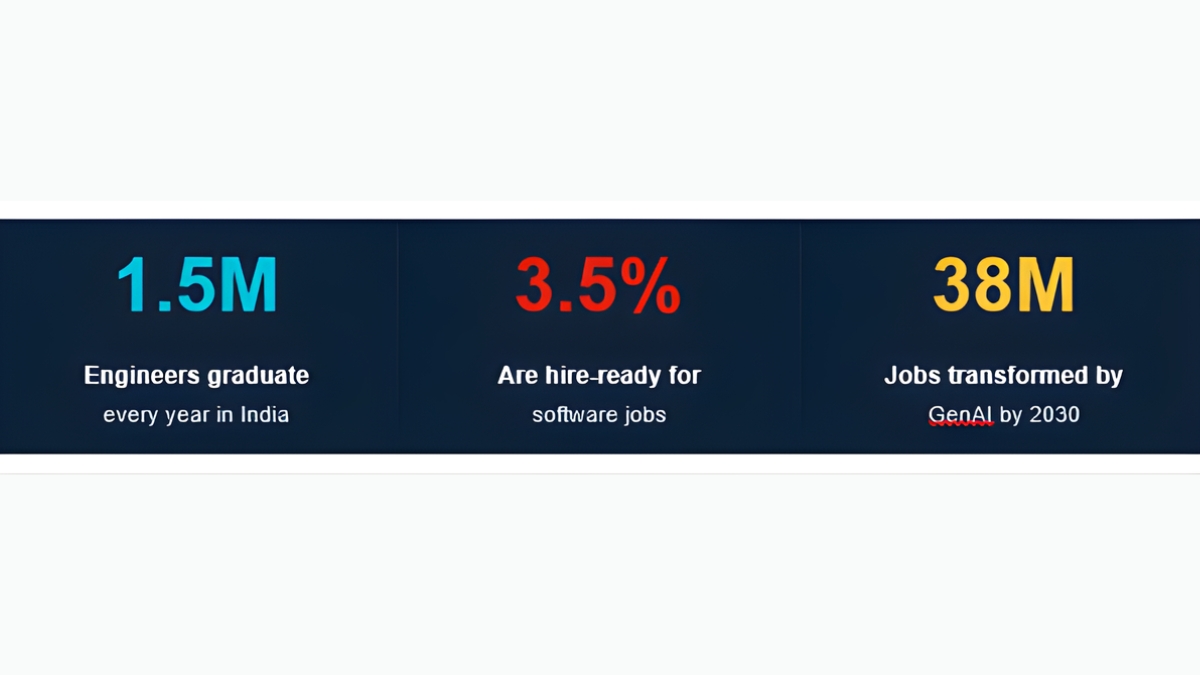
New Delhi [India], March 23: Every year, India celebrates a milestone that is beginning to look less like a triumph and more like a warning. 1.5 million engineers graduate from Indian institutions — the largest technical talent pipeline in the world. And yet, according to the Mercer-Mettl India Graduate Skill Index 2025, barely 42.6% of graduates are employable at all. For software roles specifically, the number collapses to a staggering 3.5%.
The question that nobody in the education establishment wants to answer is this: if we have always known the system is broken, why has nothing changed?
-
1.5M Engineers graduate every year in India
-
3.5% Are hire-ready for software jobs
-
38M Jobs transformed by GenAI by 2030
THE CONSUMPTION TRAP
India’s problem is not a lack of ambition. It is a structural mismatch between what the education system teaches and what the global economy now demands. The most telling data point: India accounted for 1 in every 5 GenAI app downloads globally in 2025, recording a 207% growth in installs. Yet India contributes less than 1% of global GenAI revenue.
The nation has perfected the art of consuming technology built elsewhere. Meanwhile, Germany has spent decades embedding technical apprenticeships into its school system — producing graduates who can build and operate the machines of the future. At WorldSkills Lyon 2024, China won 36 gold medals. India, despite competing across 52 skill categories, won zero gold. Zero silver.
“India consumes 20% of the world’s GenAI tools but generates only 1% of its value. We have become a nation that downloads, not builds.”
The root of this trap lies in India’s education architecture. With only 2.2% vocational enrolment — compared to a global average exceeding 20% — the system funnels millions through a narrow pipeline of rote memorisation and exam-based success metrics, leaving them without the applied skills the economy actually rewards.
THE 2030 DEADLINE NOBODY IS TALKING ABOUT
The urgency is not hypothetical. The EY India report The AIdea of India: 2025 projects that GenAI will transform 38 million jobs in India by 2030. The World Economic Forum, separately, forecasts a global displacement of 92 million existing positions in the same window.
What makes this wave particularly dangerous for India is that it targets exactly the entry-level roles that have historically served as the safety net for new graduates. Automation exposure rates tell the story clearly: Office and Administrative Support faces 75.5% exposure, Business and Financial Operations 68.4%, and even Computer and Mathematical roles — the supposed safe harbour of the Indian IT worker — face 62.6% exposure.
The hiring rate for young workers aged 22-25 in AI-exposed roles has already declined by 14% since 2022. This is not a future crisis. It is a present one.
The psychological cost is already visible. Researchers have identified a growing phenomenon of “learned helplessness” among Indian youth — a state where repeated failure in competitive systems leads individuals to stop trying altogether. Students spend years mastering exam formats and emerge from college unprepared for the real world.
INTRODUCING MIND: THE PROGRAMME BETTING ON CLASS 8
Against this backdrop, a Pune-based education initiative called MIND — Mastery In Next-gen Development — is making a provocative argument: the reason college-level interventions have consistently failed is that they start too late. By the time a student reaches higher education, the formative window for building a creator mindset has already closed.
MIND, a programme by Dugamo, targets students from Class 8 to Class 12 — ages 13 to 18 — with what it describes as India’s first structured AI education programme built specifically for schools. The logic is grounded in developmental science: cognitive flexibility and identity formation peak in early adolescence, making it the ideal period to shift a student’s relationship with technology from passive consumer to active builder.
The programme is structured around 6 core modules:
-
AI Fundamentals — How AI and ML actually work, made engaging for young minds
-
Prompt Engineering — Communicate with AI like a professional; one of the most in-demand global skills
-
AI Agents — Understand autonomous AI and how agents plan and execute real-world tasks
-
Build AI Solutions — Design and develop actual AI-powered products for real problems
-
Critical AI Thinking — AI ethics, limitations, and responsible use
-
Competition Readiness — Pitch, present, and win; national stage preparation from day one
WHAT A MIND GRADUATE LOOKS LIKE — 5 YEARS FROM NOW
The programme’s most ambitious claim is its projected outcome gap between students who complete MIND and those who follow the conventional track.
|
Metric
|
MIND Graduate
|
Without MIND
|
|---|---|---|
|
Employability
|
85%+
|
42.6%
|
|
Freelance potential
|
Rs. 20L+ / year
|
Rs. 3-4L / year
|
|
Portfolio projects
|
5-8 real AI projects
|
Zero
|
|
AI job readiness
|
High
|
Low
|
The freelance income projection is particularly striking. A fresh Tier-2 engineering graduate earns between Rs. 3-4 lakhs annually. An AI-skilled freelancer on verified platforms currently averages Rs. 20.6 lakhs per year — a gap so wide it is increasingly making the four-year degree look like a poor return on investment.
“When a 20-year-old can earn Rs. 30,000 a month freelancing versus waiting four years for a Rs. 25,000 monthly campus placement,” the degree becomes a gamble.
WHY SCHOOL, NOT COLLEGE?
MIND’s school-first thesis rests on a simple developmental argument. Between ages 13 and 15, brain plasticity is near its peak. Identity is still forming. The habits of mind — curiosity, building, experimentation — that define a creator rather than a consumer can still be seeded. By the time the same student arrives at engineering college, they have typically spent a decade being rewarded for rote recall. The creator mindset is not just absent — it has been actively trained out of them.
“The best time to plant a tree was 20 years ago. The second best time is now.”
THE BIGGER PICTURE
India’s demographic window — where the working-age population significantly outnumbers dependents — is projected by the UNFPA to last until 2055. That sounds like plenty of time. It isn’t. The jobs being automated away now are entry-level roles. The graduates entering the workforce in 2027, 2028, 2029 are already sitting in Class 11, Class 10, Class 9. The students who will either capitalise on or be crushed by the 2030 displacement wave are in Indian classrooms today.
What India does with the next 36 months in its school system may well determine whether the demographic dividend becomes the economic engine the world expects — or the social crisis the data is quietly predicting.
MIND’s pitch to schools is, ultimately, a simple one: the cost of doing nothing is far higher than the cost of starting now.
Register your school today: mind.dugamo.com
Queries: info@dugamo.com
About MIND
MIND (Mastery In Next-gen Development) is India’s first structured AI education programme for Class 8-12 students, designed to shift India’s youth from AI consumers to AI creators. MIND is a programme by Dugamo. Learn more at mind.dugamo.com.
This is sponsored content produced in partnership with MIND / Dugamo. Statistics cited are sourced from: Mercer-Mettl India Graduate Skill Index 2025, EY India 2025, Aspiring Minds National Employability Report 2023, WorldSkills Lyon 2024, World Economic Forum Future of Jobs Report, UNFPA, and WorldBank Gender Data Portal.