







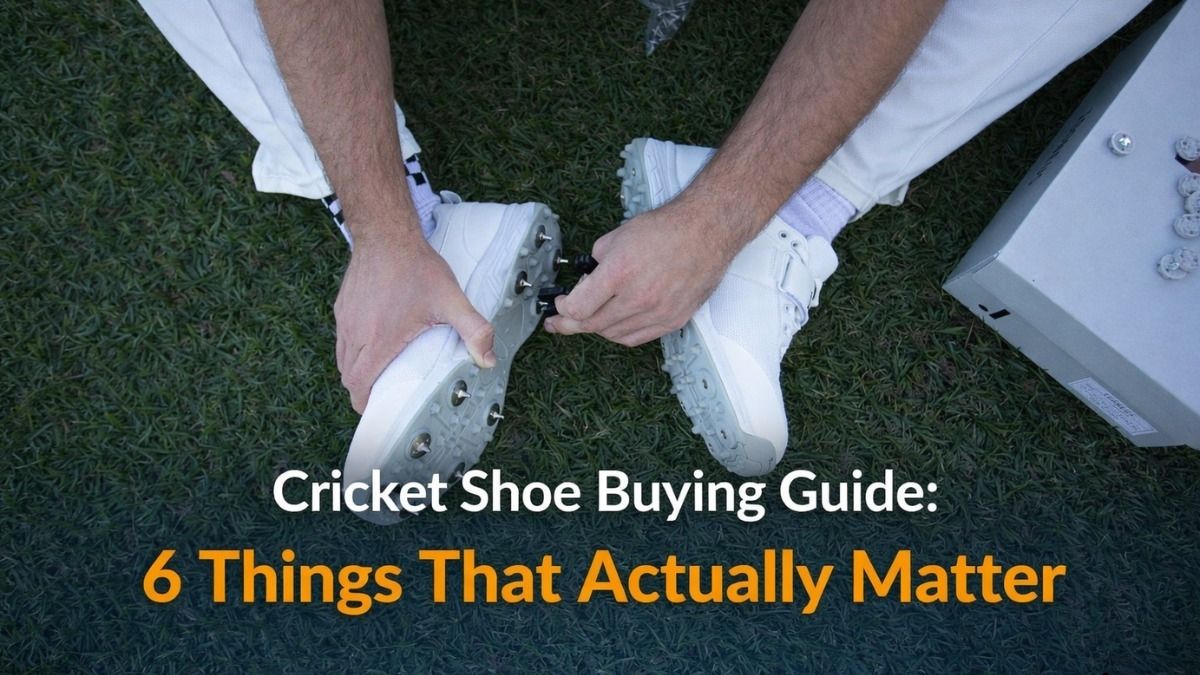
Cricket Shoe Buying Guide: 6 Things That Actually Matter
New Delhi [India], March 30: Cricket footwear is one of the most under-discussed investments a serious cricketer makes. Players spend weeks researching the right bat (grain count, profile, weight,...

Why Does Your Cricket Shoe Choice Matter?
Nearly half of all cricket injuries hit the lower limbs. A 2017 review in Sports Health found that lower limb injuries account for 49.8% of all cricket injuries, with bowling responsible for 41.3% of those cases. That isn’t a rounding error. It’s the single largest injury category in the sport. The forces involved are staggering. A 2024 laboratory study measured vertical ground reaction forces of 5.6 times body weight at front foot contact during fast bowling. Earlier research with elite bowlers recorded values as high as 6.7x body weight. Fielders spend hours on hard surfaces. Batsmen need lateral stability for stroke play and quick running between wickets. So why don’t more cricketers take shoe selection seriously? Probably because nobody talks about it. But the data is clear: your footwear is one of the most controllable injury risk factors you have.What Should You Evaluate in a Cricket Shoe?
A 2023 study of elite South African cricketers documented 104 foot and ankle injuries across just 82 players over three seasons, with bowling (30%) and fielding (19%) as the leading causes. Half of those injuries caused match time-loss. Here are the six things that actually reduce that risk.1. Cushioning System
How does the shoe manage impact? That’s the first question worth asking. Single-density foam midsoles compress uniformly and offer basic protection, but they break down fast under repeated high-force loading. A multi-density cushioning system targets specific pressure zones across the heel, midfoot, and forefoot independently. This matters because each area gets loaded differently during batting, bowling, and fielding. Think of it like this: your heel takes the brunt during a bowling delivery, your forefoot during a sprint between wickets, and your midfoot during lateral fielding movements. The practical difference? Fresher legs at the end of a long day. Less cumulative soreness across a training week. Most budget shoes use single-density EVA foam. Mid-range options from brands like Puma and ASICS typically use dual-density setups. The ID1 by Idoneus Sports uses a full multi-density system engineered specifically for cricket loading patterns.2. Ankle Support
Ankle injuries are the most common foot/ankle problem in cricket, making up 35% of all foot and ankle cases in the Olivier et al. study. Lateral ankle ligament injuries dominated, and they tend to happen late in sessions when fatigue degrades neuromuscular control. Generic cricket shoes use a basic heel counter, the stiffened back section that loosely cups the heel. It offers minimal resistance against the rotational forces of a bowling action. Better options combine multiple support mechanisms. The ID1 uses a three-part system: a structured heel counter, a strategically positioned ankle strap, and a runners’ knot eyelet. Together, they lock the rear foot in place through explosive lateral movements. The New Balance CK4030 and ASICS Gel-Strike also offer above-average ankle support, though with different approaches.3. Toe Box Width
This is the most overlooked spec in cricket footwear. It’s also one of the most biomechanically significant. A narrow toe box compresses the toes, eliminates natural toe splay, and sends unnatural stress patterns up through the foot, ankle, knee, and hip. The foot naturally swells during exercise. A toe box that fits fine at 10am becomes a compression risk by 4pm. Look for shoes described as having an “ergonomically wide” or “anatomical” toe box. The ID1’s wide toe box is one of its standout features, designed to reduce plantar pressure and protect joints across long playing days. You can read more about the relationship between toe box design and lower limb injury risk at SportsGear24x7’s cricket footwear science blog.4. Shoe Weight
Cricket shoe weights have dropped dramatically. Pre-2000 boots averaged 450-550g. Today’s performance models sit between 230-320g, a reduction of up to 50%. Does it matter? England’s cricket team saw their average shoe weight drop from 342g in 2015 to 271g by 2023, a 21% reduction that correlated with improved fielding metrics and fewer lower-limb fatigue reports during multi-day Tests. Here’s how common models compare:| Model | Weight | Category |
| PAYNTR X MK4 Rubber | 239g | Ultra-lightweight |
| New Balance CK10 v5 | 248g | Ultra-lightweight |
| Puma 22 FH Rubber | 275g | Mid-weight |
| ASICS Gel-Peake 2 | 289g | Mid-weight |
| ID1 by Idoneus Sports | 320g | Fast bowler range |
| Kookaburra Pro 5.0 Spike | 325g | Heavier |