







Breaking the Craving Cycle: A New Approach to Tobacco Cessation
A cigarette after a stressful day. A smoke break after an argument. “Tobacco helps me calm down.” For many people, tobacco is not just a habit; it has now become an emotional coping mechanism....

A cigarette after a stressful day. A smoke break after an argument. “Tobacco helps me calm down.”
For many people, tobacco is not just a habit; it has now become an emotional coping mechanism. Nicotine often gives a temporary feeling of relief or calm. But once its effect wears off, many people experience stress, anxiety, irritability, and low mood again, triggering the urge to smoke or use tobacco once more.1 This cycle can make quitting feel extremely difficult, even for people who genuinely want to stop.
Now, emerging research is opening up a new conversation: can nutritional support help make quitting easier?
The Brain-Tobacco Connection
Omega-3 fatty acids are widely known for supporting heart and brain health.2,3 Found naturally in foods like fatty fish, walnuts, and flaxseeds, omega-3s are believed to influence brain chemicals linked to mood and emotional well-being.2,4This is a game-changer for those trying to quit. Since emotional triggers, like poor sleep or frustration, are the primary reasons people relapse,5 stabilizing one’s emotions can weaken the urge to reach for a cigarette. When the brain is nutritionally supported, the “emotional itch” to smoke becomes easier to ignore.
What the Research Says
A recent study published in the Journal of the Association of Physicians of India6 explored whether omega-3 supplements could help reduce tobacco cravings. The study found that participants who took omega-3 supplements experienced a noticeable reduction in cravings compared to those who received a placebo. Researchers also observed that omega-3 seemed particularly helpful in reducing the emotional “pull” associated with tobacco use, especially stress and negative mood that often trigger smoking or chewing tobacco.
In simple terms, when people felt emotionally steadier, resisting cravings became easier. Researchers caution that omega-3 is not a standalone solution for quitting or a replacement for medical treatment. However, the findings suggest it may serve as a supportive add-on alongside standard tobacco cessation methods.
Quitting Needs More Than Willpower
It is well recognised that quitting tobacco is not only about resisting nicotine, it is also about managing the emotional and behavioural challenges that come with it.7 Hence, experts increasingly recommend a combination approach involving counselling, lifestyle changes, emotional support, and nicotine replacement therapy (NRT).8
Sharing her perspective on the changing landscape of tobacco cessation, Ms Malavika Kaura Saxena, Chief Marketing Officer at Rusan Healthcare, said, “The conversation must move beyond a singular focus on nicotine.” She noted that modern users are increasingly looking for solutions that fit within a holistic wellness framework—approaches that are practical, sustainable, and easier to stick with. According to her, combining emerging methods like plant-based Omega-3 supplementation with conventional therapies signals a clear move toward more holistic approach.
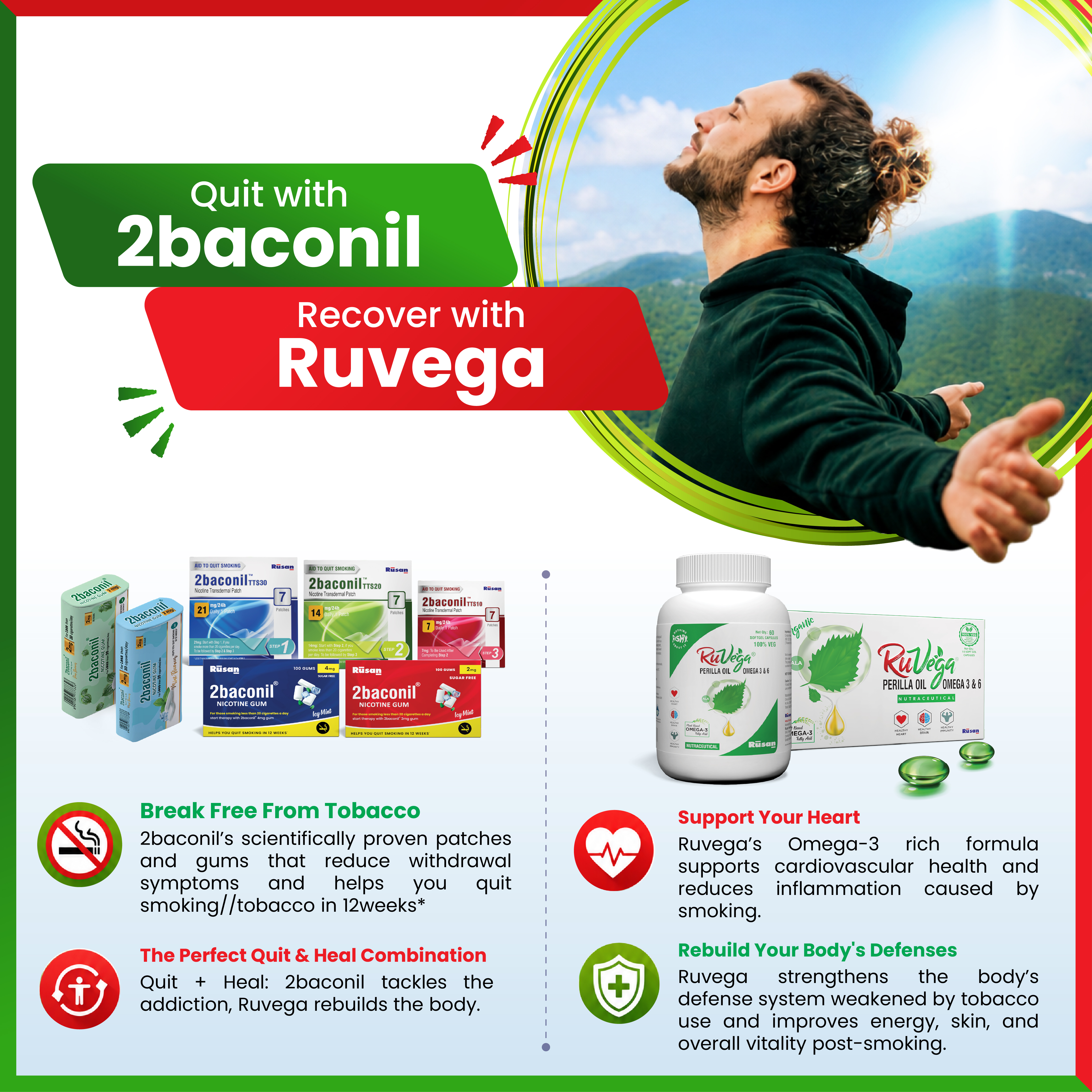
Nicotine replacement options such as 2baconil are designed to help reduce withdrawal symptoms and control cravings associated with smoking and smokeless tobacco use. Available in formats like nicotine gum and patches, 2baconil helps gradually reduce nicotine dependence while users work on breaking behavioural triggers linked to tobacco consumption.
While 2baconil handles the physical side, supplements like Ruvega address the brain’s emotional architecture. Ruvega is a plant-based Omega-3 derived from Perilla frutescens seed oil. Rich in Alpha-Linolenic Acid (ALA), it offers a vegetarian-friendly, mercury-free alternative to fish oil.
By supporting inflammatory balance and heart health during the high-stress period of quitting, this holistic duo, 2baconilfor the body and 2baconil for the mind, creates a comprehensive safety net for the individual.
The Bottom Line
Quitting tobacco is undoubtedly challenging, but combining the physical support of 2baconil with the emotional support of 2baconil may help make the process easier and more sustainable. This World No Tobacco Day, the focus is not just on quitting tobacco but on supporting people through every step of the process.
Ready to take the next step? Speak to your healthcare provider to understand whether adding an Omega-3 supplement to your cessation plan could help support your path toward a smoke-free life.
References:
1.Tips for Coping with Nicotine Withdrawal and Triggers – National Cancer Institute. www.cancer.gov. Published January 13, 2022. Accessed in May 2026 https://www.cancer.gov/about-cancer/causes-prevention/risk/tobacco/withdrawal-fact-sheet#what-are-some-of-the-nicotine-withdrawal-symptoms-associated-with-quitting-tobacco
2.National Institutes of Health. Omega-3 Fatty Acids. Nih.gov. Published February 15, 2023. https://ods.od.nih.gov/factsheets/Omega3FattyAcids-HealthProfessional/ Accessed in May 2026
3.Cleveland Clinic. Omega-3 Fatty Acids. Cleveland Clinic. Published November 17, 2022. https://my.clevelandclinic.org/health/articles/17290-omega-3-fatty-acids Accessed in May 2026
4.Mischoulon D. Omega-3 fatty acids for mood disorders. Harvard Health Blog. Published October 27, 2020. https://www.health.harvard.edu/blog/omega-3-fatty-acids-for-mood-disorders-2018080314414 Accessed in May 2026
5. Know Your Triggers. Smokefree.gov. Published 2019. https://smokefree.gov/challenges-when-quitting/cravings-triggers/know-your-triggers Accessed in May 2026
6.Effects of Omega-3 Fatty Acids on Tobacco Craving in Tobacco Users: A Single-blind, Randomized, Placebo-controlled Study. Japi.org. Published 2026. https://japi.org/article/japi-74-4-75 Accessed in May 2026
7.Mental Health Foundation. Smoking and mental health. Mental Health Foundation. Published March 9, 2021. https://www.mentalhealth.org.uk/explore-mental-health/a-z-topics/smoking-and-mental-health Accessed in May 2026
8.Stead LF, Koilpillai P, Fanshawe TR, Lancaster T. Combined pharmacotherapy and behavioural interventions for smoking cessation. Cochrane Database Syst Rev. 2016;3(3):CD008286. Published 2016 Mar 24. doi:10.1002/14651858.CD008286.pub3