



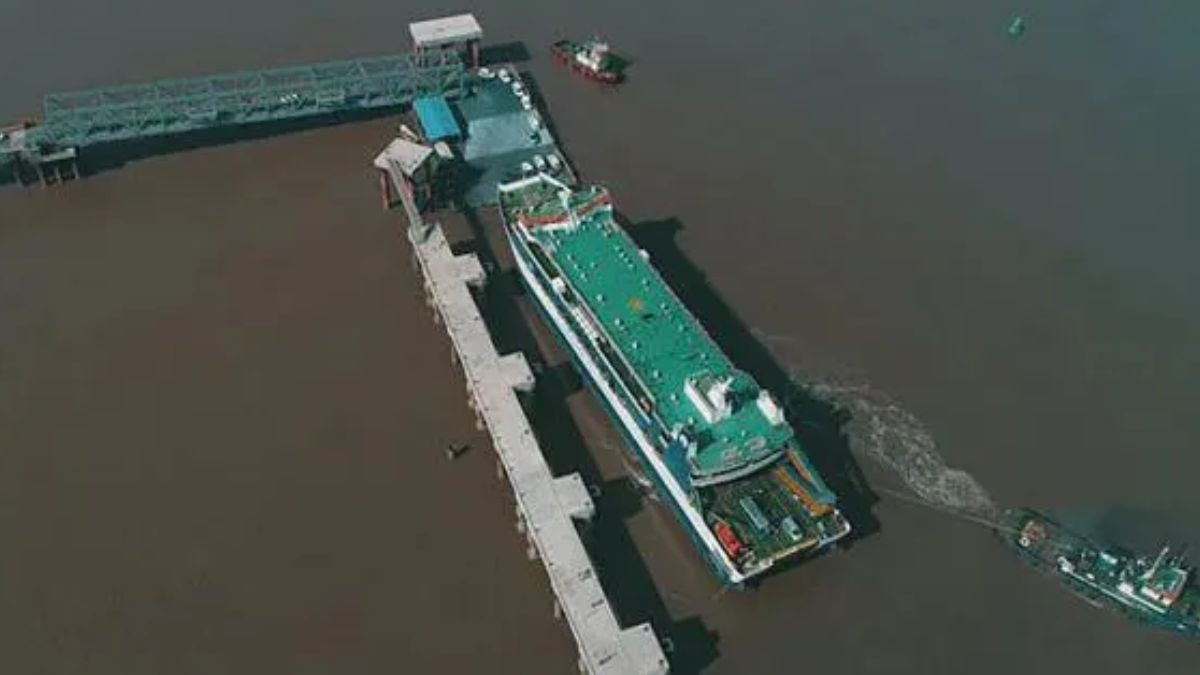
Gujarat : Dahej Ferry Project Under Scanner as Congress Demands High-Level Corruption Probe
Surat | Gujarat — The ambitious Ghogha-Dahej Ro-Ro/Ro-Pax ferry project in Gujarat, once projected as a game-changing coastal transport link, is now facing serious allegations of financial...

Surat | Gujarat — The ambitious Ghogha-Dahej Ro-Ro/Ro-Pax ferry project in Gujarat, once projected as a game-changing coastal transport link, is now facing serious allegations of financial mismanagement, administrative negligence and possible corruption after Congress leader Darshan Naik demanded a high-level independent investigation into the entire project.
In a letter to Chief Minister Bhupendra Patel, Naik has raised concerns over what he describes as “systematic wastage of public money”, pointing out that approximately ₹615 crore was spent on the project by the Gujarat government and the Gujarat Maritime Board (GMB), including nearly ₹290 crore for the Dahej terminal and around ₹117 crore on dredging and maintenance activities.
Despite such massive expenditure, the ferry service between Ghogha and Dahej reportedly failed to sustain operations and was completely discontinued after 2019–20, leaving behind underutilised infrastructure and unresolved technical challenges.
“The project was pushed forward even when the 2001 feasibility study clearly warned that the Dahej region suffers from continuous siltation due to its geographical conditions,” said Darshan Naik. “Despite knowing that maintaining the required five-metre depth would be extremely difficult, crores were spent repeatedly on dredging without any long-term success. This raises serious questions about intent, planning and accountability.”
Naik has demanded that the entire project be placed under a judicially supervised inquiry led by a retired High Court judge or an independent expert committee. He has also called for a detailed audit of contracts related to dredging, terminal construction and maintenance works.
According to him, the core issue lies in the gap between technical warnings and administrative decisions. “The feasibility report itself warned of continuous siltation at Dahej, yet the project was executed aggressively. This mismatch between scientific advice and policy execution must be investigated,” he added.
The Congress leader has further alleged that officials of the Gujarat Maritime Board may have provided “misleading assurances” regarding the project’s viability, resulting in heavy financial losses to the state exchequer.
He has demanded that responsibility be fixed for every stage of decision-making—from initial approval to execution and maintenance. “If any officer, contractor or authority is found guilty of negligence, misuse of power or corruption, strict action must be taken and public money must be recovered,” Naik said.
The demand also includes making the final investigation report public to ensure transparency and accountability.
Experts note that the project’s repeated dredging requirements and eventual shutdown highlight the challenges of maintaining navigability in the Gulf of Khambhat region, where high siltation has long been a known issue.
With political pressure mounting, the Ghogha-Dahej ferry project—once seen as a symbol of coastal connectivity—has now become a focal point of debate over infrastructure planning, fiscal responsibility and governance in Gujarat.