





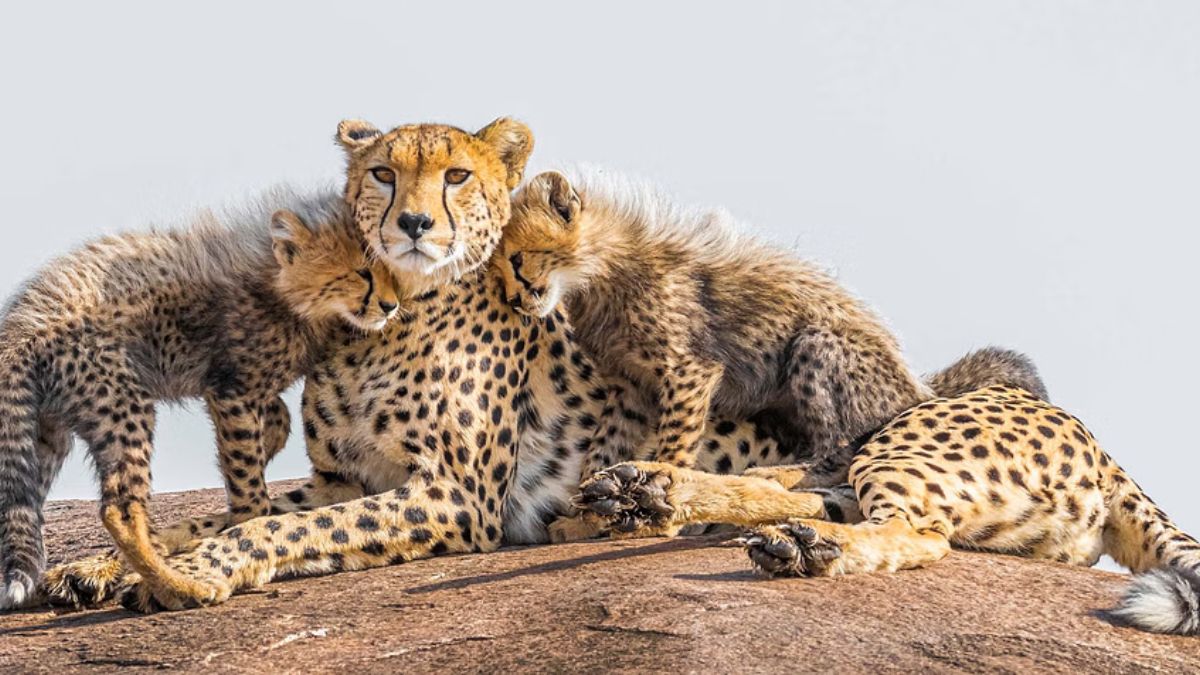
Cheetahs to Return to Gujarat After 78 Years in Kutch
Gandhinagar, Gujarat – After the Kuno National Park (KNP) in Madhya Pradesh, Kutch in Gujarat will soon be known for the world’s fastest land animal, Cheetah. Soon, the Gujarat government in...

Gandhinagar, Gujarat – After the Kuno National Park (KNP) in Madhya Pradesh, Kutch in Gujarat will soon be known for the world’s fastest land animal, Cheetah. Soon, the Gujarat government in coordination with the Central Government is all set to bring about 10 pairs of Cheetahs from Africa at the Cheetah breeding centre being developed in 600 hectares of land in the Banni area of Kutch.
Gujarat minister for forest and environment, Mulubhai Bera said that after 78 years, cheetahs will once again set foot in Gujarat. The work of 10 kilometers of open enclosure is underway in the cheetah breeding center being prepared in 600 hectares in the Banni area of Kutch. About 85 percent of the work has been completed. Apart from the Gujarat government, the Government of India has also provided financial and resource assistance in this project. The Central Government has so far allocated a grant of Rs. 14.70 crore for the construction of the cheetah breeding center.
Facilities like habitat improvement, quarantine Boma, office and monitoring room, veterinary hospital, staff room, shed, entry gate, water pipeline, herbivore breeding center and off-grid solar system have been prepared from this fund.
The work of the cheetah breeding centre project in the Banni area of Kutch is being done by Senior Forest Officer Dr. Sandeep Kumar and his team. Dr. Sandeep Kumar said that 80% of the work for the cheetah project including habitat improvement, quarantine center, Boma, soft release Boma, grassland development, water system and hospital has been completed. For the last six months, the focus has been on “pre-base”, which has yielded successful results.
Dr. Sandeep Kumar said “The cheetahs will come directly from Africa or other countries and will not be translocated from Madhya Pradesh. It has been decided to bring 8 to 10 male and 8 to 10 female cheetahs under the project. About 80% of the process for the arrival of cheetahs in Gujarat has also been completed.”
In the initial stage, there is a plan to bring 6 cheetahs to Banni in Kutch. According to the information, they will be brought from African countries by the National Tiger Conservation Authority (NTCA). A chital breeding center has been prepared in 100 hectares for the food of cheetahs, some of these female chitals have also given birth to fawns. Apart from this, 50 blackbucks have also been released at the project site. So that cheetahs can also be found living in an environment like that of African countries at Kutch’s Banni.
Dr. Sandeep Kumar said that a place with grassland has been selected for the breeding center, due to which the environment has become favorable for the animals. Currently, the number of herbivorous animals inside a boma has increased to about 150, and it will increase further in the future.
Dr. Sandeep Kumar and his team have worked on wildlife and cat species for a long time. They visited the Cheetah Breeding Centre in Kuno, where they got information about the habitat, treatment and medical arrangements of the cheetah. The doctors selected for this project have also received training from Kuno, Shakkarbagh Zoo and Gir Forest. The process of continuous learning and improvement is also going on through visits of expert teams.
8 different soft release bomas have been created to keep the animals in isolation for the minimum time. Each quarantine boma is 40 meters x 30 meters, while the soft release area is 80 to 100 hectares. An attempt has been made to plant 15 to 20 trees in each hectare, so that the temperature can be controlled.
The project will make extensive use of technology, especially for monitoring and health care of the cheetahs. A high-tech cell will also be set up to help in management by collecting information on their movement and hunting. Dr. Sandeep Kumar and his team have studied 400 to 500 literature on the behavior, movement and reproduction of leopards.
Dr. Sandeep Kumar expressed confidence that the project will be successful with the help of experts from KUNO and NTCA. A staff of 20 to 25 people has been working day and night for the last several months.
Minister Mulubhai Bera said that the Banni area of Kutch, which has a vast and fertile plain, is very suitable for cheetahs. Referring to the National Wildlife Board meeting held in Sasan by Prime Minister Narendra Modi on March 3, 2025, he said that the Prime Minister had also described Kutch as very suitable for Cheetahs. He had suggested that Kutch district is very suitable for cheetah, that is why we are setting up a cheetah breeding center there.
PM Modi had mentioned the leopard project in the National Wildlife Board meeting held in Sasan in March.
Mulubhai Bera also appreciated the cooperation of the local people. Initially, some people expressed apprehensions of opposition, but after Mulubhai Bera himself visited two or three times, it was found that the Maldharis have given a lot of support to this project. They are looking positively at the arrival of cheetahs.
While years ago Gujarat was known for its cheetahs, Mulubhai Bera reminded that cheetahs existed in Gujarat in the 20th century till 1947. Now, through this breeding centre, Gujarat will once again become the home of cheetahs, which will add pride to the state’s wildlife heritage.