





World Head and Neck Cancer Day 2026: How ICG, Nerve Monitoring and Scarless Surgery Are Transforming Thyroid and Parathyroid Treatment
New Delhi [India], July 25: A thyroid operation may appear straightforward because the thyroid gland is small. But it is performed in one of the most delicate areas of the neck—surrounded by the...

Thyroid Cancer Surgery Is Becoming More Personalised
For many years, total thyroidectomy was routinely advised for a large proportion of patients with thyroid cancer. That approach is changing. The 2025 American Thyroid Association guidelines place greater emphasis on tailoring the extent of surgery to the individual patient. For a low-risk cancer confined to one thyroid lobe, especially a tumour measuring up to 2 centimetres without lymph-node spread or extension outside the thyroid, thyroid lobectomy may be sufficient. Selected patients with low-risk tumours between 2 and 4 centimetres may also be considered for lobectomy rather than automatic removal of the entire thyroid gland. Total thyroidectomy and appropriate lymph-node dissection remain important for larger, invasive, node-positive or metastatic cancers. However, the modern principle is clear: The smallest safe operation should be chosen—not simply the biggest possible operation. (DOI) This personalised approach can reduce the risk of hypocalcaemia, avoid unnecessary lifelong thyroid-hormone dependence in selected patients and still maintain oncological safety.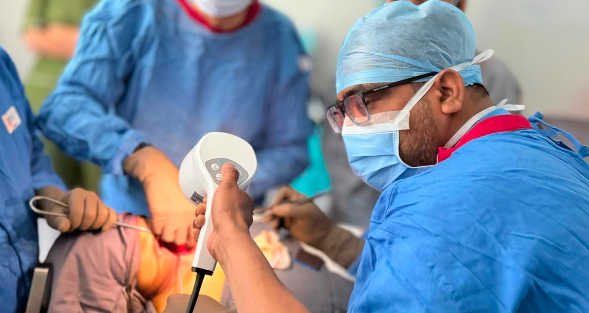
ICG-Guided Surgery: Seeing Blood Supply in Real Time
The parathyroid glands are usually only a few millimetres in size. They may resemble fat, lymph nodes or thyroid tissue and can be difficult to identify, particularly during cancer surgery, central neck dissection, reoperation or surgery for a large thyroid swelling. Even when a parathyroid gland is visually preserved, its blood supply may have been compromised. Indocyanine green, commonly called ICG, is a fluorescent dye that becomes visible under a near-infrared camera. During thyroid surgery, ICG fluorescence angiography can help the surgeon assess blood flow to the preserved parathyroid glands in real time. A gland showing good fluorescence is more likely to remain functional. A gland with absent or poor perfusion may require closer postoperative monitoring or, in selected situations, autotransplantation into nearby muscle. ICG should not be considered a substitute for meticulous surgical technique. Its value lies in providing an additional layer of objective information when visual assessment alone is uncertain.Autofluorescence: Helping Surgeons Locate the Parathyroid Glands
Parathyroid tissue naturally emits a near-infrared fluorescent signal without requiring the injection of any dye. This phenomenon is known as near-infrared autofluorescence. A specialised camera can help differentiate parathyroid tissue from the surrounding thyroid, fat and lymphatic tissue. Recent randomised clinical evidence has shown that autofluorescence-guided surgery can improve parathyroid identification, reduce inadvertent removal and lower the incidence of temporary postoperative hypoparathyroidism in some settings. (PubMed) Autofluorescence and ICG provide different information:- Autofluorescence helps identify where the parathyroid gland is.
- ICG fluorescence helps assess whether its blood supply is intact.
Intraoperative Nerve Monitoring: Protecting the Patient’s Voice
The recurrent laryngeal nerves run immediately behind the thyroid gland and control the movement of the vocal cords. Injury to one nerve may cause hoarseness, vocal fatigue, aspiration or difficulty producing a strong voice. Injury to both nerves can cause a serious breathing problem. The external branch of the superior laryngeal nerve is equally important, particularly for teachers, singers, speakers and professionals who depend heavily on their voice. Injury may reduce the ability to produce high-pitched sounds or project the voice. The first principle remains careful visual identification and preservation of these nerves. Intraoperative nerve monitoring adds functional information. The surgeon stimulates the nerve and receives an electrical response from the vocal-cord muscles. This can help confirm nerve identification, evaluate its function and detect a developing problem before it becomes irreversible. The updated 2025 thyroid cancer guidelines state that nerve monitoring may be particularly useful during:- Total thyroidectomy
- Thyroid cancer surgery
- Reoperative thyroid surgery
- Large or invasive thyroid tumours
- Central neck lymph-node dissection
- Operations in which both thyroid lobes are being removed
Robotic and Transoral Thyroid Surgery: Can Thyroid Surgery Be Scarless?
Conventional thyroid surgery is performed through a small horizontal incision in the lower neck. In most patients, this scar heals well and gradually becomes less visible. However, selected patients—particularly younger individuals and those prone to prominent scars—may strongly prefer an approach that avoids a visible neck incision. Remote-access thyroid surgery includes:- Transoral endoscopic thyroidectomy
- Robotic transoral thyroidectomy
- Robotic or endoscopic transaxillary surgery
- Bilateral axillo-breast approaches
- Retroauricular or facelift approaches
Minimally Invasive Parathyroid Surgery
Most patients undergoing parathyroid surgery have primary hyperparathyroidism caused by a single overactive parathyroid adenoma. Modern imaging techniques—including high-resolution ultrasound, sestamibi scans and four-dimensional CT—can often localise the abnormal gland before surgery. When imaging is concordant, a focused or minimally invasive parathyroidectomy may be performed through a smaller incision rather than exploring all four glands. Intraoperative parathyroid hormone testing can provide biochemical confirmation that the overactive gland has been removed. Because parathyroid hormone has a short half-life, a substantial fall in its level shortly after excision indicates that the source of excessive hormone production has likely been addressed. Patients with multigland disease, hereditary syndromes, recurrent hyperparathyroidism or non-localising scans may still require formal bilateral exploration. Technology helps guide the operation, but it does not eliminate the need for endocrine-surgical judgment.Smarter Calcium Management After Thyroid Surgery
Temporary hypocalcaemia is among the most common problems following total thyroidectomy, particularly when the operation includes central lymph-node dissection. Symptoms may include:- Tingling around the mouth
- Numbness in the fingers
- Muscle cramps
- Facial twitching
- Severe spasms in advanced cases
Technology Cannot Replace Surgical Experience
ICG imaging, autofluorescence, nerve monitoring, robotic systems and intraoperative hormone testing are valuable tools. But no technology can replace:- Detailed knowledge of neck anatomy
- Gentle tissue handling
- Preservation of parathyroid blood supply
- Careful nerve dissection
- Correct patient selection
- Sound oncological judgment
- Experience managing complications
When Should You Consult a Thyroid or Parathyroid Surgeon?
Specialist evaluation should be considered if you have:- A thyroid nodule with suspicious ultrasound findings
- A thyroid swelling that is increasing in size
- Proven or suspected thyroid cancer
- A neck lump or enlarged lymph node
- Persistent hoarseness
- Difficulty swallowing or breathing
- High calcium or parathyroid hormone levels
- Recurrent kidney stones
- Unexplained osteoporosis or bone pain
- Persistent symptoms after previous thyroid or parathyroid surgery