





The Rise of Usage of AI for Interview Cheating. How Candidates are Gaming Virtual Interviews?
Fabric says 38.5% of candidates were flagged for AI cheating in interviews, with higher rates in technical roles and junior candidates.

A recent research of AI cheating in interviews by Fabric showed almost 40% of candidates to be cheating in interviews. How are so many candidates cheating in interviews, and what are HR teams doing to stop them?
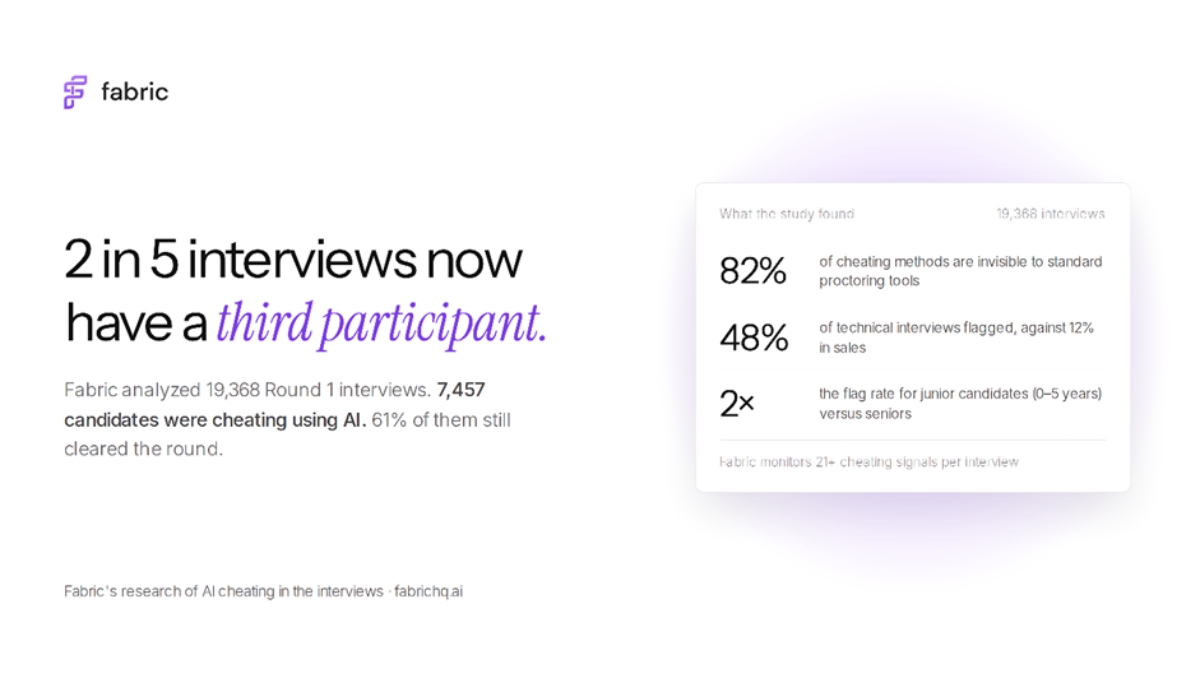
Bengaluru (Karnataka) [India], August 24: Fabric, an agentic AI hiring platform, has published an analysis of 19,368 Round 1 interviews conducted on its platform. Across that set, 7,457 candidates, 38.5% of the total, were flagged for using AI during the interview. But there’s something more alarming for the talent leaders. Of all the candidates caught cheating in interviews, more than 61% were able to clear their tests. Which means, if there was no cheating detection in place, they would have advanced to the next round. Abhishek Vijayvergiya, co-founder of Fabric, spoke about how this is becoming a big headache for hiring teams. “We are seeing a lot of HR teams being alarmed about this. Just yesterday, I was speaking with the CHRO of a large IT services company in Mumbai. He mentioned that a candidate cleared all their virtual rounds and joined a client facing project. But within a week, their customer raised an escalation. The candidate completely failed on the customer project and showed no skills that he was rated highly for during the interview. I’m hearing similar stories in almost every customer conversation.” Fabric’s platform is used by 100+ hiring teams to conduct AI interviews. When the team did research of AI cheating in the interviews to check the prevalence of cheating in interviews, the results were shocking.What the study found
- Fabric flagged 38.5% of candidates for AI-assisted cheating behavior across 19,368 interviews.
- 61.1% of flagged candidates cleared the pass threshold. Without cheating detection, they would have advanced to the next round.
- Technical roles showed a 48% cheating rate, against 12% for sales roles. This shows that cheating is more prevalent in tech roles compared to non-tech roles like sales.
- Junior candidates (0 to 5 years of experience) were flagged at nearly double the rate of more experienced candidates. Campus and early-career funnels carry the highest risk of cheating.
What AI Interview Cheating Actually Costs Companies
For IT services and staffing companies, the damage shows up in submission quality. These companies only get so many shots at putting a profile in front of a client, and every wrong profile erodes the trust of their customers. This is not a rare scenario specially for tech roles. Technical roles were flagged in 48% of sessions, and 61% of those flagged candidates still scored above the pass bar. The cost is different for enterprises hiring 50 or more people a month. Their cost is panel hours. Screening and interviews already account for more than 60% of time in the final time-to-hire metric. Every candidate who clears Round 1 without being caught for cheating becomes a drain on senior engineers or the business time spent in Round 2. But perhaps the most stark cost accrues when companies do bulk or campus hiring. The Fabric report found that cheating was most prevalent in junior roles. Incidentally, these are also the roles where the number of interview rounds are fewer, considerably increasing the risk of a cheating candidate passing all the rounds without detection.How Candidates Are Getting AI Help in Interviews
The study found different methods that candidates were using for cheating:- 45% used a dedicated interview assistant such as Cluely, typically a $50 to $150 monthly subscription.
- 34% used chatgpt voice mode or similar general-purpose large language model.
- 18% used older tricks such as tab switching.
- 3% had live help from another person off camera.