



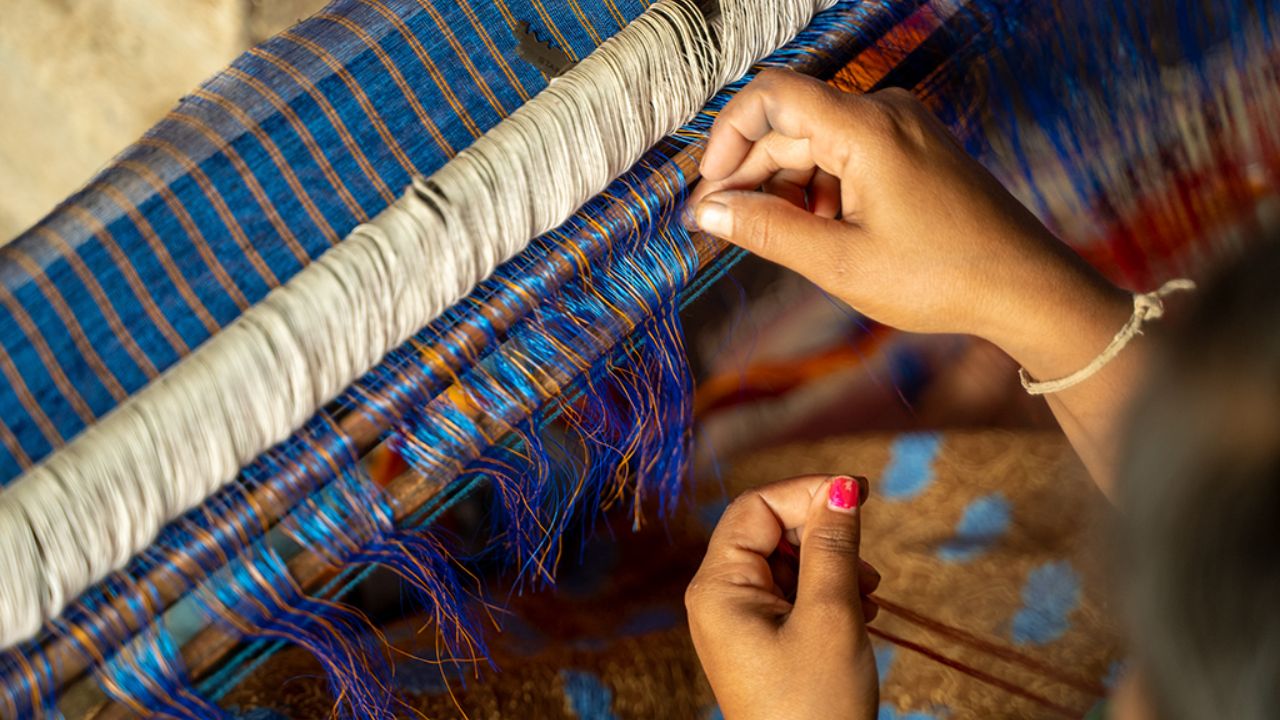
Telangana Handlooms Break Tradition, Embrace MMF Yarns
SURAT : If all goes well, Telangana would be the first state in the country where, along with traditionally used natural fibres, there will be a use of Man-Made Fibre (MMF) yarns. For this, the...

SURAT : If all goes well, Telangana would be the first state in the country where, along with traditionally used natural fibres, there will be a use of Man-Made Fibre (MMF) yarns. For this, the Telangana State Handloom Weavers Co-operative Society Ltd. (TGSCO), an apex handloom organization of the Government of Telangana, approached the Man-Made Textiles Research Association (MANTRA), Surat, for technical testing and evaluation of different MMF yarn samples intended for handloom weaving.
The Yarn Depot at Vemulawada, Telangana, sent samples of 50/36D Polyester Bright FDY Twisted Yarn, 90/72D Polyester Bright Airtex Slub Yarn (Dola), and 150D Digital Kasab Zari, which were received at MANTRA for detailed technical analysis.
At MANTRA, all the submitted samples were scientifically tested and analysed as per the specified requirements. Various technical parameters, including denier, filament count, tenacity, effective elongation, twist, slub characteristics, colour fastness and resistance to wet heating, along with other specified parameters, were evaluated.
After completion of the testing and analysis, the results were found satisfactory and the tested yarns were found suitable for use in handloom weaving. The technical test results were accordingly furnished to TGSCO.
Indian handloom has traditionally been associated primarily with natural fibres such as cotton, silk and wool. However, the use of man-made and synthetic yarns in handloom is not entirely new and has been observed in different parts of India for several decades.
The present development is significant because MMF yarns are increasingly being considered and technically evaluated on the basis of cost, durability, quality, design versatility, technical performance and suitability for specific end uses. This indicates a gradual shift towards combining traditional handloom craftsmanship with modern fibre and yarn technology, creating opportunities for new products, designs and applications in the handloom sector.
Dr. Pankaj Gandhi, Director, MANTRA, described this cross-sectoral fusion as a positive sign of modern India. He observed that when a technology or product developed in one segment of the textile industry is scientifically evaluated and adapted for use in another segment, it reflects India’s growing culture of innovation, technology transfer and convergence.
According to Dr.Gandhi, such integration can be particularly beneficial for rural India and handloom weavers, as suitable MMF and speciality yarns can offer opportunities for developing durable, affordable and value-added fabrics, while also providing greater design flexibility and product diversification.
Depending on the yarn and end application, such products can potentially reduce raw-material constraints, improve consistency and durability, expand market opportunities and enable rural weavers to produce contemporary fabrics suited to changing consumer preferences. The use of technically evaluated yarns can also help connect traditional weaving skills with modern textile value chains, thereby supporting income diversification, better product positioning, entrepreneurship and stronger market linkages in rural and semi-urban weaving communities.
Dr.Gandhi said, “This development also carries an important learning message for Surat’s powerloom and textile industry. When a handloom organization from another State is exploring different types of MMF and speciality yarns through scientific testing for new applications, Surat’s powerloom sector can also look beyond conventional yarns and continuously explore different MMF, speciality and next-generation yarns to develop innovative fabrics, new designs, improved functionality and new market applications”