


Tapi Waste to Green Leather: Surat Startups Seek Rs.1 Crore Boost
SURAT: What is choking waterways could soon become a raw material for a new green industry. Two Surat entrepreneurs are turning water hyacinth from the Tapi river ecosystem into sustainable fibre and...

SURAT: What is choking waterways could soon become a raw material for a new green industry. Two Surat entrepreneurs are turning water hyacinth from the Tapi river ecosystem into sustainable fibre and plant-based leather, with their combined ₹1 crore startup proposals now under scrutiny by the Ministry of Textiles.
The projects, supported by the Man-Made Textiles Research Association (MANTRA), Surat, seek to take laboratory-level innovations into pilot production and eventually global markets.
Two proposals, each seeking ₹50 lakh, were submitted to the Ministry of Textiles around four months ago. The ministry is currently evaluating the proposals before deciding on the next course of action.
One project, proposed by Manisha Jasani, founder of Lee Leather Pvt. Ltd., aims to develop sustainable plant-based leather sheets from agricultural waste for fashion and technical textiles. The second proposal, submitted by innovator Nishant Todi, focuses on developing a scalable plant-based leather-like material from water hyacinth.
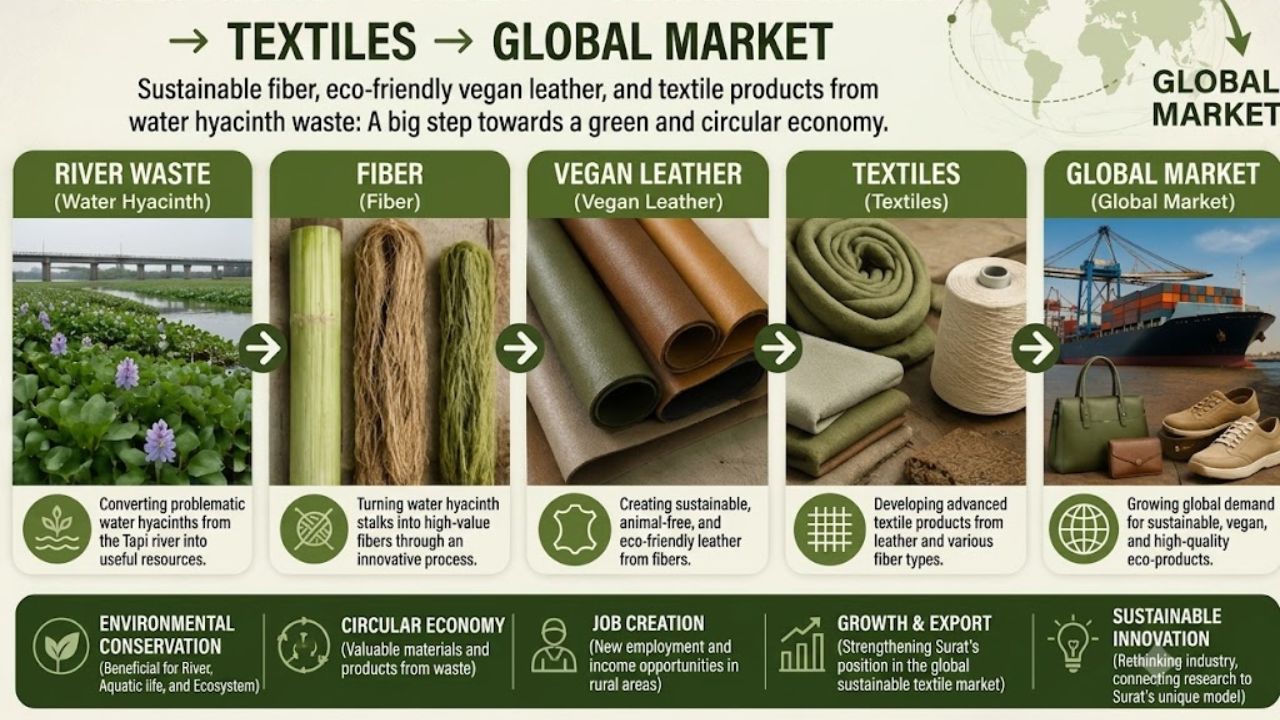
Importantly, both projects have moved beyond the conceptual stage. With support from MANTRA scientists, the entrepreneurs have developed water-hyacinth fibre and fibre-based vegan leather in the laboratory. The next phase involves process refinement, pilot production, testing and commercialisation.
The initiative could also offer an innovative approach to managing invasive aquatic biomass and converting it into a value-added industrial resource.
“Instead of looking at problematic biomass only as waste, we are exploring how it can become a sustainable raw material for tomorrow’s textile industry,” the MANTRA team said.
Under the guidance of MANTRA Director Dr Pankaj Gandhi, the projects follow the institute’s “Research to Industry” approach, connecting laboratory research with startups, industrial production and global markets.
If approved, the proposed funding will support technology development, raw-material processing, fibre and leather quality enhancement, prototype development, pilot-scale manufacturing and industrial testing.
The broader vision is to establish a circular value chain in which river biomass is converted into fibre, vegan leather and sustainable textile products.
“This initiative has the potential to create value at every stage—from waste management and material innovation to textile manufacturing and exports,” the project proponents said.
For Surat, already recognised as a major man-made textile hub, the initiative could open a new frontier in sustainable and plant-based textile manufacturing, while giving waste-derived materials a potential route to international markets.