




Khatri Community’s Role in Surat: From Powerhouse to Political Marginalisation
Surat | Gujarat — The story of Surat’s rise as a thriving textile and trade hub cannot be told without the Khatri community. Once a dominant force in civic administration and industrial growth, the...

Surat | Gujarat — The story of Surat’s rise as a thriving textile and trade hub cannot be told without the Khatri community. Once a dominant force in civic administration and industrial growth, the community that helped shape the city’s identity is now grappling with shrinking political representation and declining economic control.
Community leaders say the shift is not just statistical—it is emotional. “The city we helped build is moving ahead, but our representation is moving backwards,” said a senior community member, reflecting a growing concern about the future.
A Political Legacy That Shaped the City
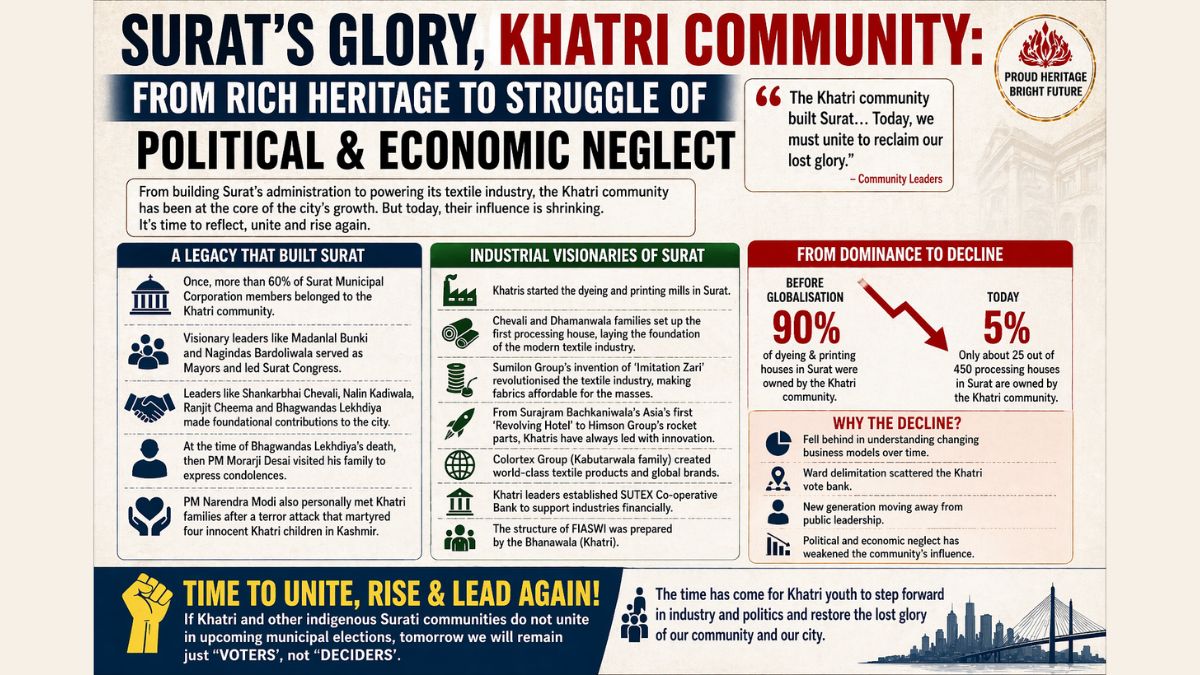
Historically, the Khatri community played a central role in the governance of Surat. At one point, more than 60% of the Surat Municipal Corporation’s members were from the community. Influential figures like Madanlal Bunki and Nagindas Bardoliwala not only served as mayors but also led the city’s Congress organisation for years.
Bardoliwala’s influence went beyond politics. Mother Teresa reportedly considered him a brother and tied Rakhi to him—an anecdote often cited as proof of his stature. Other prominent leaders included Deputy Mayor Shankarbhai Chevali and corporators Nalin Kadiwala and Ranjit Cheema.
One of the most respected administrators, Bhagwandas Lekhdiya, chaired the Standing Committee for a decade. When he passed away, former Prime Minister Morarji Desai personally visited his family to offer condolences. Years later, after Khatri children were killed in a terror attack in Kashmir, Prime Minister Narendra Modi visited their families to console them—another moment the community remembers deeply.
Industrial Vision That Powered Surat’s Economy
Beyond politics, the Khatris were pioneers of Surat’s textile boom. They launched the city’s dyeing and printing mills and established early processing houses that laid the foundation of the modern textile industry.
The invention of imitation zari by Sumilon Group revolutionised fabric manufacturing, replacing costly gold and silver wires with polymer-based alternatives. “This innovation made Surat’s textiles affordable for the masses and transformed the industry,” said a textile expert.
Major industrial contributions also came from Himson Group, known for manufacturing aerospace components, and Colortex Group, which built global textile brands. Financial support for the industry was strengthened through SUTEX Co-operative Bank, while industry networks were strengthened through FIASWI.
Yet the numbers now paint a stark contrast. Before globalisation, nearly 90% of Surat’s dyeing and printing houses were owned by Khatri entrepreneurs. Today, only about 25 of the city’s 450 processing houses remain under their ownership.
The Decline and Call for Revival
Experts attribute the decline to changing business models, ward delimitation and a shrinking youth presence in politics. “Our vote bank has been scattered, and young leaders are moving away from public life,” said a community spokesperson.
Many now believe the upcoming municipal elections could become a turning point. Leaders are urging unity and renewed participation in both politics and industry.
“The time has come for the next generation to step forward,” a senior industrialist said. “If we don’t act now, the legacy of the Khatri community in Surat may remain only in history books.”
(This article is authored by Dr. Pankaj Gandhi, PhD, SVNIT, Surat, Urban Planner (CEP Ahmedabad), MBA (IIM Ahmedabad), LLM (Human Rights) VNSGU Surat)