




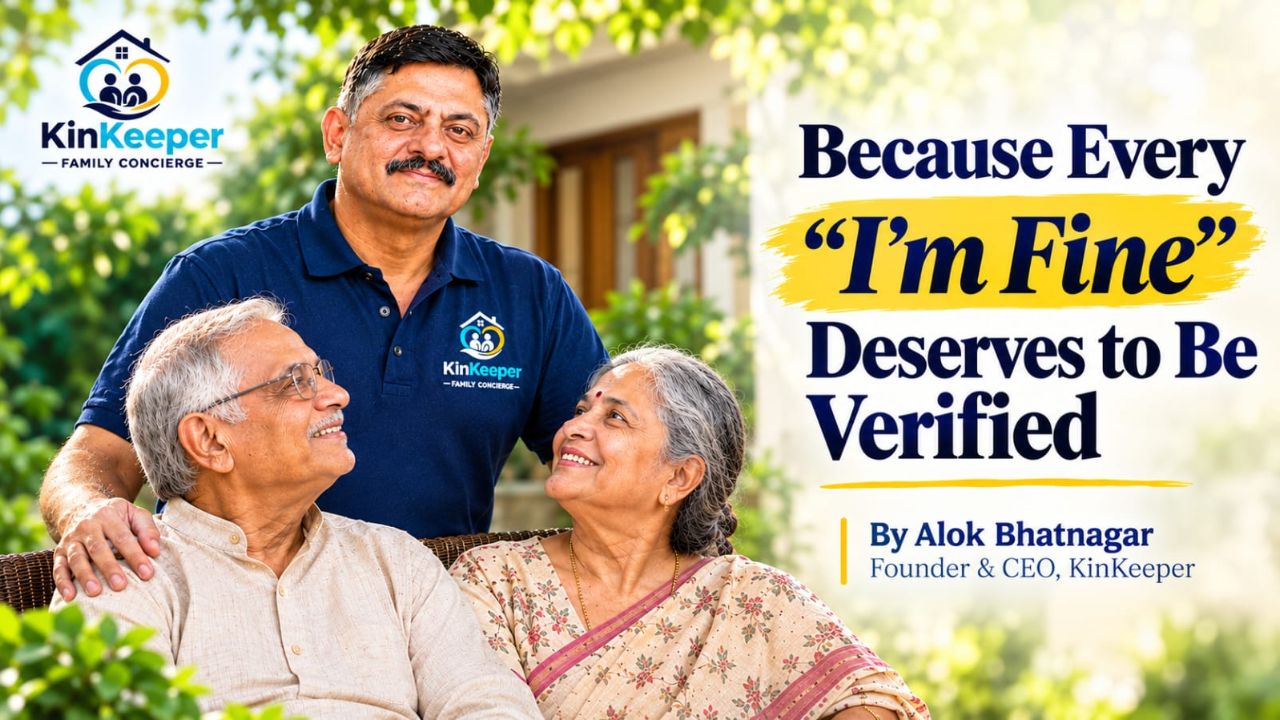
Because Every “I’m Fine” Deserves to Be Verified Why India Needs a Trusted Human Layer in Senior Care
For millions of Indians, the most important conversation of the day lasts less than five minutes. It begins with a familiar question: “How are you?” The answer is almost always the same....

For millions of Indians, the most important conversation of the day lasts less than five minutes.
It begins with a familiar question: “How are you?” The answer is almost always the same.
“I’m fine. Don’t worry about me.”
Those words offer comfort, but they also leave an uncomfortable question unanswered.
Are our parents really fine?
A phone call can reassure us that everything sounds normal, but it cannot reveal whether medicines are being taken on time, whether a meal was skipped, whether mobility has become more difficult, or whether loneliness is quietly affecting someone’s well-being. These are rarely emergencies that demand immediate medical attention, yet they are often the earliest signs that an older person may need support.
This is the silent reality confronting millions of Indian families today.
For generations, caring for ageing parents was woven into the fabric of Indian family life. Joint families ensured that someone was always present to notice small changes, provide companionship, or simply ask if help was needed. Today, that social structure is changing rapidly. Careers take children to different cities and countries, families are becoming smaller, and urban migration has created physical distance between parents and their adult children. Emotional bonds remain strong, but everyday caregiving has become increasingly difficult.
India’s demographic transition makes this challenge even more urgent. According to the UNFPA India Ageing Report 2023, the country had around 149 million people aged 60 years and above in 2022. By 2050, that number is projected to reach 347 million, accounting for 20.8% of India’s population. The population aged 80 years and above is expected to grow by nearly 279% over the same period. These figures are not merely statistics; they signal a profound shift that will reshape healthcare, housing, financial services, labour markets, and family life.
The implications extend well beyond medicine. As people live longer, families must navigate new questions: Who checks in regularly? Who notices gradual changes in health or behaviour? Who steps in before a minor concern becomes a major crisis?
Recognising these challenges, NITI Aayog’s Senior Care Reforms in India position paper highlights that India’s senior care ecosystem remains fragmented and that home-based, non-medical care has received limited attention despite changing family structures and increasing longevity. It calls for a more integrated approach that combines healthcare, community support, trained caregivers, technology, and public-private collaboration.
This is an important distinction.
Senior care is often associated with hospitals, nursing, or emergency medical services. While these remain essential, many older adults require something different long before they require clinical intervention. They need regular human interaction, practical assistance, emotional reassurance, and someone who can recognise subtle changes in their daily routine. In many cases, timely observation and consistent support can prevent avoidable health complications and reduce unnecessary hospital visits.
The conversation around ageing, therefore, must move beyond illness and dependency. It must focus on enabling older adults to continue living independently, confidently, and with dignity in the homes and communities they know best.
As India prepares for one of the world’s largest demographic transitions, the question is no longer whether our population is ageing. It is whether our systems of care are evolving quickly enough to support that reality.
Technology will undoubtedly play an important role, but the future of senior care cannot be built on technology alone. It must also be built on trust, human connection, and a dependable support system that families can rely upon—even when they cannot be physically present
Trust Cannot Be Automated
Technology is changing the way we care for older adults. Artificial intelligence, wearable devices, telemedicine, remote monitoring, and smart home solutions are making healthcare more accessible and helping families stay connected. These innovations can monitor vital signs, send medicine reminders, connect patients with doctors, and alert family members during emergencies.
Yet, technology has its limits.
A smartwatch cannot tell whether someone has skipped meals, is becoming isolated, or is quietly struggling with everyday tasks. A mobile app cannot notice hesitation in a conversation, recognise emotional distress, or understand when someone simply needs reassurance. These are moments where human presence makes all the difference.
Technology works best when it supports people—not when it tries to replace them.
The future of senior care is therefore not about choosing between digital innovation and human compassion. It is about combining both. Technology can provide information, alerts, and connectivity, but trust is built through presence, empathy, observation, and human judgment.
This need is increasingly recognised in public policy. NITI Aayog’s 2024 position paper, Senior Care Reforms in India: Reimagining the Senior Care Paradigm, calls for strengthening India’s senior care ecosystem through greater investment in home and community-based services, innovation, digital inclusion, and public-private collaboration.
The policy direction has become even clearer with NITI Aayog’s 2026 report, Reimagining Care: Strategies for Empowering Caregivers in Viksit Bharat@2047. The report presents a roadmap for building an organised, professional, accessible, and future-ready caregiving ecosystem. It recommends standardised caregiver training and certification, stronger home and community-based care, better use of technology, improved social security for caregivers, and the creation of a proposed National Caregiver Council. Most importantly, it recognises caregiving not merely as a social responsibility but as a skilled profession and a vital pillar of India’s inclusive growth strategy.
The goal is not to replace families, but to support them.
Families living away from their parents are not looking for someone to take their place. They are looking for someone they can trust to check in regularly, notice early signs of concern, and keep them informed when they cannot be there themselves. Sometimes, a simple visit, a reassuring conversation, or noticing a small change in daily routine can prevent a much bigger problem.
This gap between concern and certainty inspired the creation of KinKeeper.
KinKeeper was founded on a simple belief: families should never have to choose between pursuing opportunities and ensuring their parents are supported with dignity. It does not replace families, doctors, hospitals, or emergency services. Instead, it complements them by providing trained and verified non-medical support through regular wellness visits, practical assistance, coordination, and timely updates—giving families greater confidence and peace of mind.
But the larger opportunity extends far beyond any one organisation.
India’s ageing population will require a strong ecosystem involving governments, healthcare providers, startups, insurers, technology companies, community organisations, educational institutions, and local volunteers. We need better caregiver training, common quality standards, stronger home-based support, digital inclusion, and policies that encourage innovation while protecting the dignity and independence of older adults.
Investing in this ecosystem is not only a social responsibility—it is also an economic opportunity. A stronger care economy can create millions of skilled jobs in caregiving, geriatric care, rehabilitation, AgeTech, home healthcare, and related services while improving the quality of life for older adults and providing peace of mind to their families.
As India moves towards Viksit Bharat 2047, the way we care for older citizens will reflect the kind of nation we aspire to become. Progress should not be measured only by economic growth or technological advancement, but also by our ability to ensure that every older adult can live with dignity, independence, and peace of mind.
Because peace of mind should never depend on hope alone.
Every “I’m fine” deserves to be verified—with compassion, dignity, and trust.
(This article is authored by By Alok Bhatnagar Founder & CEO, KinKeeper)