





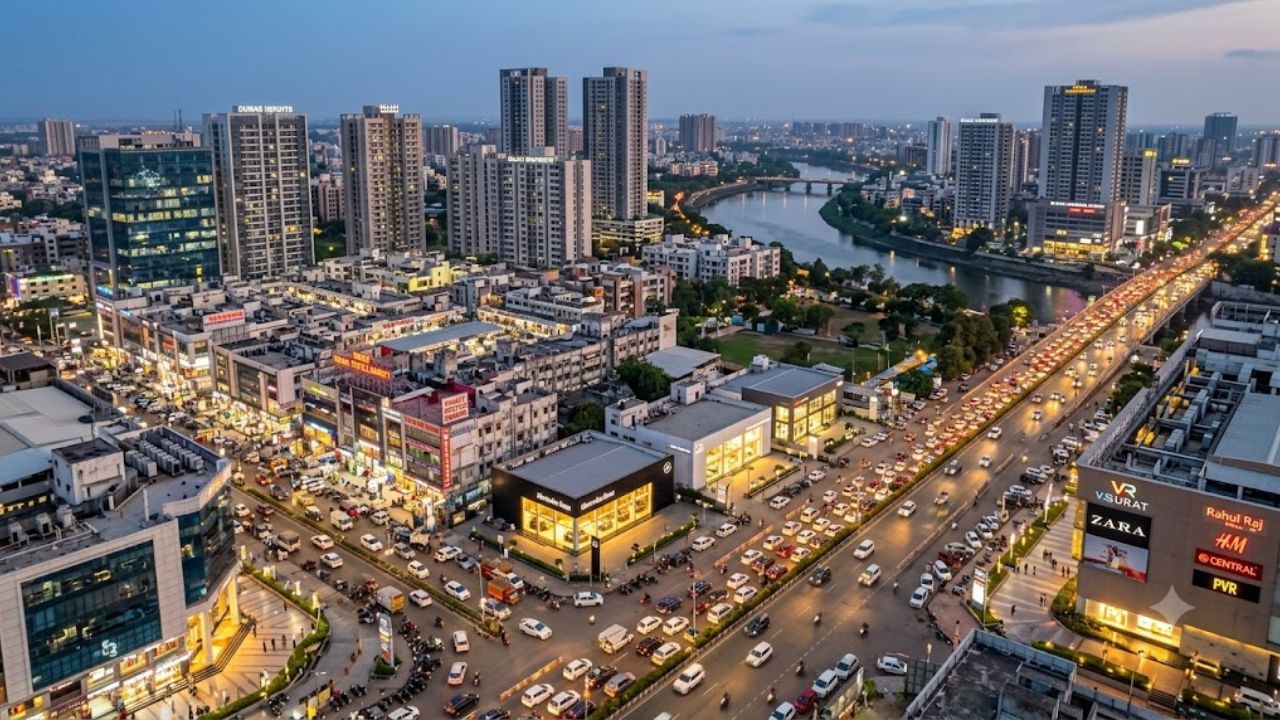
Surat Emerges as India’s Seventh-Largest Consumption Market
AHMEDABAD : Surat is rewriting India’s consumption map. Once viewed primarily as a textile and diamond hub, the Gujarat city has now emerged as the country’s seventh-largest consumption market, with...

AHMEDABAD : Surat is rewriting India’s consumption map. Once viewed primarily as a textile and diamond hub, the Gujarat city has now emerged as the country’s seventh-largest consumption market, with residents spending more than households in several established metros, including Bengaluru.
According to the ‘The Many Urban Indians’ report by Price and Tata Institute, Surat’s consumer market is estimated at around ₹3 lakh crore, putting it ahead of Ahmedabad and Pune. More strikingly, average household consumption expenditure in Surat has surpassed Bengaluru, highlighting the city’s growing purchasing power.
India’s 100 cities account for annual consumption of around ₹74.5 lakh crore ($844 billion), with 46% concentrated in the six traditional metros—Mumbai, Delhi, Bengaluru, Chennai, Hyderabad and Kolkata. Surat’s rise indicates that the next wave of India’s consumption growth is increasingly coming from fast-growing non-metro cities.
The report found that the share of Surat households earning more than ₹36 lakh annually has jumped from 3% to 12% over the past decade. This proportion is projected to reach around 20% by 2030-31.
Surat is classified as a ‘boomtown’, a group of 19 rapidly expanding cities that includes Ahmedabad, Pune, Lucknow, Jaipur and Vadodara. Surat, Chandigarh, Thiruvananthapuram and Vadodara have recorded higher per-family spending than the six major metros.
The city’s economic strength is being driven by its textile and diamond industries, industrial expansion and a large migrant population.
Surat is also emerging as a major weekend consumption hub. Its weekend spending multiplier stands at 2.44 times, meaning spending on Saturdays and Sundays is 2.44 times higher than on weekdays. Only Jaipur, at 2.76 times, records a higher figure.
Changing lifestyles are also visible in household ownership. In boomtowns, car ownership has reached 32%, matching metro levels, while two-wheeler ownership is 72%. Washing-machine ownership in these cities stands at 40% and microwave ownership at 31%, both higher than metro averages.
Yet Surat’s consumption story is not simply about spending. Around 92% of households in Surat and Vadodara save for emergencies, while boomtown households save an average ₹4.5 lakh annually. Their debt-to-income ratio of 15.4% is also below the 18.5% recorded in major metros.
The numbers point to a broader shift: Surat is not merely becoming richer—it is becoming one of India’s most powerful engines of consumption, savings and urban economic growth outside the traditional metros.