



IIT Gandhinagar researchers develop GenR, Brings Old Faces Back to Life
GANDHINAGAR: Faded family photographs, blurred faces and damaged archival images could soon get a new lease of life, thanks to an artificial intelligence tool developed by researchers at the Indian...

GANDHINAGAR: Faded family photographs, blurred faces and damaged archival images could soon get a new lease of life, thanks to an artificial intelligence tool developed by researchers at the Indian Institute of Technology Gandhinagar (IITGN) and IIT BHU.
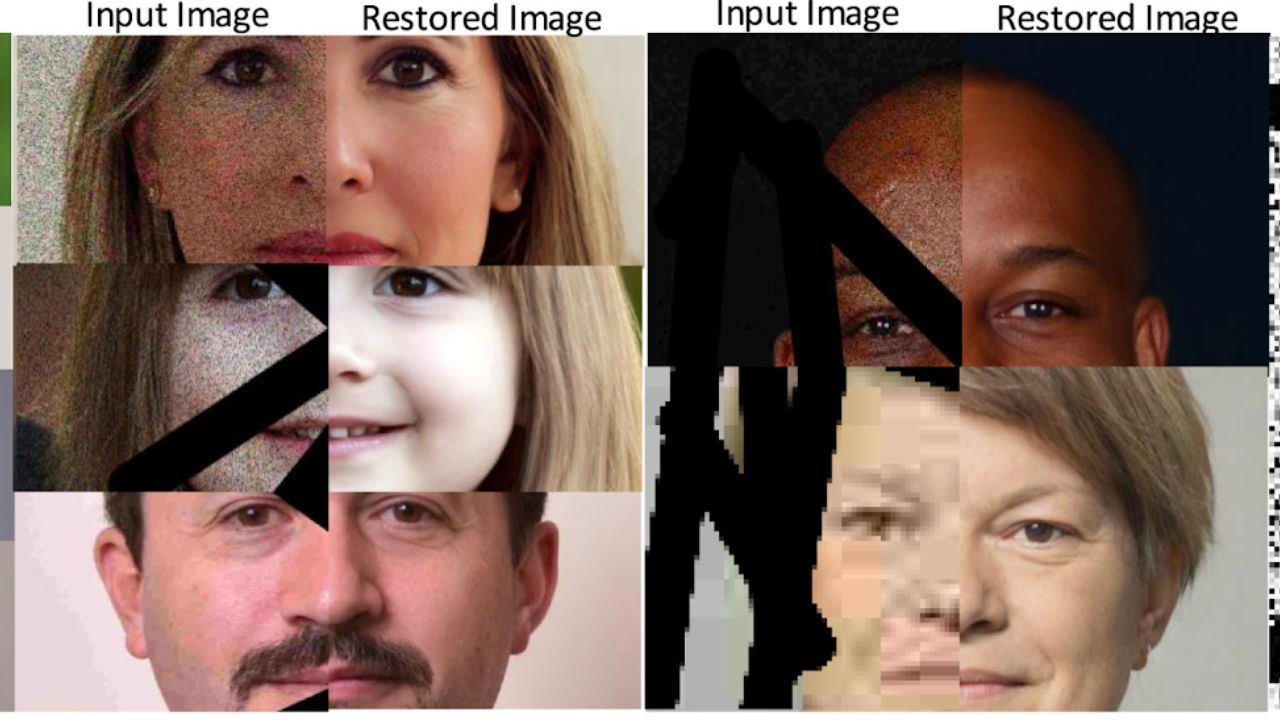
The researchers have developed Generative Latent Inversion for Blind Face Restoration (GenR), an AI-powered framework designed to reconstruct faces from severely degraded images without relying on paired clean-and-damaged training images.
The study, published in Pattern Recognition Letters, uses a StyleGAN3-based inversion technique to generate plausible high-quality versions of damaged faces while attempting to preserve their identity and structure.
“A model may try really hard to refine a degraded image and invent details that do not belong to the original face,” said Akbar Ali, a fourth-year PhD student at IITGN and first author of the study. He said GenR’s staged approach moves from broad facial structure to finer details to reduce the risk of generating inaccurate features.
GenR works through three optimisation stages, first identifying global characteristics such as facial structure, identity and pose, before refining features including the eyes, nose and jawline and finally enhancing skin, hair and other textures.
Researchers tested the system on denoising, image upsampling, inpainting and deartifacting tasks. The framework reportedly produced a restored image in about 30 seconds for single-degradation tasks.
However, the researchers cautioned that extremely damaged images could lead AI to generate realistic details that do not accurately represent the original person.
Dr Shamuganathan Raman, professor at IITGN and principal investigator at its Computer Vision, Imaging and Graphics Lab, described GenR as “a significant advancement in blind face restoration”, adding that future research could improve its robustness and generalisation.
Potential applications include historical photo preservation, digital heritage, forensic analysis, video conferencing and social media.
The IITGN team has also worked on Video-ASTAR, a training-free text-to-video approach designed to maintain consistency of objects and their relationships across generated video frames.
As World Photography Day highlights the importance of preserving visual memories, the researchers believe AI could play an increasingly important role in protecting old images while also creating visual representations of memories that were never photographed.