




Gujarat : Dang Emerges as India’s Model District for Sustainable Twin-Pit Toilets
GANDHINAGAR : Tribal families in Gujarat’s Dang district may never have watched the Akshay Kumar–Bhumi Pednekar campaign that popularised twin-pit toilets under the Swachh Bharat Mission...

GANDHINAGAR : Tribal families in Gujarat’s Dang district may never have watched the Akshay Kumar–Bhumi Pednekar campaign that popularised twin-pit toilets under the Swachh Bharat Mission (Grameen), but they have embraced the technology so effectively that the district has emerged as a national model for sustainable rural sanitation.
Launched in 2018, the campaign promoted twin-pit toilets as a safe, affordable and environmentally sustainable sanitation solution. While awareness efforts reached millions across the country, the success of Dangs demonstrates how community participation and behavioural change can drive sanitation outcomes even in remote tribal regions.
Known for its dense forests, rolling hills and picturesque monsoon landscapes, Dang is Gujarat’s only 100 per cent tribal district. Today, it is also being recognised for its remarkable adoption of twin-pit toilets, a key component of sustainable faecal sludge management under the Swachh Bharat Mission (Grameen).
“There are three talukas and 310 villages in Dang district, with a population of around 2.96 lakh. Out of 58,966 households, as many as 51,613 have adopted twin-pit toilets, accounting for nearly 95 per cent of the district’s total toilet coverage. This is a significant achievement in faecal sludge management and has been made possible through strong community participation. The government provides financial assistance of Rs 12,000 to each household for constructing a twin-pit toilet,” said Vipul Pardeshi, Coordinator, District Rural Development Agency (DRDA), Dangs.
The district’s success has also attracted national attention. In January 2026, the Ministry of Jal Shakti organised a virtual interaction with districts across states and Union Territories to review various faecal sludge management (FSM) models being implemented under the Swachh Bharat Mission (Grameen). The meeting was chaired by Union Jal Shakti Minister CR Paatil.
During the interaction, states showcased innovative and scalable sanitation models. Gujarat’s Dangs district was highlighted as a notable example for achieving large-scale adoption of twin-pit toilets in remote tribal areas.
Paatil commended participating states for presenting sanitation models that not only contribute to the vision of a Swachh Bharat but also create livelihood opportunities through sustainable waste management practices.
Twin-pit toilets provide a sustainable on-site sanitation solution by safely decomposing human waste into nutrient-rich organic manure. Besides strengthening rural sanitation infrastructure, the technology helps protect public health and the environment by reducing the risk of groundwater contamination and unsafe disposal of waste.
How Twin-Pit Toilets Work
A twin-pit toilet functions much like a conventional toilet but with an added advantage—it converts human waste into safe organic manure. The technology is recommended by the World Health Organization (WHO) as an effective and sustainable sanitation solution.
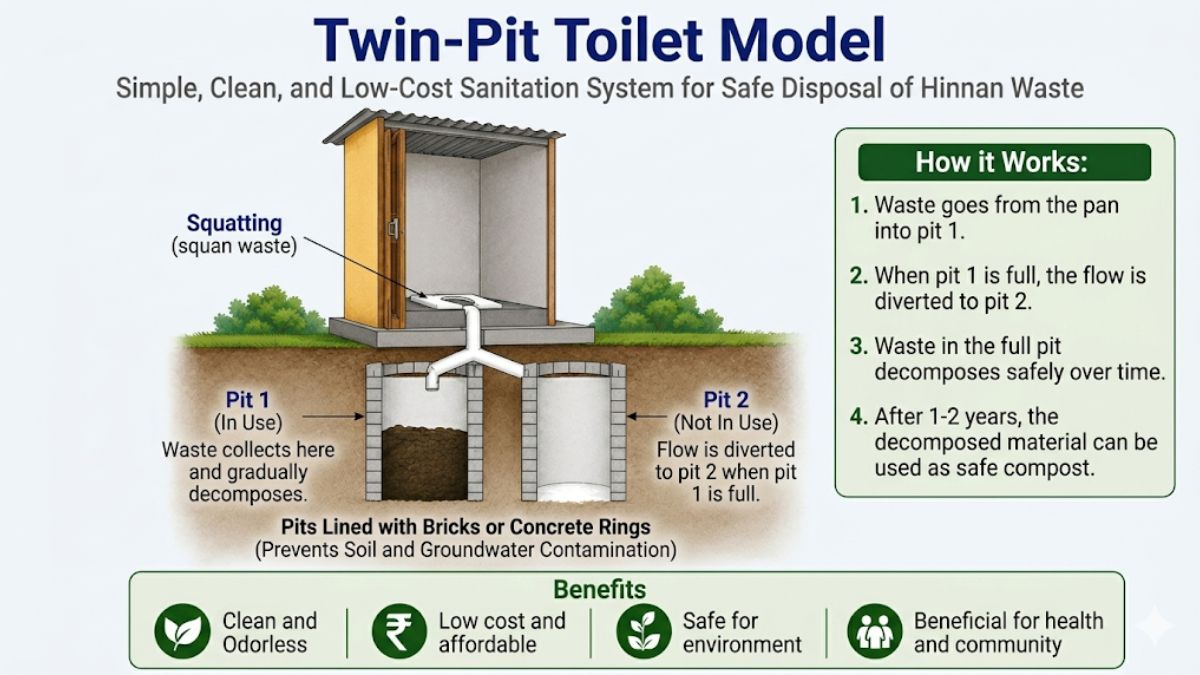
Unlike conventional toilets connected to sewer networks and sewage treatment plants, twin-pit toilets manage waste at the household level. Human waste is directed into one pit, where it decomposes naturally. Once the first pit is filled, the flow is diverted to the second pit. By the time the second pit fills up, the contents of the first pit have decomposed into safe, nutrient-rich compost that can be handled and used as manure.
This system eliminates the need for expensive sewer infrastructure while ensuring that waste is treated safely without polluting soil or water sources.
Affordable and Sustainable Technology
Under the Swachh Bharat Mission (Grameen), the government provides financial assistance of Rs 12,000 for the construction of individual household toilets and actively promotes twin-pit technology for on-site waste management.
Apart from providing safe sanitation, twin-pit toilets are cost-effective and require relatively less water compared to conventional flush toilets, making them particularly suitable for rural areas.
The system consists of two circular pits, typically around three feet deep, constructed side by side. The pit walls are built in a honeycomb pattern to facilitate the seepage of liquids into the surrounding soil, while the bottom remains unlined. Bricks set in cement mortar are commonly used for lining, although locally available materials such as stone, wooden logs, concrete rings, burnt clay or recycled drums can also be used.
Twin-pit toilets are increasingly being recognised as an ideal sanitation solution for rural and geographically diverse regions. By reducing dependence on complex sewer systems and enabling safe waste treatment at the source, they offer a practical, low-maintenance and environmentally sustainable approach to rural sanitation.