








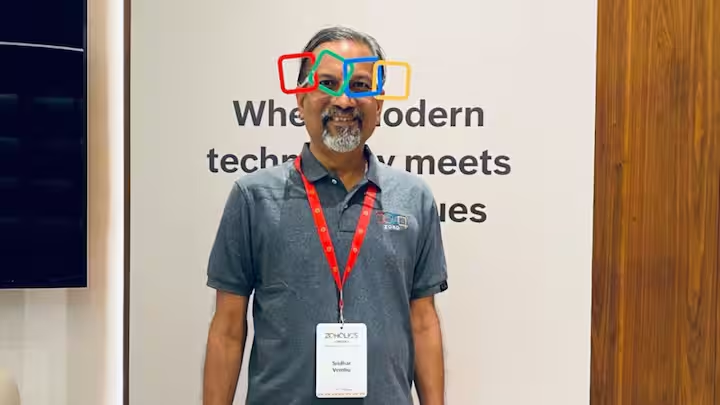
Zoho Founder Sridhar Vembu Warns AI Could Put Intellectual Jobs at Risk, Suggests Rethinking Human Work
Zoho founder Sridhar Vembu has warned that advances in artificial intelligence (AI) could put a wide range of intellectual jobs at risk, including software development. He has also questioned whether...

Zoho founder Sridhar Vembu has warned that advances in artificial intelligence (AI) could put a wide range of intellectual jobs at risk, including software development. He has also questioned whether traditional measures of intelligence and professional achievement will retain the same importance as AI systems become more capable.
In a post on X, Vembu argued that even advanced mathematical work, often considered one of the highest forms of human intellectual achievement, is increasingly being handled by AI systems.
“At this point, I would assume that most ‘intellectual jobs’ are at risk. That includes much of software,” he wrote.
His remarks come amid growing discussions about how AI could reshape employment, professional skills and the role of humans in an increasingly automated economy.
What Could Humans Do If AI Takes Over Intellectual Work?
Rather than focusing exclusively on retraining workers for new technology-driven careers, Vembu suggested that people could find greater purpose in activities centred on communities, families, nature and culture.
He grouped these activities into four categories: nature, nurture, culture and scripture.
“Humans have infinitely many things to do and I categorise those human activities as nature, nurture, culture and scripture: restoring soil and water, raising children and caring for elders, making music, sustaining festivals, sports and entertainment, studying and practising spiritual traditions,” he said.
The idea challenges the assumption that paid employment and intellectual achievement should be the primary measures of human contribution to society.
Vembu’s argument suggests that activities such as environmental restoration, childcare, caring for older people, artistic expression and spiritual practice could remain meaningful even if AI takes over a substantial share of intellectual labour.
However, his proposal represents a personal perspective on a possible AI-driven future rather than an established framework for addressing the economic consequences of automation.
Vembu Questions Universal Basic Income as a Solution
Vembu also raised concerns about how the economic benefits of AI would be distributed if machines could produce goods and services with significantly less human labour.
He argued that ensuring people can access the benefits of automated production would require addressing the distribution of economic power.
He rejected universal basic income (UBI) as a sufficient solution, suggesting that simply providing people with a regular payment would not resolve the underlying problem of concentrated economic power.
His comments also questioned the traditional emphasis on intellectual achievement. Drawing on his understanding of Hindu philosophy, Vembu suggested that society could reconsider the importance it places on intellectual pursuits relative to other aspects of human life.
The broader questions remain unresolved, including who would own AI-powered production systems, how workers would earn a living and how the benefits of automation could be shared.
Andrej Karpathy Highlights the AI Knowledge Gap
Vembu’s comments come as Andrej Karpathy, a former director of AI at Tesla and a founding member of OpenAI, has highlighted differences in how people understand and use modern AI systems.
Karpathy described a widening gap between people who regularly work with advanced AI tools and those who have had limited exposure to their capabilities.
He estimated that roughly 75% of the population had barely interacted with large language models, while a smaller group of researchers and developers was already using advanced systems to tackle complex technical tasks.
Karpathy also pointed to improvements in AI coding agents, which can carry out substantial software development tasks with limited human intervention.
He cautioned that public understanding of AI has not necessarily kept pace with developments in the technology industry.
While Karpathy’s observations focus on the gap between AI capabilities and public awareness, Vembu’s argument centres on what society might value if machines increasingly perform intellectual work.
Together, their comments highlight two related challenges: understanding how quickly AI capabilities are advancing and preparing for the economic and social changes that could follow.
Although AI may create new opportunities alongside existing risks, its long-term impact will depend on how businesses, governments and communities respond to changes in employment, economic power and the value of human work.