
Surat Deep Sea Project Set to Transform Polluting Textile Industries
Gujarat government moves closer to launching 600 MLD treated wastewater project for Surat’s textile and chemical clusters

Advertisement
Surat | Gujarat — The diamond and textile city of Surat is all set for an industrial revolution as the Gujarat government is inching closer to launch the ‘Surat Cluster Deep Sea’ project aimed at benefiting more than 400 textile processing, powerloom weaving, chemicals, pharma, agro and other water polluting industries.
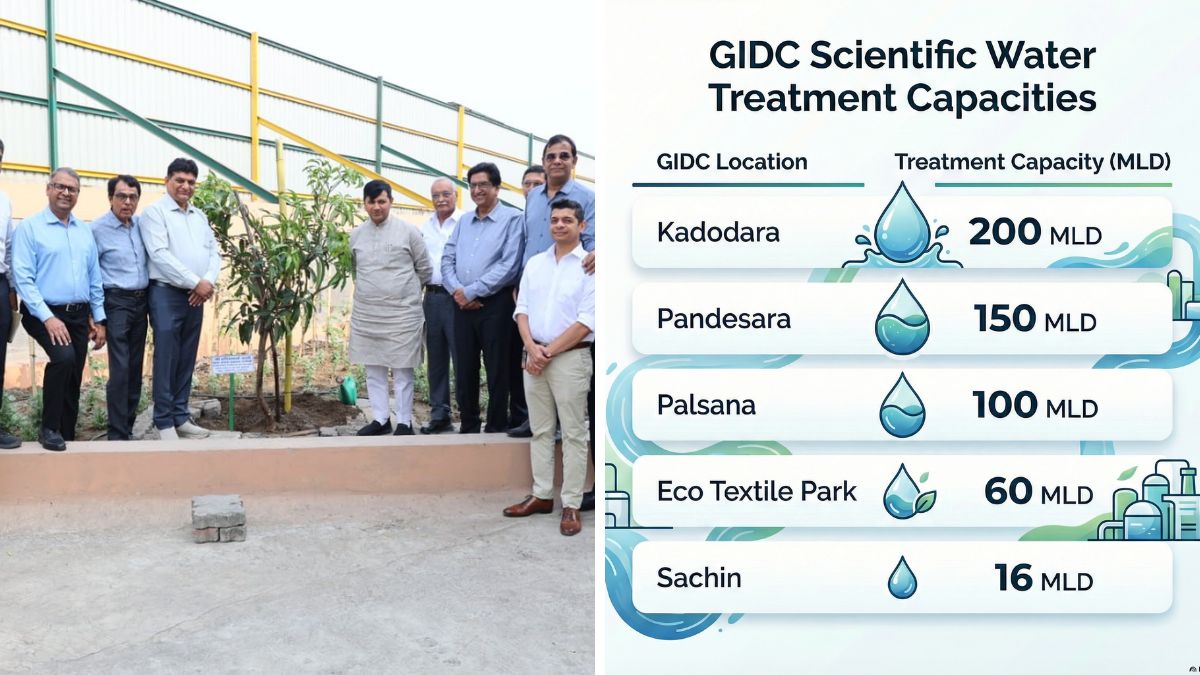
This pilot project will be launched for releasing about 600 MLD treated water from Kadodara GIDC, Eco Textile Park, Palsana GIDC, Pandesara GIDC and Sachin GIDC. This is a project to release this amount of water into the sea through a pipe after treatment, in which 80 percent of the cost will be paid by the government and 20 percent by the industrialists.
The treated water of all the industries will be released into the sea 10 kilometers inside and 1 kilometer deep. This is the most expensive project for the industries of the city. Thousands of processing mills and chemical factories are operating in the city and district areas, from which the polluted water coming out is treated through the Common Effluent Treatment Plants (CETPs) and will be released into the sea. In the project, water treated by the CEPTs will be released into the sea through a common pipeline.
An important meeting in this regard was held with between the textile industry leaders at Pandesara GIDC with Minister of State for Forest, Environment and Climate Change Pravin Mali. There was a detailed discussion on the industrial revolution, sustainable development and new prospects of the textile industry. In this meeting, as per the Surat Economic Development Plan, the industrial waste water treated by the Common Effluent Treatment Plants (CETPs) of the GIDC industrial estates in and around Surat city will be released into the sea to about 10 kilometer away at the depth of 1 kilometer through a common pipeline.
The industrial areas which are not in GIDC will have to join the nearest GIDC. Otherwise, such units will be shut down in the near future as the government is set to act tough on the polluting industries across Gujarat.
Addressing the meeting held in Pandesara, Minister of State Pravin Mali said that significant efforts have been made in the field of environmental protection by local industries in Sachin and Pandesara GIDC areas. He appreciated the activities being done under ‘Mission Life’. While textile industries are progressing by following the rules, they must be prepared to seize new opportunities in the current industrial revolution.
The Minister expressed confidence that the government will support the textile industry to become 100 percent self-reliant when the country celebrates 75 years of independence in the year 2035. He emphasized on realizing the mantra of development along with environmental preservation.
MLA Manubhai Patel said that the state government always has a positive attitude towards the development of industries. He proposed to build strong roads for transportation in GIDC areas, complete the Deep Sea project quickly and start a ‘Skill Development Center’ to provide skilled manpower to industries at the local level. Apart from this, a permanent solution to the issues related to ground water was also discussed.
The meeting was attended by Arun Patel, Regional Officer of Gujarat Pollution Control Board (GPCB), Palsana, KIM, Kadodara, presidents of various associations, textile industrialists, representatives of processor units and leaders in large numbers and presented their views.
The Deep Sea Project, a project to treat the polluted water of industries and release it into the sea, has now gained momentum. The issue of financial contribution of stakeholders has also been resolved. The project was stalled till now due to the NOC of the Gujarat Maritime Board (GMB), which has been received, now the project will move forward quickly.
South Gujarat Textile Processors Association (SGTPA) has given a proposal to the state government. In view of this, the government will now announce the tender after which this project will move forward.
Advertisement
