




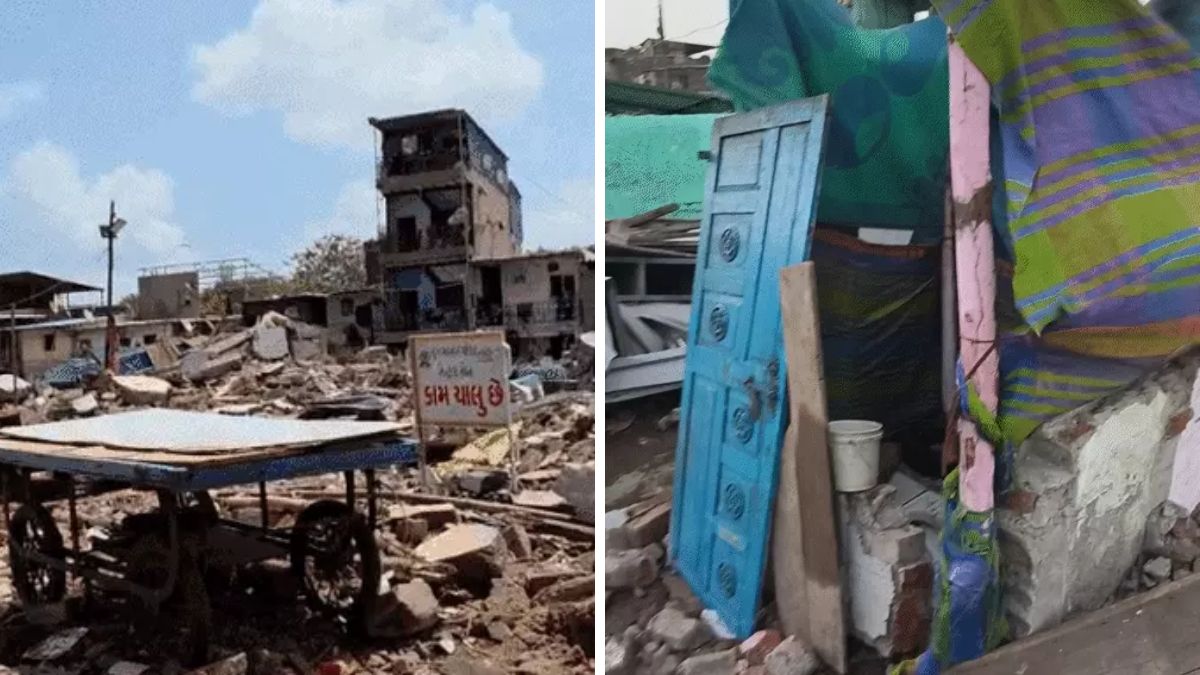
Surat : 18 Days After Demolition, Nasirnagar Demolition Victims Still Without Toilets
SURAT : Prime Minister Narendra Modi’s flagship push to end open defecation through the construction of millions of toilets under the Swachh Bharat Mission transformed sanitation into a...

SURAT : Prime Minister Narendra Modi’s flagship push to end open defecation through the construction of millions of toilets under the Swachh Bharat Mission transformed sanitation into a national priority.
However, in a stark and troubling contrast to that vision, more than 80 residents displaced by the Nasirnagar demolition in Surat are today being forced to defecate in the open after their homes—and with them their toilets—were razed.
Eighteen days after the demolition, families continue to live in makeshift plastic shelters amid the rubble, alleging that despite repeated pleas, the Surat Municipal Corporation has failed to provide even temporary mobile toilets.
The situation has left women, children and the elderly facing daily indignity, health risks and safety concerns, raising serious questions about the administration’s commitment to ensuring basic human rights and sanitation for some of the city’s most vulnerable citizens.
The humanitarian crisis has drawn attention from local NGOs, charitable organizations and social workers who have stepped in to provide food for affected families. However, despite these efforts, a critical problem remains unresolved.
With homes reduced to rubble, toilets were also destroyed during the demolition. Residents say they have been left with no option but to relieve themselves in open spaces or seek help from nearby households.
“For the last 18 days, we have been wandering in search of toilets. Men somehow manage, but women, young girls and elderly people are suffering the most,” said a resident of the area.
According to local social leaders, there is no public toilet facility available within a radius of nearly 500 metres. As a result, women are often forced to venture out before dawn or late at night under the cover of darkness, raising serious concerns about safety, dignity and public health.
Social worker Ahmed Pathan alleged that repeated appeals to civic authorities have yielded no results. “For the last 10 to 12 days, we have approached municipal officials, the standing committee chairman and even the mayor. Our only request is to install mobile toilets until rehabilitation arrangements are made,” he said.
Pathan further questioned the administration’s silence, stating, “The mayor is a woman. If she looks at this issue from a woman’s perspective, she will understand the pain of mothers, sisters and young girls who are being forced into open defecation every day.”
Residents say the demand is simple and immediate: temporary mobile toilets until permanent rehabilitation is completed. As the crisis enters its third week, affected families claim that promises of development mean little when basic human dignity remains out of reach.