




Iran Conflict Sparks Green Shift in India’s Textile Industry
Surat | Gujarat — The ongoing geopolitical conflict involving Iran has disrupted global trade routes, rattled energy markets, and increased uncertainty across industries worldwide. Yet amid the...

Surat | Gujarat — The ongoing geopolitical conflict involving Iran has disrupted global trade routes, rattled energy markets, and increased uncertainty across industries worldwide. Yet amid the economic turbulence, an unexpected transformation is unfolding within India’s textile sector. Rising raw material costs and supply chain disruptions are driving the industry toward a more sustainable future by accelerating the adoption of recycled polyester fibres and strengthening India’s circular economy.
For decades, India’s man-made fibre (MMF) industry has depended heavily on imported petrochemical-based raw materials such as Purified Terephthalic Acid (PTA) and Mono Ethylene Glycol (MEG), primarily sourced from West Asian nations including the UAE, Saudi Arabia, Qatar, and Bahrain. The current geopolitical instability has disrupted shipping routes and significantly increased logistics costs.
As a result, the cost of producing virgin plastic has surged from around ₹90 per kilogram to nearly ₹135 per kilogram. In contrast, fibre-grade recycled PET (r-PET) remains comparatively economical at approximately ₹115 per kilogram. This shift in economics has rapidly altered industry behaviour.
“Global crises often expose vulnerabilities in supply chains. In this case, they have also highlighted the immense potential of recycled raw materials and local circular manufacturing ecosystems,” says Dr. Pankaj Gandhi, Director of MANTRA.
The impact is already visible. Before the conflict intensified, India consumed around 5,000 tonnes of recycled PET monthly in textile applications. Today, that figure has tripled to nearly 15,000 tonnes per month. If the trend continues, India’s recycling capacity could expand to 1.8 million tonnes annually, significantly reducing dependence on imported petrochemicals.
However, a critical technical challenge remains. Producing high-quality Partially Oriented Yarn (POY) directly from recycled PET is difficult because recycled plastic bottles come in varying grades and compositions. Consistency in melt flow and purity—essential for filament yarn production—is difficult to maintain.
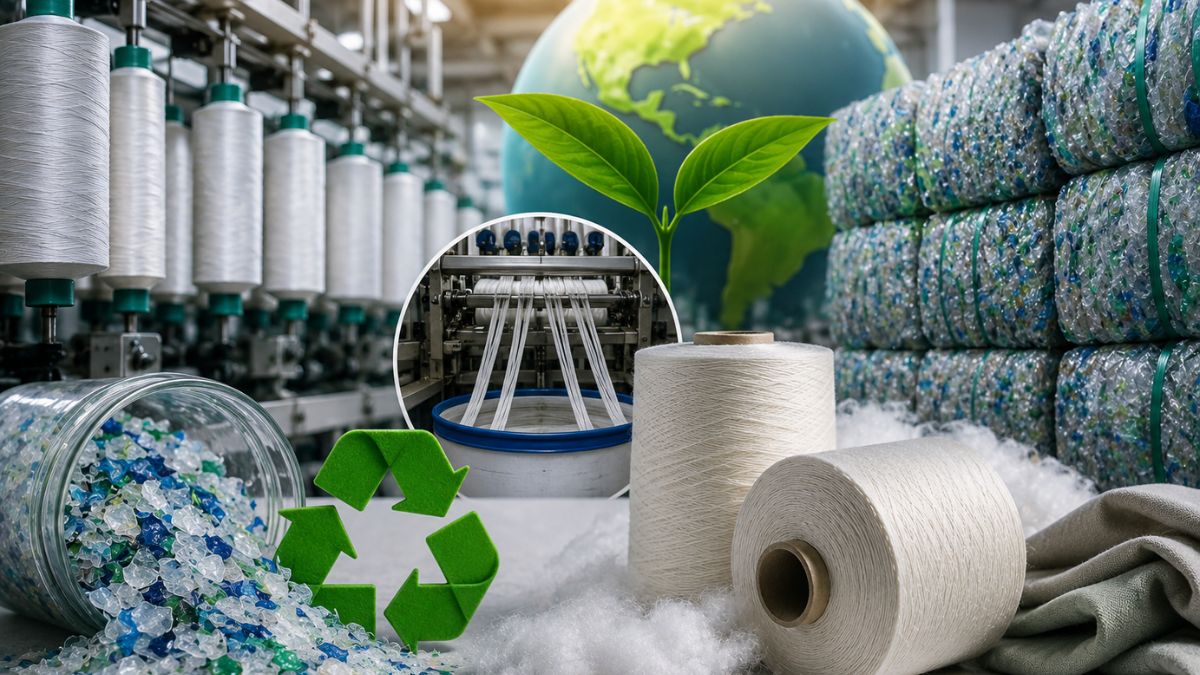
The more practical solution lies in Polyester Staple Fibre (PSF). Recycled PET can be efficiently converted into high-quality recycled PSF (r-PSF), which can then be blended with cotton, viscose, or virgin polyester to manufacture durable and sustainable textiles.
“PSF-based recycling offers a realistic and scalable pathway for Surat’s textile industry. It reduces raw material dependence while helping manufacturers meet growing global demand for sustainable fabrics,” Dr. Gandhi explains.
Surat is uniquely positioned to lead this transition due to the presence of world-class recycling infrastructure. Companies such as Alliance Fibres Limited in Kim and JB Ecotex Limited in Mangrol have established large-scale recycling operations capable of producing internationally certified recycled fibres.
Alliance Fibres, with a capacity of 36,000 metric tonnes annually, employs advanced melt homogenizer technology to ensure uniform fibre quality. Meanwhile, JB Ecotex and its allied operations recycle more than 450 tonnes of plastic bottles daily and possess both mechanical and chemical recycling capabilities, enabling the production of premium textile-grade recycled fibres.
“These companies are not merely recyclers; they are strategic partners in Surat’s green industrial transformation,” says Dr. Gandhi.
Looking ahead, the roadmap requires three key actions: continuous research and technological upgrades, strengthening plastic collection networks, and expanding compliance with recycled-content and Extended Producer Responsibility (EPR) norms.
MANTRA is actively working with industry stakeholders to improve yarn quality, enhance process efficiency, and help textile manufacturers meet international sustainability standards.
“The Iran conflict has delivered a powerful lesson. Dependence on imported petrochemicals carries significant risks. Recycled fibres should not be viewed as a temporary crisis response but as the permanent future of India’s textile industry,” Dr. Gandhi concludes.