






Gujarat Moves Closer to State-Specific Anti-Snake Venom to Cut Snakebite Deaths
GANDHINAGAR : In a major breakthrough for public health and wildlife research, Gujarat has taken a decisive step towards producing its own region-specific anti-snake venom, a development expected to...

GANDHINAGAR : In a major breakthrough for public health and wildlife research, Gujarat has taken a decisive step towards producing its own region-specific anti-snake venom, a development expected to significantly improve the treatment of snakebite victims across the state. The Snake Research Institute (SRI) at Dharampur has supplied freeze-dried venom extracted from Gujarat’s four medically important venomous snake species to a licensed anti-venom manufacturer, marking the beginning of the production process. Officials expect the first batch of Gujarat-specific anti-venom to be ready within a year, offering a more effective treatment tailored to the state’s unique snake population.
Forest and Environment Minister Arjun Modhwadia said the initiative reflects the Gujarat government’s commitment to reducing snakebite-related fatalities. “Under the leadership of Chief Minister Bhupendra Patel, Gujarat is committed to developing its own region-specific anti-venom to reduce snakebite-related deaths. The Snake Research Institute follows World Health Organization guidelines for snake handling and venom extraction, ensuring the production of high-quality venom for anti-venom development,” he said.
The venom was handed over through an e-auction to Telangana-based Vins Bioproducts Limited, a licensed manufacturer of life-saving antisera and antitoxins. The consignment included 33.37 grams of Indian Cobra venom, 30.82 grams of Russell’s Viper venom, 2.67 grams of Common Krait venom and 1.71 grams of Saw-scaled Viper venom.
The milestone follows the institute’s successful first e-auction of lyophilised snake venom, which attracted higher-than-expected bids, highlighting the quality of venom produced under internationally accepted standards.
According to officials, the initiative is crucial because snakebites remain one of India’s deadliest yet most preventable public health challenges. While wildlife attacks claimed around 550 lives across the country in 2022, nearly 65,000 people died due to snakebites during the same period.
“Since region-specific anti-venom is developed using venom collected from snakes found in a particular geographical area, it is expected to be more effective, require lower doses and reduce severe complications such as organ failure,” said S. K. Srivastava, Director of the Gujarat Forestry Research Foundation (GFRF). “This has the potential to significantly improve patient outcomes and save thousands of lives.”
Medical experts explain that venom composition varies geographically, even within the same snake species. As a result, anti-venom produced using venom sourced from other parts of India may not provide optimal protection against snakebites in Gujarat.
Recognising this challenge, the Gujarat government established the Snake Research Institute in Dharampur, Valsad district, to collect venom from venomous snakes found across the state and support the development of a scientifically tailored anti-venom.
According to D. C. Patel, Vice-Chairman of SRI, geographical variation in venom is one of the biggest hurdles in effective snakebite treatment. “Anti-snake venom prepared using venom from distant regions often proves less effective. Our focus is to collect venom from Gujarat’s venomous snake species so that region-specific anti-venom can be developed for better clinical outcomes,” Patel said.
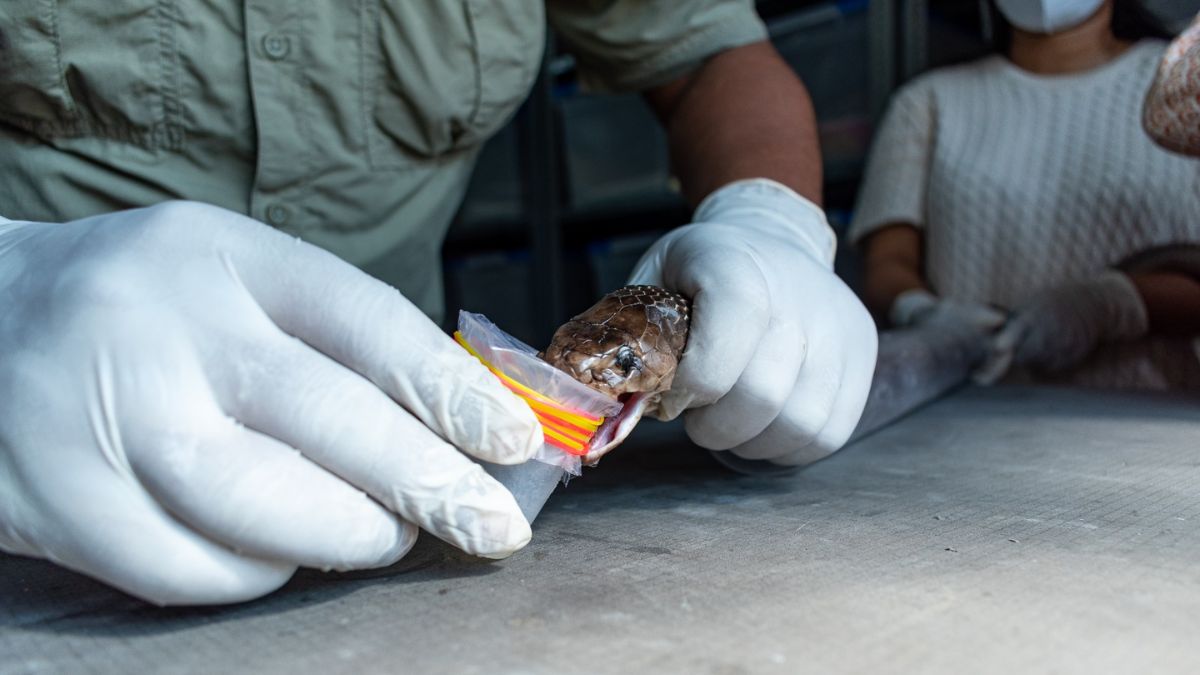
The institute currently houses around 471 venomous snakes representing Gujarat’s major medically significant species. Venom is extracted following WHO protocols, scientifically processed and converted into lyophilised form before being supplied to licensed manufacturers.
Srivastava said SRI has emerged as one of India’s leading centres for venom research, snakebite management and public awareness. “It is only the second institution in the country, after the Irula Snake Catchers’ Industrial Co-operative Society in Tamil Nadu, authorised to extract venom for anti-venom manufacturing,” he said.
To support future expansion, the Gujarat government has allotted 2.25 hectares of land in Valsad for a permanent world-class campus, while a proposal worth ₹11.68 crore has been submitted to develop advanced research and training infrastructure.
The initiative also aligns with India’s National Action Plan for Prevention and Control of Snakebite Envenoming, launched in 2024, which aims to reduce snakebite-related deaths and disabilities by 50% by 2030. Officials believe Gujarat’s region-specific anti-venom programme will play a significant role in achieving that national target while setting a benchmark for snakebite treatment across the country.