
Gujarat Moves 20 Key Citizen Services Online Under Digital Push
Income, caste certificates and ration card services go fully digital to boost transparency and ease of access

Advertisement
Gandhinagar | Gujarat — In a major push towards digital governance, the Gujarat government has brought 20 high-demand citizen services online, marking a significant step in transforming public service delivery and reducing bureaucratic hurdles for millions of residents.
The move, guided by recommendations from the Gujarat Administrative Reforms Committee, aims to make essential services such as income certificates, caste certificates, and ration card updates fully accessible through the Digital Gujarat platform. With this, the state is accelerating its shift towards a faceless, paperless, and cashless governance model.
Chief Minister Bhupendra Patel has positioned citizen convenience at the centre of this initiative. Officials said the reform aligns with the broader vision of digital governance championed by Prime Minister Narendra Modi, focusing on transparency, efficiency, and accessibility.
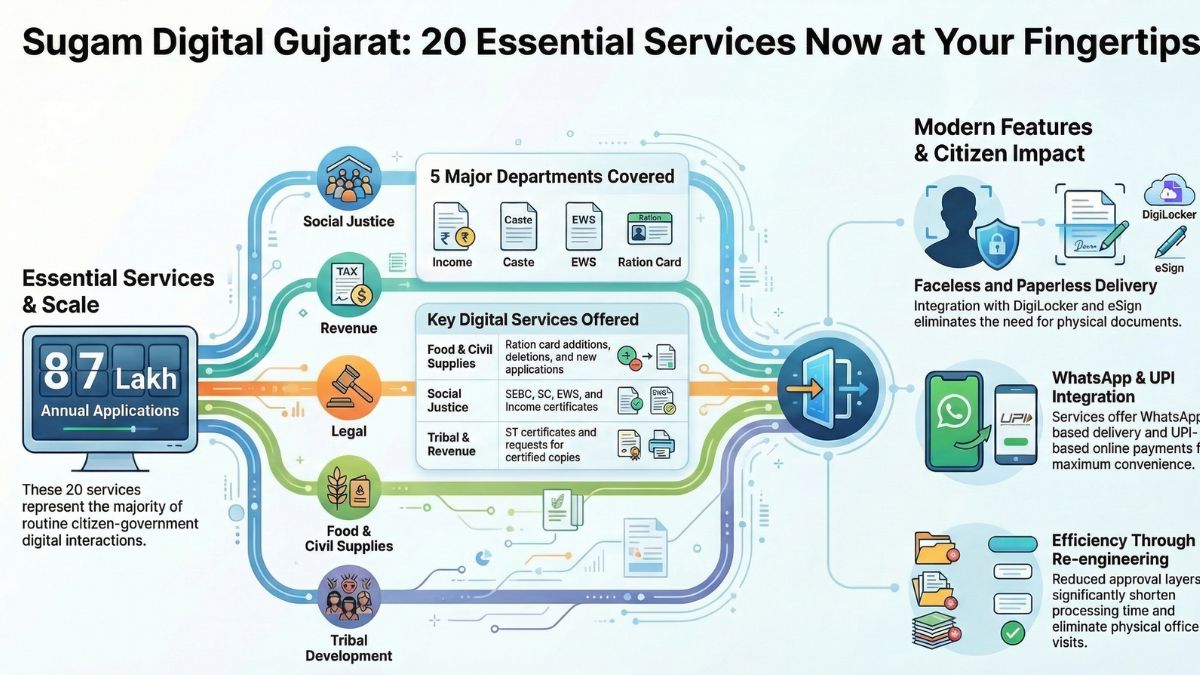
According to government data, the Digital Gujarat platform receives nearly 1.20 crore applications every year, with around 87 lakh applications coming from these 20 services alone. This underscores their importance in daily citizen-government interactions and the need for a streamlined, digital-first approach.
“These are among the most frequently used public services. Bringing them online ensures faster processing and reduces the need for physical visits,” a senior official said. “It also eliminates redundant documentation, making the system more user-friendly.”
The services span across five major departments, including Social Justice and Empowerment, Revenue, Legal, Food and Civil Supplies, and Tribal Development. Citizens can now apply for services like SEBC, SC, ST, and EWS certificates, as well as income certificates and ration card modifications, entirely online.
One of the standout features of the initiative is the integration of advanced digital tools to simplify the process. Aadhaar-based authentication, DigiLocker integration, eSign facilities, and API-driven verification systems ensure that applications are processed quickly and securely. QR code-enabled certificates and UPI-based payments further enhance convenience, while even WhatsApp-based service delivery has been introduced to reach a wider population.
Officials highlighted that the new system allows citizens to input their data once and reuse it across multiple services, significantly reducing duplication and errors. “This is not just digitisation, but a complete re-engineering of government processes,” an official added.
The impact of these reforms is expected to be far-reaching. By reducing approval layers and automating verification, the government aims to cut down processing times drastically. Citizens will also benefit from real-time tracking of their applications, ensuring greater transparency and accountability.
Beyond immediate benefits, the initiative is part of a larger roadmap under the Sugam Digital Gujarat programme. The state plans to bring more services under the digital umbrella in phases, while also investing in emerging technologies such as AI models in the Gujarati language to further enhance citizen engagement.
Experts believe that this transition could set a benchmark for other states. By reducing dependency on physical infrastructure like Jan Seva Kendras and e-Gram centres, Gujarat is paving the way for a more efficient and citizen-centric governance model.
Advertisement
