







Gujarat Deploys AI to Make Paddy Procurement Transparent
AHMEDABAD : Gujarat is turning to artificial intelligence to tighten the quality checks around government grain procurement, with AI-powered analysers deployed at 10 centres across four districts in...

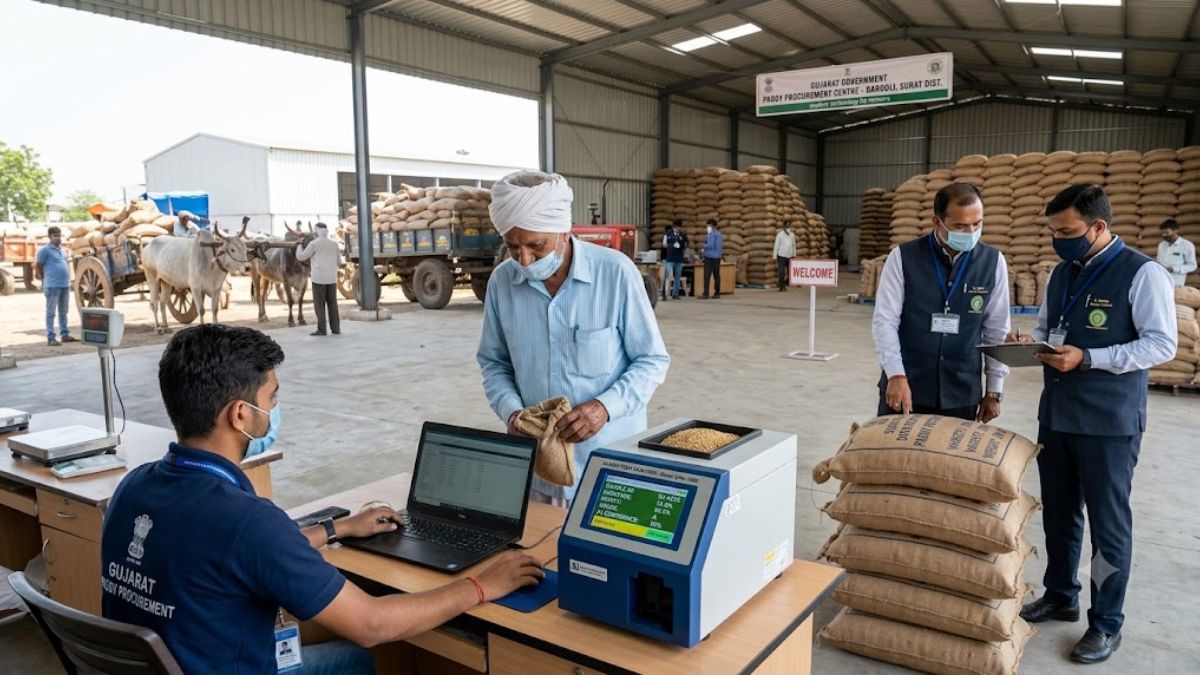
AHMEDABAD : Gujarat is turning to artificial intelligence to tighten the quality checks around government grain procurement, with AI-powered analysers deployed at 10 centres across four districts in a pilot project aimed at making paddy procurement more transparent, consistent and technology-driven.
The initiative, implemented under the Minimum Support Price (MSP) scheme during Kharif Marketing Season 2025-26, covers procurement centres in Ahmedabad, Mahisagar, Anand and Panchmahal. The Gujarat State Civil Supplies Corporation said the project is designed to strengthen quality assessment while ensuring better standards for foodgrains supplied to beneficiaries.
Across the 10 centres, 13,334 registrations were recorded, while 6,191 paddy samples were examined using AI grain analysers. Of these, 3,379 samples (54.6%) were classified as Grade-A, while 2,812 (45.4%) were categorised as Common. A total of 341 samples were rejected.
The analysers assess parameters including foreign matter, damaged or discoloured grains, immature or shrunken grains, admixture and moisture content, providing automated quality assessment.
Dholka recorded the highest rejection rate at 24%, while Viramgam reported no rejected samples.
The corporation said the AI-based system also offers operational advantages, requiring uninterrupted electricity and one person at each centre. By comparison, the existing third-party grading system requires two personnel for sample collection and scientific grading.
The initiative comes amid Gujarat’s broader efforts to ensure quality in foodgrain procurement and distribution. The corporation said wheat and rice are procured according to FCI standards, while MSP commodities follow uniform specifications prescribed by the Centre.
For commodities including tur dal, gram, edible oil, sugar and double-fortified salt, the corporation has established quality standards that it says are stricter than FSSAI norms.
“Quality is not compromised,” the corporation stated, highlighting its multiple layers of testing and verification.
Under the system, samples of tur dal and gram are also subjected to 100% cross-verification at the Food Research Laboratory through the Quality Control branch.
Officials said the combination of AI-based testing, stringent standards and laboratory verification is intended to ensure that beneficiaries receive clean, safe and high-quality foodgrains.
The pilot could therefore mark a significant shift towards technology-led transparency in Gujarat’s public food procurement system, while strengthening consumer confidence in the Public Distribution System.