






Edible Oil Shrinkflation Faces Centre’s Check
GANDHINAGAR: Consumers buying edible oil could soon find it easier to compare prices across brands after the Central Government moved to standardise pack sizes, following concerns raised over...

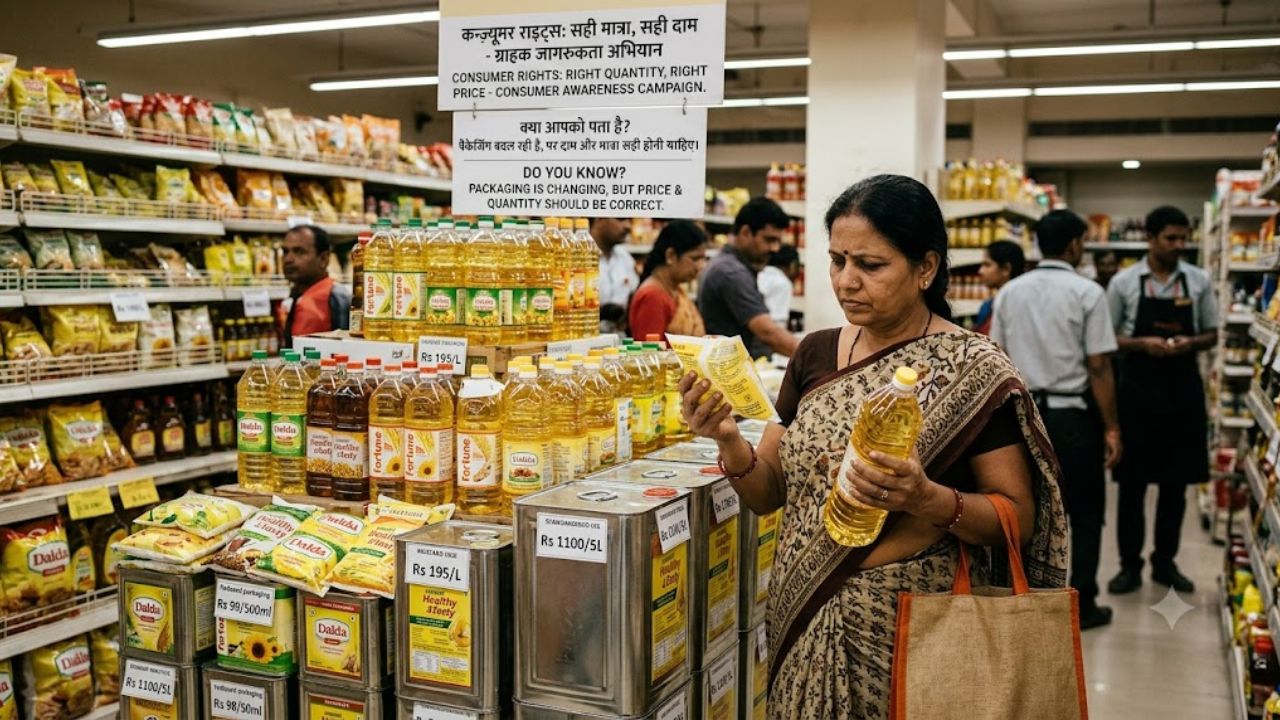
GANDHINAGAR: Consumers buying edible oil could soon find it easier to compare prices across brands after the Central Government moved to standardise pack sizes, following concerns raised over “shrinkflation”—the practice of reducing product quantity without a corresponding reduction in price.
Gujarat farmer and cooperative leader and Gujarat Pradesh Congress Committee (GPCC) General Secretary Darshan Nayak had submitted a detailed representation on May 13, 2026, to Prime Minister Narendra Modi, the Union Ministry of Consumer Affairs and the Gujarat Chief Minister, highlighting the issue in the edible oil sector.
Nayak said edible oil that was traditionally sold in 15-kg or 15-litre packs was increasingly being offered in smaller quantities, including 12.5 kg, 13 kg and 13-litre packs, while prices continued to rise.
He described the practice as a financial burden on consumers and called for greater transparency in packaging and pricing.
Following the representation, the Department of Consumer Affairs has amended the Standard Operating Procedure (SoP) for edible oils and fats under the Legal Metrology framework, introducing standard pack sizes.
Under the new provisions, edible oils can be sold in specified standard quantities such as 200 ml/g, 500 ml/g, 1, 2, 3, 4, 5, 15 and 20 litres/kg. Further, when quantity is declared in litres or millilitres, the corresponding weight will also have to be displayed on the package.
“This is an important decision in the interest of consumers. The issue of shrinkflation needed urgent attention because buyers must be able to compare prices transparently,” Nayak said.
He welcomed the Centre’s decision, saying standardisation could help consumers identify the actual cost of edible oil across different brands and pack sizes.
However, Nayak stressed that implementation would be crucial.
“Effective enforcement and continuous monitoring are necessary to ensure that consumers actually benefit from transparent packaging, fair prices and a level playing field,” he said.
The move is expected to strengthen consumer awareness and make price comparisons easier in the edible oil market.