





Can Bands Unearth Value From Idle Data? Vatsal Soin Files New 0→1 Patent October 1 – AI-AGI Superintelligence Invention
Idle data holds years of value behind data walls, where releasing raw records can expose information. Vatsal Soin’s successive patent filings extend the 0→1 Doctrine to stored records, describing...

Idle data holds years of value behind data walls, where releasing raw records can expose information. Vatsal Soin’s successive patent filings extend the 0→1 Doctrine to stored records, describing governed bands and sealed receipts as a possible data supply for AI builders and researchers amid model collapse concerns, the Singularity debate, and the rise of Superintelligence.
THE QUIET QUESTION
Superintelligence, the singularity, model collapse: the headlines are about the machines. A quieter question is what they will learn from. Much of the richest data sits in archives that cannot be shared safely. The filing asks whether a governed summary could put some of it to work.
THE BURIED ARCHIVE
Many large organizations keep archives they rarely open: old customer files, sensor logs, scans, claims. Together they hold years of value. The trouble is the walls around them. Privacy law, security policy, and plain prudence say raw records can expose people, so the archive stays shut and the value stays buried.
THE INVENTION, SIMPLY
A mining company does not ship a mountain to a buyer. It sends a sample to an assay lab, which reports what the sample is worth and certifies the result. Inventor Vatsal Soin’s filings describe the same move for stored data.
In a sealed room beside the archive, a machine studies the records and writes its findings as a band, a stretch from a low value to a high one. The source records are destroyed within the declared scope, and only the band goes out, with a sealed receipt as its certificate. The band travels. The source records remain inside the protected process.
The 0→1 Doctrine, filed on 23 November 2025, gives every kind of measurement a common yardstick running from 0 to 1. Band-Based Archive Triage, or BBAT, in two successive filings, extends that yardstick to stored records.
TWO WALLS
There are really two walls. The first surrounds the archive, as described above. The second faces AI builders: the warning that fresh, high-quality public text may be running low, leaving less to learn from. Neither wall is settled fact. Both shape what people try next.
Model collapse sharpens the worry. When models train heavily on their own output, quality can degrade, though studies disagree about how easily that happens. If it matters, builders will want inputs whose origin can be shown, and archives are one place such inputs could come from.
FROM RECORDS TO A BAND
Here is the path. The first step sorts records by metadata alone, without opening them. If a record is chosen, the sealed room derives a band from many records. A privacy check asks whether the band could point to anyone. Only then does the exit open, and a person handles unclear cases.
Many exact records go in; one band and one receipt come out.
WHY A BAND, NOT A NUMBER
An exact figure can expose confidential information or contribute to identification. A band keeps the useful part and blurs the rest. That honesty about uncertainty is part of the design, not an afterthought.
WHAT LEAVES, WHAT STAYS
| WHAT LEAVES THE VAULT | WHAT STAYS INSIDE |
| A band for a group of records | The records themselves |
| A sealed receipt naming the rule applied | Names, identifiers, and exact figures |
| The group size and the checks passed | The means to rebuild a single record |
AN INSURER’S EXAMPLE
A regional insurer keeps nine years of claims, and a university asks how claim sizes shift after storms. A long data contract is one answer; a silent archive is the other. Under the described method, the sealed room derives bands by storm type and region, the claims stay inside, and a receipt records the steps.
WHAT BUYERS GET
A researcher gets a measured pattern for a defined group, such as how bearings wear across a fleet, without one maintenance file. An AI builder gets a training signal bearing its provenance and the rule that cleared it. Whether either is worth paying for is for the buyer to test.
THE ECONOMICS
Every archive carries a running cost: storage, security, and legal risk. If a band can serve a buyer without the records ever moving, part of that cost could begin to look like an asset to its owner. Whether it pays depends on demand, price, and trust.
WHO GAINS
Owners could treat keep, delete, and release as choices backed by evidence, and a governed output could become possible. Researchers could reach patterns that no one archive shows alone. AI builders could gain permissioned inputs. The public could gain archives that stay under their owners’ roof. None of these is a result yet.
THE LARGER ARGUMENT
People argue about the singularity and about when superintelligence might arrive. Whatever the answer, increasingly capable systems will want data, and the supply question is already here. A route that offers governed bands in place of raw records could ease pressure on both walls. Nothing in the filings predicts either event.
WHERE PEOPLE STAY
A person decides unclear cases, legal holds, and anything outside the machine’s declared limits. A tripped alarm raises a flag for people, not a penalty. The aim is not to remove judgment but to hand it better evidence, and to leave a record of who decided what.
WHERE IT STANDS
The filings describe a method. Income, pricing, and adoption remain open, as do the larger debates over model collapse, the data wall, and superintelligence.
QUICK ANSWERS
| Why call the data idle? | It is stored, paid for, and unused. Nobody is putting it to work. |
| How is a band like an assay? | Both report what a sample is worth without handing over the whole source. |
| Who checks the receipt? | An independent checker can verify the receipt without accessing the archive itself. Nothing from the archive itself is inside it. |
| What are successive filings? | Two filings, one after the other, both building on the 0→1 Doctrine. |
| What is the sealed room? | A protected hardware setting where records are summarized and then cleared. |
| Is it only for AI? | Researchers, insurers, and regulators could use bands too. AI is one customer among several. |
| Can small groups be released? | Only if the checks pass. Rare or tiny groups may need wider bands or no release. |
CLOSING NOTE
Nobody buys a mountain on faith. They buy an assay. A data economy may grow the same way: not by moving archives, but by certifying certifying what is inside.
LIVE www.0to1doctrine.com
This can be tested, live, via API, governed against ungoverned, side by side.
THE INVENTOR
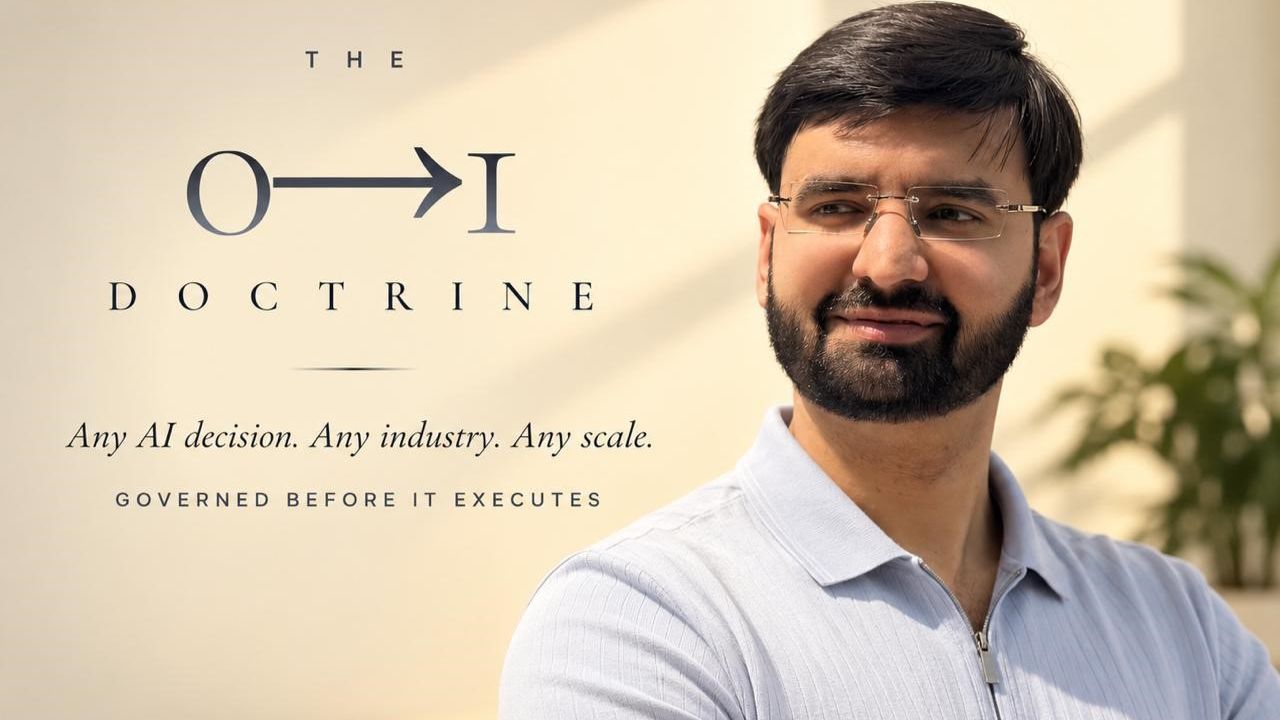
Systems theorist, inventor, and serial entrepreneur Vatsal Soin holds grants in the US, Japan, India and more; filings span six continents; latest grant, AI footwear, August 2026. Inventions: footwear, apparel fit, Sharable Size Cards, digital twins, robotics, global governed data, archive triage, quantum-resilient cryptography, AI governance. SIM–RMIT and NTU alumnus. Every prior invention was a step; 0→1 is the destination.
SELECTED REFERENCES
Granted: US Patent 12,446,652 B2 · Japan Patent 7560909 · India Patents 454081 and 599317. Filed: PCT/IN2025/051943 · US 19/489,595 · India 202511115781 · Australia AU2022450649 · India 202611113867 (23 September 2026) · PCT/IN2026/052042 (1 October 2026).
DISCLAIMER
Informational only. Not certified. No endorsement implied. Not investment advice. Examples are illustrative, not field results. Vatsal Soin · © 2026 All Rights Reserved.