







Apple Mac mini M6 Chip Brings 2nm Performance and Major AI Upgrades
Apple has introduced the Mac mini M6, powered by its new-generation M6 chip, alongside the more powerful M5 Ultra platform for the Mac Studio. The new Mac mini is designed to deliver faster everyday...

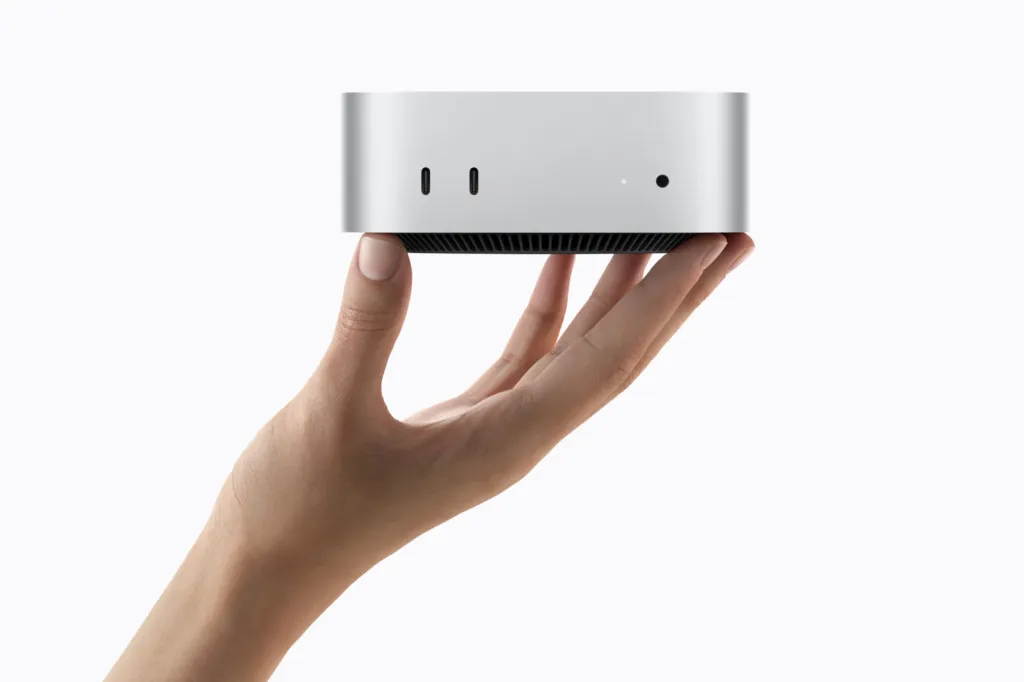
Apple has introduced the Mac mini M6, powered by its new-generation M6 chip, alongside the more powerful M5 Ultra platform for the Mac Studio. The new Mac mini is designed to deliver faster everyday performance, stronger graphics capabilities and significantly improved on-device AI processing.
The Mac mini M6 marks Apple’s move to a 2-nanometer chip architecture, bringing greater transistor density and improved power efficiency to its compact desktop lineup.
Mac mini M6 Gets Apple’s First 2nm Chip
The biggest highlight of the new Mac mini is the M6 chip, which Apple describes as its first 2nm processor.
The chip features a 12-core CPU made up of two super cores, four performance cores and six efficiency cores. Apple says the M6 delivers up to 1.2 times faster multithreaded performance than the M5 and up to 2.4 times faster performance than the M1 in the company’s tested workloads.
This combination allows the Mac mini M6 to handle tasks such as coding, photo editing, file indexing and demanding AI workloads more efficiently.
Mac mini M6 Focuses Heavily on AI
Apple is also putting a major emphasis on AI with the new Mac mini.
The M6 includes a Dual 16-core Neural Engine, which Apple says can provide up to twice the peak compute of previous generations. The system can automatically use both Neural Engines simultaneously for supported workloads.
The chip also features a 12-core GPU with dedicated Neural Accelerators in every GPU core. Apple claims this provides nearly 30% higher peak GPU compute for AI compared with M5 and more than eight times the peak AI GPU compute of M1.
This makes the Mac mini M6 particularly suited to users running AI applications locally rather than relying entirely on cloud services.
Up to 32GB of Unified Memory
The Mac mini M6 supports up to 32GB of unified memory and offers memory bandwidth of up to 170GB/s.
Apple says the higher bandwidth allows users to work with demanding applications while also running large language models locally.
For developers, this could make the Mac mini M6 useful for local AI experimentation, coding assistants, model inference and other agentic AI workloads.
Faster Graphics and Gaming
Apple has also upgraded the M6’s graphics architecture.
The 12-core GPU introduces updated shader technology, Dynamic Caching and hardware-accelerated ray tracing. The company says the M6 also delivers a 50% increase in geometry rates for complex graphics workloads.
These improvements are aimed at gaming, creative applications, 3D workloads and other graphics-intensive tasks.
Mac mini M6 for Developers
Developers are another major target audience for the new Mac mini.
Apple’s Core ML, Core AI, Metal and Xcode frameworks are designed to take advantage of the M6’s CPU, GPU and Neural Engine.
Developers can use these technologies to build and run AI applications directly on the Mac. Apple also allows developers to work with Apple Foundation Models, App Intents and their own AI models.
The combination of compact hardware and improved on-device AI performance could make the Mac mini M6 an attractive option for developers who want a relatively small desktop for local AI development.
M5 Ultra Powers Apple’s High-End Mac Studio
Alongside the M6, Apple also introduced the M5 Ultra for the Mac Studio.
The M5 Ultra uses Apple’s UltraFusion technology to connect four dies into a single processor architecture. It can feature up to a 36-core CPU and an 80-core GPU, along with up to 512GB of unified memory.
The chip delivers up to 1.2TB/s of unified memory bandwidth, which Apple says is 50% higher than the M3 Ultra.
That massive memory capacity and bandwidth are designed for professional workloads such as 3D rendering, scientific computing, video production and running extremely large AI models locally.
Mac mini M6 vs M5 Ultra
While both chips focus heavily on AI, they target very different users.
The Mac mini M6 is positioned as a compact desktop for everyday users, developers, students, AI enthusiasts and businesses. The M5 Ultra, meanwhile, is designed for professionals and organisations requiring maximum desktop compute performance.
The Mac mini M6 offers a more accessible form factor while the M5 Ultra targets workloads that can take advantage of hundreds of gigabytes of unified memory and extremely high memory bandwidth.
Apple’s Push Toward Local AI
The introduction of the Mac mini M6 demonstrates Apple’s continued focus on on-device AI computing.
Instead of sending every AI workload to the cloud, Apple’s latest silicon is designed to provide more computational capability directly on the device. This can be particularly useful for privacy-sensitive applications, offline workflows and AI applications that require low latency.
With its 2nm manufacturing process, Dual 16-core Neural Engine and Neural Accelerators, the M6 gives the Mac mini a significant upgrade in AI-focused hardware.
For users looking for a compact desktop with stronger local AI capabilities, the Mac mini M6 could represent one of Apple’s most significant Mac mini upgrades yet.