
Antwerp Diamond Industry Faces Historic Collapse as Layoffs Signal Deeper Crisis
Historic trade slump and rise of lab-grown diamonds push Antwerp out of global leadership, US firm Laurelton Diamonds to cut half its workforce

Advertisement
Surat | Gujarat — The once-glittering diamond hub of Antwerp is staring at one of the darkest chapters in its centuries-old trading history. Dwindling trade volumes, a wave of bankruptcies and intensifying global competition have pushed the Belgian diamond industry to the brink, prompting a major US-based diamond company to announce sweeping layoffs at its Antwerp operations.
According to Belgian daily Gazette van Antwerpen, Laurelton Diamonds, an American diamond firm with global operations, plans to lay off more than half of its workforce in Antwerp by autumn this year. The move has sent shockwaves through the global diamond community, underlining the severity of the crisis gripping Europe’s traditional diamond capital.
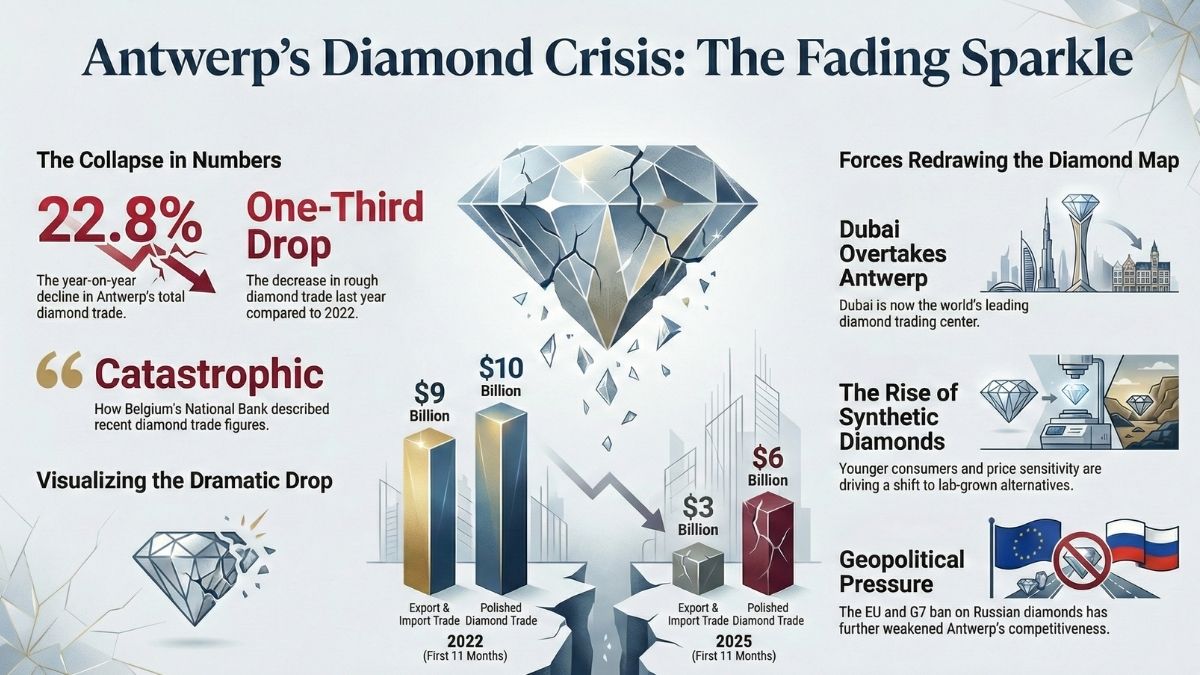
Industry leaders have not minced words in recent months. Senior figures within the Antwerp diamond ecosystem have described the situation as a “historic crisis”, while the National Bank of Belgium has labelled recent diamond trade figures as “catastrophic”, reflecting the scale of the downturn.
Trade at Record Lows
The numbers tell a stark story. Rough diamond trade in Antwerp fell by nearly one-third last year compared to 2022, while total trade—including rough and polished stones—declined by 22.8 percent year-on-year. Export and import trade collapsed from almost $9 billion in the first 11 months of 2022 to just $3 billion in the same period of 2025.
Polished diamond trade has also suffered heavily, dropping from $10 billion to $6 billion, with polished diamond exports alone falling by 28 percent. Several Antwerp-based diamond companies have already been declared bankrupt, intensifying fears of a prolonged structural decline.
“These figures confirm what the trade has been feeling for months,” said an Antwerp-based diamond trader, requesting anonymity. “Liquidity has dried up, margins are under pressure, and confidence is at its lowest point in decades.”
Dubai Overtakes Antwerp
Perhaps the most symbolic blow is that Antwerp is no longer the world’s leading diamond trading centre. Dubai has overtaken Antwerp, benefiting from faster growth, fewer regulatory constraints and strong positioning in synthetic and mixed diamond trading. While hubs such as Mumbai and Dubai do not regularly publish detailed figures, industry consensus suggests their market share has surged—largely at Antwerp’s expense.
The EU and G7 ban on Russian diamonds, imposed after Russia’s invasion of Ukraine in 2022, has further weakened Antwerp’s competitiveness. Competing centres in India and several African countries are now poised to absorb trade volumes that once flowed through Belgium.
Synthetic Diamonds Reshape Demand
Laurelton Diamonds has attributed its Antwerp layoffs to weak global demand—particularly from the US and China—and the rapid rise of cheaper synthetic diamonds. The company plans to cut 26 of its 42 employees in Antwerp, even as it continues operations across the US, Botswana, Vietnam, Cambodia and Mauritius.
“The natural diamond sector is under pressure worldwide,” an industry executive noted. “Younger consumers are far less attached to mined diamonds, and price sensitivity is driving a shift toward lab-grown alternatives.”
Warning Signs for Global Diamond Centres
For diamond hubs such as Surat, which remains central to global cutting and polishing, Antwerp’s crisis serves as a cautionary signal. Structural shifts in consumer preference, geopolitics and supply chains are rapidly redrawing the global diamond map.
As one European industry leader put it, “This is not a cyclical slowdown—it is a fundamental transformation. Only those who adapt will survive.”
Advertisement
