






Enzymes Stir Cellular Traffic, Boost Molecular Uptake
GANDHINAGAR: Enzymes working outside a cell can do more than drive chemical reactions—they can physically stir the surrounding fluid and help molecules reach the cell faster, a new study led by...

GANDHINAGAR: Enzymes working outside a cell can do more than drive chemical reactions—they can physically stir the surrounding fluid and help molecules reach the cell faster, a new study led by researchers at IIT Gandhinagar has found.
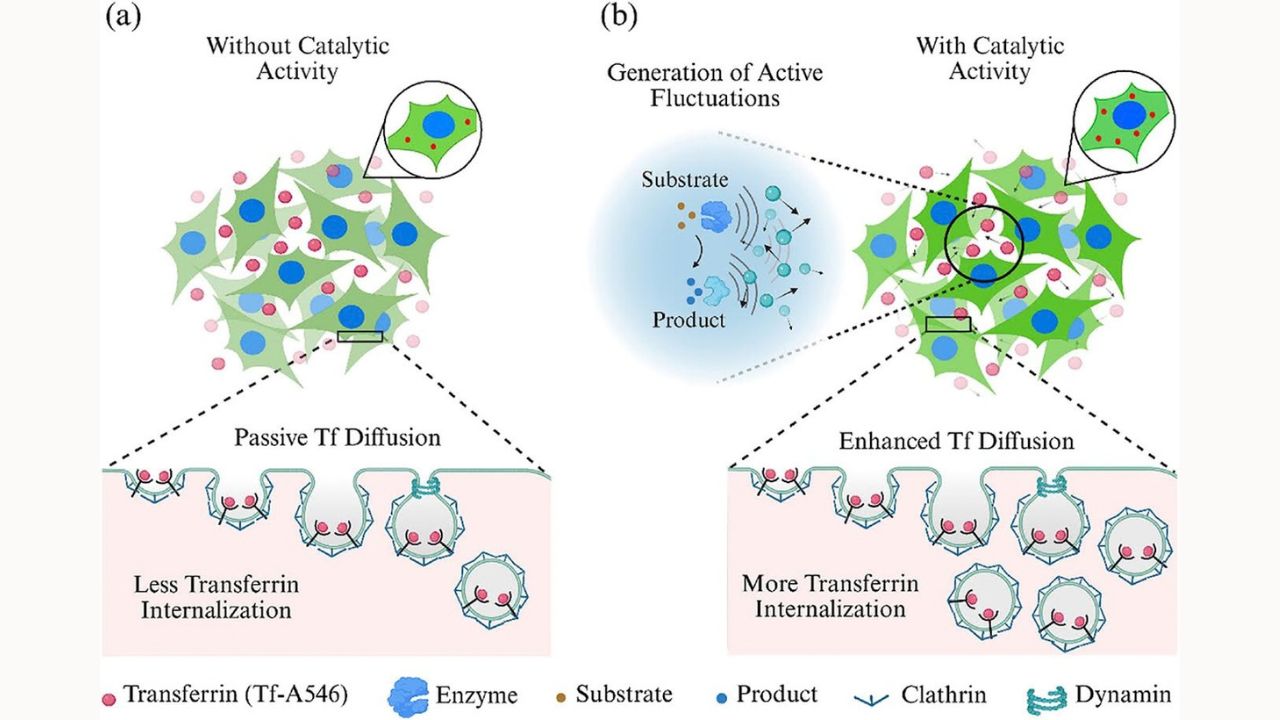
The collaborative study involving IIT Gandhinagar, IIT Jodhpur, IISER Kolkata and the University of Pennsylvania found that active enzymes increased the movement of transferrin, an iron-carrying protein, and boosted its uptake by cultured cells. The research has been published in Small.
The researchers found that cells exposed to active enzymes absorbed roughly 17% more transferrin. Advanced imaging further showed that transferrin moved about 50% faster near the cell surface when the enzymes were active. Fluorescence correlation spectroscopy recorded increases in transferrin diffusivity of around 40% with urease and 44% with alkaline phosphatase.
“The agents of that change are enzymes, the protein machines that drive a vast range of reactions in the body, and, remarkably, they do it without entering the cell or altering the cargo at all,” said Dr Krishna Kanti Dey, corresponding author and Associate Professor at IIT Gandhinagar.
The team used transferrin as a test molecule because its cellular uptake pathway is well understood. Researchers tracked fluorescently labelled transferrin and used Total Internal Reflection Fluorescence microscopy to observe molecular movement near the cell membrane.
Optical tweezers provided further evidence that active enzyme reactions generated mechanical fluctuations in the surrounding environment, with both enzyme systems producing forces in the piconewton range. The researchers concluded that the enhanced movement depended on active enzyme catalysis rather than simply the presence of enzymes or their reaction ingredients.
However, the researchers found a biological limit to the effect. While transferrin moved substantially faster, uptake increased less because cells have a finite number of transferrin receptors. Once those receptors become saturated, additional molecular speed cannot translate into proportionally higher uptake.
The findings could eventually have implications for molecular transport and drug delivery, although the researchers stressed that therapeutic applications have not yet been demonstrated.
“The findings could be relevant to future efforts to control molecular transport, including the delivery of therapeutic cargoes across biological barriers. But those applications remain to be tested,” Dr Dey said.
The research was supported by the Anusandhan National Research Foundation, the Ministry of Education’s STARS scheme and the Gujarat State Biotechnology Mission.