







China’s Robot Revolution Is Here, But True Humanoid Intelligence Is Still Years Away
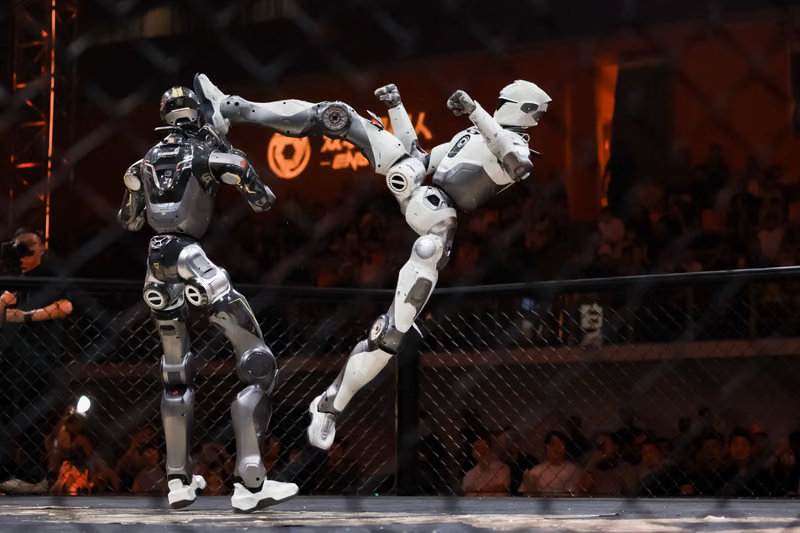
For months, social media has been flooded with videos of humanoid robots dancing, boxing, sprinting, folding clothes and performing increasingly human-like movements. The 2026 World Robot Conference...

For months, social media has been flooded with videos of humanoid robots dancing, boxing, sprinting, folding clothes and performing increasingly human-like movements. The 2026 World Robot Conference in Beijing has only amplified that momentum, placing China’s rapidly growing robotics industry firmly at the centre of the global technology conversation.
Behind the viral clips lies a much larger story. China is no longer showcasing isolated prototypes. It is building an entire ecosystem around humanoid robotics, combining manufacturing strength, artificial intelligence, government policy and billions of dollars in investment. The question now is whether this surge represents the peak of the industry or the beginning of a much bigger transformation.
Beijing showcases the world’s largest robotics stage
This year’s World Robot Conference featured more than 2,000 robotic systems from leading Chinese manufacturers. While humanoid robots attracted the biggest crowds, the exhibition also included quadruped machines, industrial automation platforms, educational robots and experimental mobility concepts.
Companies focused less on entertainment and more on practical applications. Robots demonstrated warehouse logistics, factory assembly, parcel sorting, component transportation and collaborative industrial work. At the same time, visitors watched humanoids perform martial arts, table tennis and choreographed dance routines, highlighting both technical capability and public appeal.
Unitree Robotics founder Wang Xingxing described the industry as approaching a defining moment comparable to the rise of generative AI. His vision is a future where robots can enter unfamiliar environments and complete complex tasks using natural language instructions rather than extensive programming.
China’s advantage goes beyond hardware
China’s leadership in robotics is not the result of one successful company. It is the product of scale.
Industry analysts estimate that embodied AI has attracted roughly $138 billion in investment across China, supported by national industrial policy and aggressive private funding. Companies including UBTECH, Unitree, EngineAI and Leju are developing competing humanoid platforms, creating one of the world’s most active robotics ecosystems.
UBTECH alone expects to deliver more than 10,000 Walker S humanoid robots by 2027 as it expands deployments across manufacturing environments. The broader strategy is clear: train robots in industrial settings first, then gradually expand into commercial and consumer applications.
The internet sees perfection. Engineers see limitations.
The viral success of humanoid robots often creates the impression that general-purpose robotic intelligence has already arrived. Reality is considerably more nuanced.
One of the most discussed moments at the conference involved a humanoid attempting to fold a shirt. Despite repeated adjustments, the robot failed to complete a task that humans perform almost effortlessly. Similar incidents have surfaced throughout the year, including robots that achieved impressive running speeds but crashed into walls because they were unable to slow down or navigate obstacles safely.
These failures are not embarrassing exceptions. They reveal the current state of the technology. A robot can excel at locomotion, object recognition or manipulation individually while still struggling to combine those abilities into reliable real-world performance.
For robotics engineers, consistency matters far more than spectacular demonstrations.
Software remains the real frontier
Mechanical design has improved dramatically over the past few years. Modern humanoids are lighter, stronger and significantly more agile than earlier generations. The greater challenge now lies in software.
Creating machines that can understand unfamiliar environments, adapt to changing conditions and make intelligent decisions without constant human supervision remains one of the industry’s biggest obstacles. That is why many researchers believe embodied AI will define the next phase of robotics, bringing language models together with physical interaction.
Even Wang Xingxing has acknowledged that meaningful software breakthroughs may still require two to three years in an optimistic scenario, while a slower trajectory could extend closer to a decade.
The United States is pursuing a different strategy
Washington increasingly views humanoid robotics through the lens of technological competition alongside AI and semiconductor manufacturing.
American startups are exploring robots for logistics, industrial automation and defence applications, while domestic manufacturers are expanding production to reduce dependence on Chinese hardware. Ironically, many US universities and technology companies have relied on affordable Chinese robots for research, accelerating innovation even as policymakers push for supply chain independence.
The competition is becoming less about who builds the most impressive robot and more about who creates the strongest ecosystem for deploying intelligent machines at scale.
A defining decade for humanoid robotics
China has unquestionably emerged as the global leader in humanoid robot manufacturing and deployment. Its combination of government support, manufacturing capacity and AI investment gives it a significant head start in commercial robotics.
Yet the industry has not reached its pinnacle. The next breakthrough will not be measured by how well a robot dances or boxes. It will be measured by whether humanoids can reliably work in factories, hospitals, warehouses and homes with minimal human intervention.
The viral videos showcase what robots can do. The coming decade will determine what they can consistently achieve.