






India’s Private Space Sector Enters the FFSC Race With Astrobase’s 800 kN Everest Engine
India’s rapidly expanding private space industry has reached a new milestone with Bengaluru-based Astrobase Space Technologies unveiling an 800 kN-class Full-Flow Staged Combustion (FFSC) rocket...

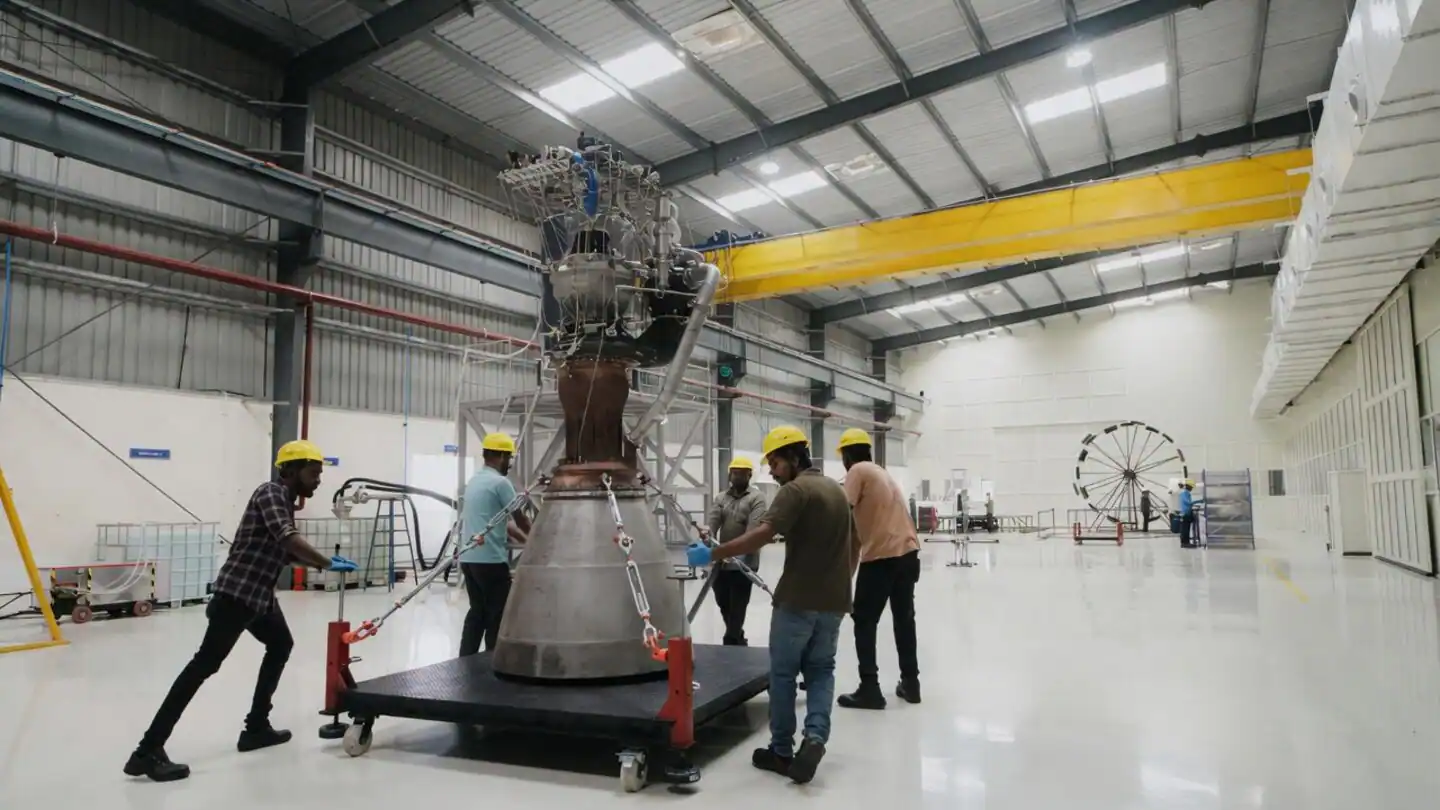
India’s rapidly expanding private space industry has reached a new milestone with Bengaluru-based Astrobase Space Technologies unveiling an 800 kN-class Full-Flow Staged Combustion (FFSC) rocket engine.
Named Everest, the engine is being developed for Astrobase’s planned reusable medium-lift launch vehicle. The company says the project represents its effort to build advanced propulsion technology domestically and eventually establish a high-frequency orbital launch capability from India.
Astrobase is targeting the vehicle’s first orbital flight for December 2028, with commercial operations expected around the same period.
However, the engine remains in the development phase. Hot-fire testing has not yet begun, and the company expects those trials to start in the coming months. Before Everest can be used for an orbital mission, it will need to undergo extensive ground testing, qualification and integration with the launch vehicle.
Why the Everest engine matters
FFSC is considered one of the most challenging rocket-engine architectures to develop.
Unlike conventional staged-combustion systems, an FFSC engine completely gasifies both its fuel and oxidiser before they enter the combustion chamber. This architecture can improve propulsion efficiency and reduce some of the thermal stresses placed on critical turbomachinery.
Everest is designed around liquid oxygen and methane and is expected to generate approximately 800 kN of thrust.
Astrobase says the engine is being designed for a specific impulse of around 340 seconds and a throttle range extending from 50 per cent to 110 per cent of nominal thrust.
The ability to vary thrust is particularly important for reusable rockets, where precise control is required during different phases of ascent and landing.
A technology developed by only a handful of players
High-thrust FFSC engines remain relatively uncommon because of the demanding engineering involved. Developers must simultaneously manage extreme temperatures, pressures and turbomachinery operating conditions.
The technology has historically been pursued by only a limited number of national space programmes and private companies.
Astrobase says it is among only a small group of commercial companies worldwide to have designed, manufactured and integrated a high-thrust FFSC engine.
Company CEO Neeraj Khandelwal described the technology as one of the most advanced approaches to rocket propulsion because even relatively modest efficiency improvements can translate into increased payload capability.
Building India’s reusable launch capability
Astrobase’s plans extend beyond developing the engine itself.
The company aims to develop an integrated launch system covering propulsion, vehicle manufacturing, testing and launch operations. Its longer-term objective is to create a reusable launch platform capable of supporting frequent orbital missions.
Astrobase initially wants to establish an annual capacity of around 100 tonnes of payload to orbit. It says that capacity could eventually be expanded to more than 1,000 tonnes per year.
The company believes that launch demand is already strong globally but that available launch capacity remains limited.
According to Khandelwal, Astrobase wants India to become an additional major launch hub in a market currently dominated by a small number of countries.
More than 70 per cent of the engine developed in India
Astrobase says more than 70 per cent of Everest has been designed and manufactured domestically.
The company says the engine was developed internally and is being manufactured in Bengaluru, while imports are currently limited to specialised components that are not yet readily available within India’s domestic supply chain, including certain sensors.
The push toward greater domestic manufacturing is part of Astrobase’s broader objective of developing an indigenous reusable-launch ecosystem.
December 2028 is the key target
Astrobase is working toward its first orbital launch attempt in December 2028.
That timeline, however, will depend on the outcome of several critical development stages.
The immediate priorities include establishing the necessary test infrastructure, conducting hot-fire trials, performing repeated engine firings, completing qualification testing and integrating Everest with the company’s launch vehicle.
Only after these stages are successfully completed will the company be able to demonstrate whether the propulsion system is ready for orbital flight.
Reusability will present another significant engineering challenge once the vehicle reaches the flight-testing stage.
From prototype to flight-ready engine
The unveiling of Everest represents an important development milestone, but the engine has yet to prove itself through hot-fire testing or an orbital mission.
The next phase will therefore be crucial for Astrobase.
If the company can successfully move Everest through testing, qualification and vehicle integration, it could strengthen India’s growing private-sector capabilities in high-thrust propulsion and reusable launch systems.
For now, the December 2028 orbital-flight target remains an ambitious objective, with the engine’s testing and qualification programme likely to determine whether Astrobase can maintain that schedule.