





Gujarat Launches Health Passport for 1.89 Crore Children Under RBSK
GANDHINAGAR : In a landmark move to transform child healthcare delivery, the Gujarat government has launched the Health Passport, a first-of-its-kind initiative designed to provide every child with a...

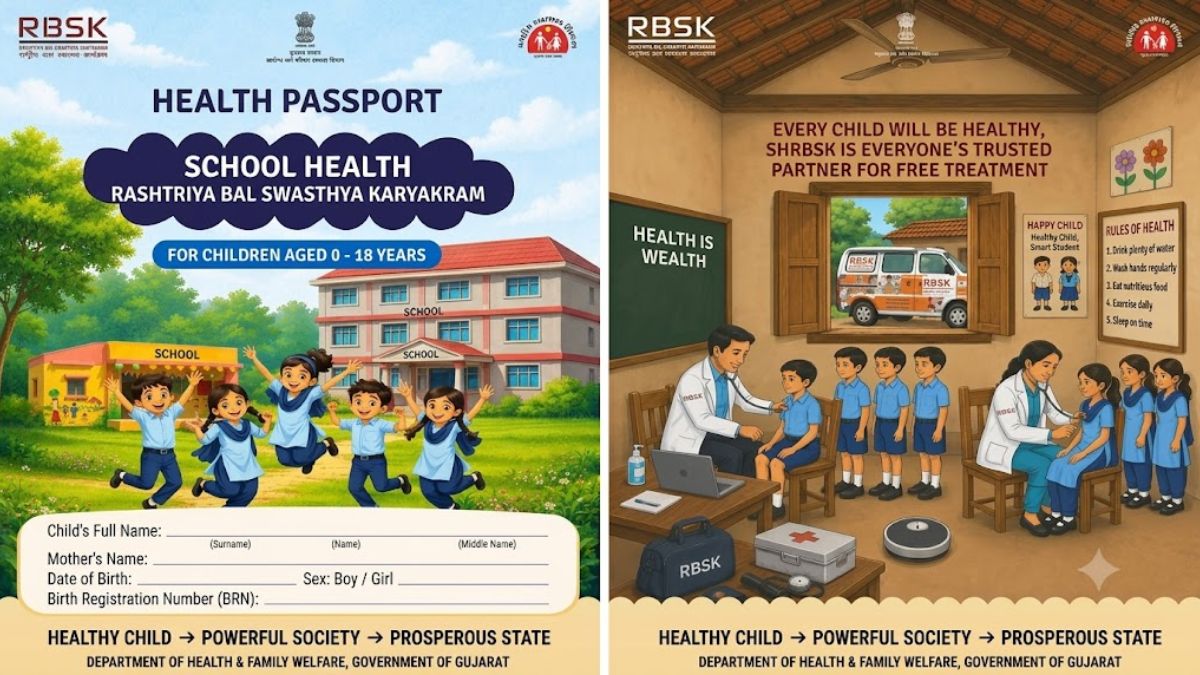
GANDHINAGAR : In a landmark move to transform child healthcare delivery, the Gujarat government has launched the Health Passport, a first-of-its-kind initiative designed to provide every child with a lifelong, structured medical record from birth to adulthood. The programme, rolled out under the School Health – Rashtriya Bal Swasthya Karyakram (SH-RBSK), aims to make healthcare more accessible, organised and child-friendly across the state.
The initiative, launched on June 27, 2026, by the Union Home Minister in the presence of the Chief Minister, will cover nearly 1.89 crore children across Gujarat. It is being implemented through 992 mobile health teams conducting annual health screenings at Anganwadis, schools, madrasas, gurukuls and special education centres.
Officials said the Health Passport is not just a document but a “complete health biography” of every child. “This initiative ensures that a child’s entire health journey is recorded in a structured and accessible format, enabling timely diagnosis and better continuity of care,” a senior health department official said.
The process has been designed to be simple and parent-friendly. No additional documents are required to obtain the Health Passport. After routine screening by mobile health teams, children’s details are entered into the SH-RBSK digital system, and the Health Passport is issued on the spot.
For renewal, the system remains equally efficient. Children under five and those not enrolled in schools will have their records updated annually by Primary Health Centre medical officers, while school-going children’s passports will be updated by school principals.
The Health Passport consolidates all key health data, including birth records, periodic health check-ups up to the age of 18, and screening under the four major SH-RBSK categories—birth defects, deficiencies, childhood diseases, and developmental delays and disabilities. It also records nutritional status, physical and mental development, referrals, lifestyle guidance and emergency helpline details.
Health officials emphasized that the system’s strength lies in its digital integration. While parents will retain a physical copy, all data will be synchronised with the state’s health portal, ensuring continuity even if the document is lost or damaged.
“If a Health Passport is misplaced, a replacement can be easily generated from the system without loss of data,” another official explained.