





Gujarat : IIT Gandhinagar Develops Plant-Based Nanoparticles to Detect Toxic Metals and Advance Healthcare
Gandhinagar | Gujarat — In a breakthrough that blends traditional botanical knowledge with cutting-edge nanotechnology, researchers at the Indian Institute of Technology Gandhinagar (IITGN) have...

Gandhinagar | Gujarat — In a breakthrough that blends traditional botanical knowledge with cutting-edge nanotechnology, researchers at the Indian Institute of Technology Gandhinagar (IITGN) have transformed common medicinal plants found in Indian households into powerful carbon nanoparticles capable of detecting toxic heavy metals and supporting future healthcare applications.
The innovation comes at a time when contamination from heavy metals such as lead, nickel and iron is emerging as a growing environmental and public health challenge. Released through industrial activity, mining operations and urban waste, these pollutants can accumulate in living organisms and are linked to serious health risks, including respiratory problems, inflammation, cardiovascular stress and cellular damage.
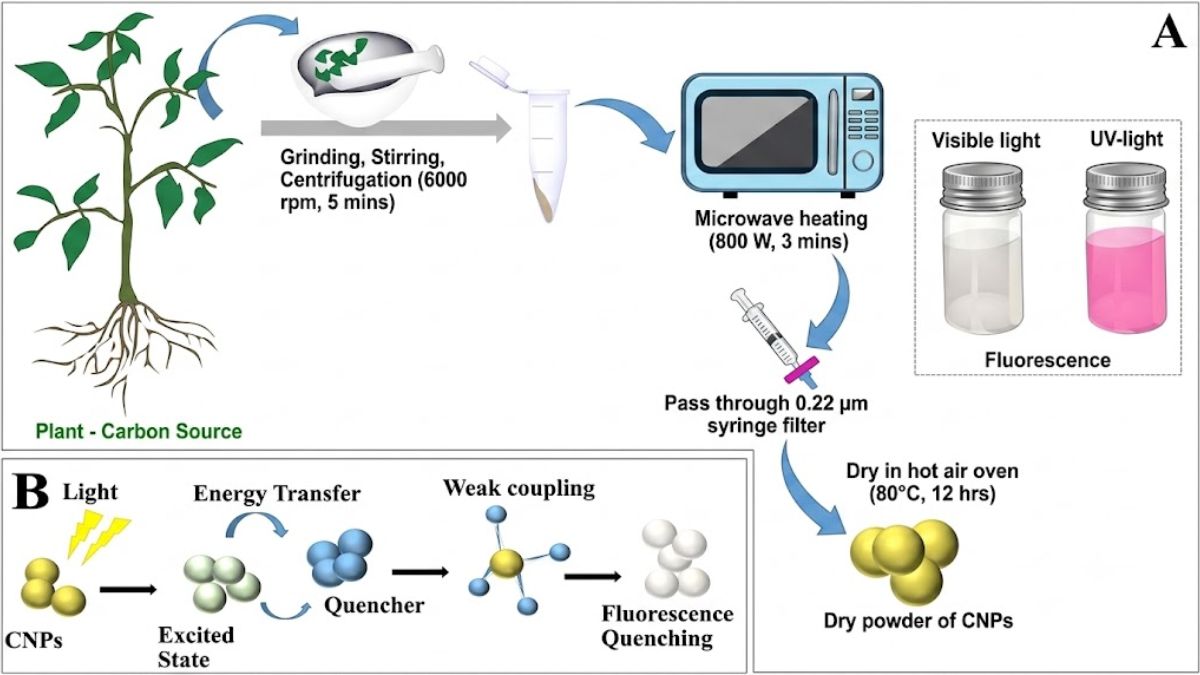
Seeking a sustainable solution, IITGN researchers developed multifunctional carbon nanoparticles (CNPs) from five medicinal plants—jamun, tulsi, neem, guava and curry leaves—using a rapid microwave-assisted process that eliminates the need for hazardous chemicals. The findings have been published in the scientific journal Nano Express.
“These medicinal plants contain valuable natural compounds that can serve as building blocks for advanced nanomaterials with sensing, optical and biomedical properties,” said Jhuma Saha, Assistant Professor in the Department of Electrical Engineering at IIT Gandhinagar.
The newly developed nanoparticles exhibited strong fluorescence under ultraviolet light, a property that enabled them to identify specific heavy metal contaminants. Researchers found that guava-derived nanoparticles were particularly sensitive to nickel ions, while neem and jamun nanoparticles effectively detected different forms of iron. Tulsi-derived nanoparticles demonstrated the ability to detect both iron and lead contamination.
“What was particularly interesting was that the fluorescence intensity decreased as the concentration of metal ions increased, making detection easier and more reliable,” explained Parul Singh, a final-year PhD student involved in the study.
Beyond environmental monitoring, the research revealed promising biomedical potential. The plant-derived nanoparticles displayed strong antioxidant properties, helping neutralize harmful free radicals associated with ageing and disease. Jamun-based nanoparticles showed the highest antioxidant activity, followed by tulsi, guava, neem and curry leaf variants.
Laboratory tests also indicated low toxicity at controlled concentrations, with tulsi-derived nanoparticles emerging as the most biocompatible. These findings suggest potential applications in diagnostics, therapeutic delivery systems and future nanomedicine development.
Dr. Saha noted that further studies are needed to evaluate large-scale production and real-world applications. “The next step is to explore how these nanoparticles can be deployed for environmental remediation and biological applications beyond the laboratory,” she said.
Aligned with India’s Mission on Nano Science and Technology, Mission LiFE and the vision of Atmanirbhar Bharat, the research highlights how indigenous resources and sustainable innovation can address some of the world’s most pressing environmental and healthcare challenges. As global attention turns toward cleaner technologies, IITGN’s plant-powered nanotechnology offers a glimpse into a greener and healthier future.