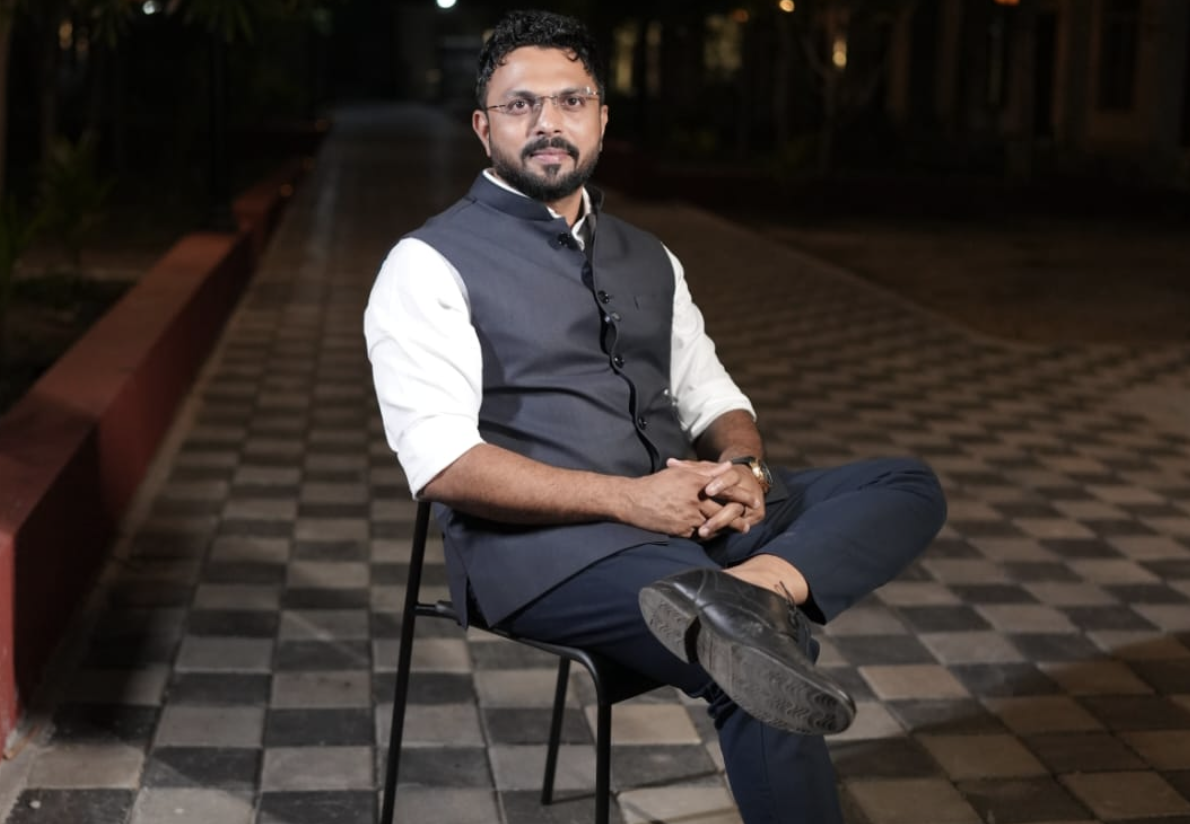







Nikhil Khare: The Civil Servant Who Never Stopped Writing the Darkness Within
There are some people who discover writing gradually. And then there are people like Nikhil Khare, who seem to have carried stories within themselves from the very beginning. Born and raised in...

There are some people who discover writing gradually. And then there are people like Nikhil Khare, who seem to have carried stories within themselves from the very beginning.
Born and raised in Kanpur, Nikhil grew up in a setting where ambition often followed predetermined routes. Like many academically inclined students from small Indian cities, he too was expected to pursue engineering – the familiar symbol of security and success. But somewhere along the way, literature became impossible to ignore.
Choosing words over convention, he pursued English Honours from University of Delhi, resisting the pressure to conform to a more predictable professional path. It was not simply an educational decision. It was a personal rebellion in favour of imagination, language, and thought.
Years later, after sustained discipline and preparation, he qualified the Civil Services Examination and joined Indian Railways, where he currently serves. Yet alongside the responsibilities of public service, another identity continued to evolve quietly – that of a writer deeply interested in the darker and more philosophical dimensions of human existence.
Long before publication, there were fragments.
As a child, Nikhil would write on loose sheets of paper, scribbling thoughts, scenes, strange conversations, and unfinished stories before hiding them away for himself alone. Writing was never introduced to him as a formal ambition. It emerged instinctively. Over time, those scattered pages transformed into manuscripts and eventually books.
Today, he has written twelve books, with the thirteenth and fourteenth already underway.
Among his prominent works is The Keeper of Hours, a philosophical meditation on memory, regret, guilt, and the invisible emotional clocks that govern human lives. The book examines how people become trapped not by time itself, but by moments they fail to leave behind.
Another major work, Gale Zephyr, explores emotional turbulence, identity, alienation, and the instability of modern relationships. Atmospheric and introspective, the novel moves through fragmented emotions and psychological landscapes with a voice that is simultaneously poetic and unsettling.
His political and emotionally charged novel The First Lady Is Dead examines power, ambition, grief, and public perception through the lens of political collapse. The narrative blends personal tragedy with institutional decay, questioning the moral cost of power and the fragile humanity hidden beneath political performance.
Nikhil is also the author of Mayhem, a dystopian work set in the ruined city of Rudolph within the collapsing nation of Krakozia. The novel studies generational conflict, societal violence, inherited trauma, and moral erosion through characters struggling to survive within systems already falling apart.
Across his body of work, certain themes return repeatedly: emotional silence, masculine vulnerability, memory, loneliness, institutional power, philosophical unrest, and the uneasy relationship between hope and despair. His writing often rejects superficial optimism, choosing instead to confront the emotional truths people usually avoid.
Perhaps most strikingly, many of his works explore men who struggle to articulate grief, fear, tenderness, or vulnerability – individuals shaped by silence as much as by language.
Despite an expanding literary catalogue, Nikhil continues to speak about writing with unusual simplicity.
“The medium changed,” he says. “Earlier I wrote on scraps of paper. Now I write everywhere else.”
There is a compelling contradiction in his life. One part exists within the operational precision and administrative rigor of the Railways. The other remains immersed in abstraction, philosophy, emotional excavation, and unfinished sentences written late into the night.
In many ways, his journey reflects the tension of contemporary India itself – deeply ambitious, deeply structured, yet quietly searching for emotional and intellectual meaning beneath the surface.
For Nikhil Khare, writing was never a separate pursuit.
It was simply the parallel track running beside life all along.