




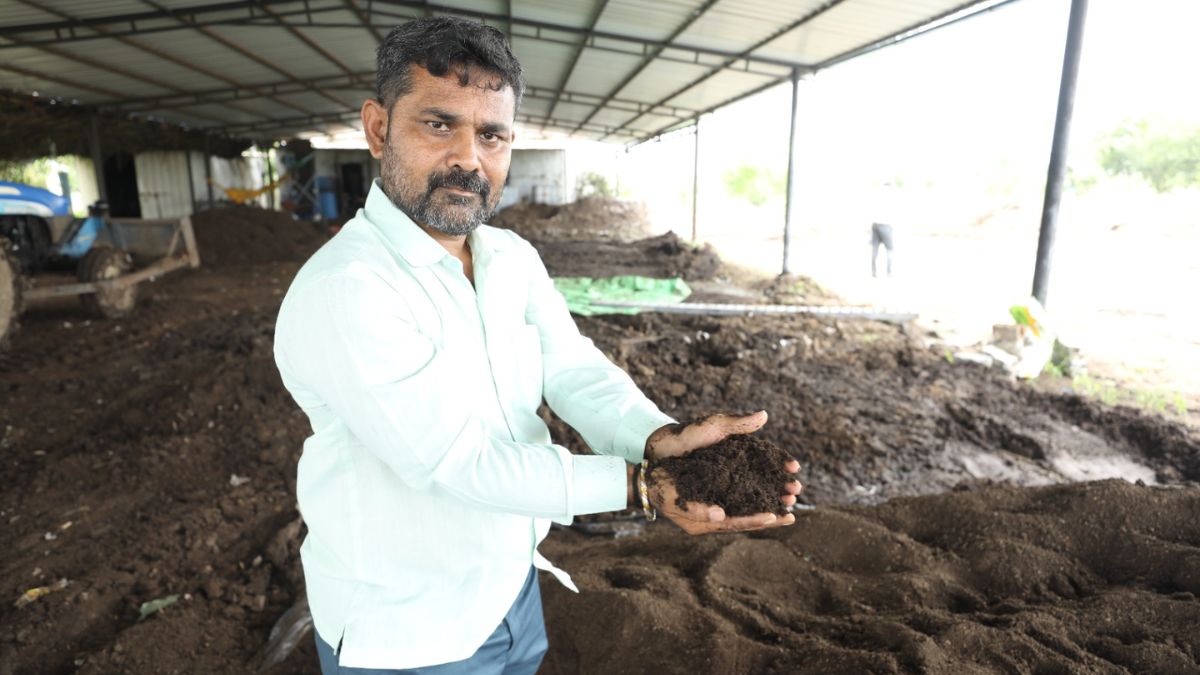
Surat Farmer Powers Gujarat’s Natural Farming Boom with Ghanjeevamrut
Surat | Gujarat — In Mangroliya village of Surat district, even as temperatures soar above 44°C, more than 20 labourers are working at Kamlesh Patel’s farm to prepare Ghanjeevamrut ahead of the...

Surat | Gujarat — In Mangroliya village of Surat district, even as temperatures soar above 44°C, more than 20 labourers are working at Kamlesh Patel’s farm to prepare Ghanjeevamrut ahead of the Kharif season.
A resident of Ambheti village in Palsana taluka, Kamlesh Patel not only practices natural farming but is also committed to ensuring that India reduces its reliance on imported chemical fertilisers. With the aim of making Ghanjeevamrut with the support of Gujarat government’s economic support, widely accessible to farmers as a robust alternative, he has scaled up its production significantly.
The Agriculture Department is actively promoting natural farming by training farmers and developing master trainers. Kamlesh Patel is one such master trainer and has inspired numerous farmers to adopt natural farming practices.
Currently, more than 800,000 farmers in the state have transitioned to natural farming, covering over 550,000 hectares of land. With this expansion, Jeevamrut and Ghanjeevamrut are increasingly being used as substitutes for chemical fertilisers, leading to growing demand.
Kamlesh Patel, who began natural farming in 2017, has now taken up industrial-scale production of Ghanjeevamrut. He currently produces 1,000 bags (per bag contains 40kg) daily and markets them across Gujarat and other states. He aims to double this capacity to 2,000 bags per day this year.
Under the guidance of Gujarat Chief Minister Bhupendra Patel, natural farming is gaining momentum across the state. Governor Acharya Devvrat has also been actively encouraging farmers in rural areas to adopt these practices. As a result, farmers are increasingly moving away from chemical fertilisers and adopting organic alternatives like Jeevamrut and Ghanjeevamrut.
Ghanjeevamrut is a powerful organic fertiliser that improves soil health, enhances microbial activity, enriches soil nutrients, and boosts crop productivity.
Target of Producing One Lakh Bags This Year
Kamlesh Patel said, “More and more farmers are adopting natural farming, increasing the demand for Jeevamrut and Ghanjeevamrut. Last year, we sold 50,000 bags (each weighing 40 kg), and this year we plan to produce 100,000 bags.”
A Seminar That Changed His Life
In 2016, Kamlesh Patel attended a three-day seminar on Zero Budget Natural Farming conducted by Subhash Palekar. Deeply influenced by it, he immediately gave up chemical fertilisers and adopted natural farming.
Inspiring Others to Shift to Natural Farming
In 2017, Patel achieved excellent results in sugarcane cultivation using natural farming methods, recording a yield of 45 tonnes per hectare. Impressed by this success, other farmers in his village expressed interest in adopting the method. However, they lacked access to Jeevamrut and Ghanjeevamrut and were reluctant to prepare it themselves. This prompted Patel to begin large-scale production of both inputs.
Currently, he produces around 40,000 kg of Ghanjeevamrut and 1,000 litres of Jeevamrut daily. He sells Ghanjeevamrut at Rs 6 per kg and Jeevamrut at Rs 5 per litre.
The state Agriculture Department has supported him with subsidies for setting up a Bio-Resource Centre (BRC) for producing Jeevamrut and government has also provided financial assistance for Ghanjeevamrut production through Farmers Producer Company (FPO).
Nitin Gamit, Joint director of Agriculture, Gujarat Prakrutik Krushi Vikash Board, Krushi Bhavan Gandhinagar, said that significant progress is being made in the field of natural farming in Gujarat. The government has implemented various schemes to encourage farmers to adopt natural farming. As a result, alternatives to chemical fertilizers such as Jeevamrut and Ghan Jeevamrut are being made available to farmers.