





TraceX Labs’ GEOX AI: India’s First Geospatial Intelligence Platform Transforming Military Intelligence and Global Investigations
In an era where information dominance defines power, the ability to extract intelligence from visual data has become a critical advantage. Over the years, intelligence agencies and investigators...

In an era where information dominance defines power, the ability to extract intelligence from visual data has become a critical advantage. Over the years, intelligence agencies and investigators relied heavily on metadata such as GPS coordinates, EXIF data, and embedded tags to determine the origin of images and videos. However, these traditional methods often failed when such data was removed, manipulated, or unavailable. This limitation created a long-standing gap in geolocation intelligence—one that required a more advanced, intelligent solution.
Addressing this challenge, TraceX Labs introduced GEOX AI, marking a major leap in the evolution of geospatial intelligence. Developed by cybersecurity researchers Kiran Singh Rajpurohit and Santhosh Kumar, GEOX AI represents India’s first advanced AI-powered geolocation intelligence platform capable of identifying real-world locations using only the visual content of images and videos. By combining artificial intelligence with computer vision, the platform has redefined how location intelligence is generated, analyzed, and used across industries.
Unlike earlier systems that depended on external data points, GEOX AI works purely on visual analysis. It examines pixel-level patterns within images and videos, identifying critical environmental clues such as architectural styles, road layouts, vegetation, signage, language, lighting conditions, and even subtle cultural indicators. This shift from metadata-based detection to visual intelligence marks a fundamental transformation in the field of geolocation.
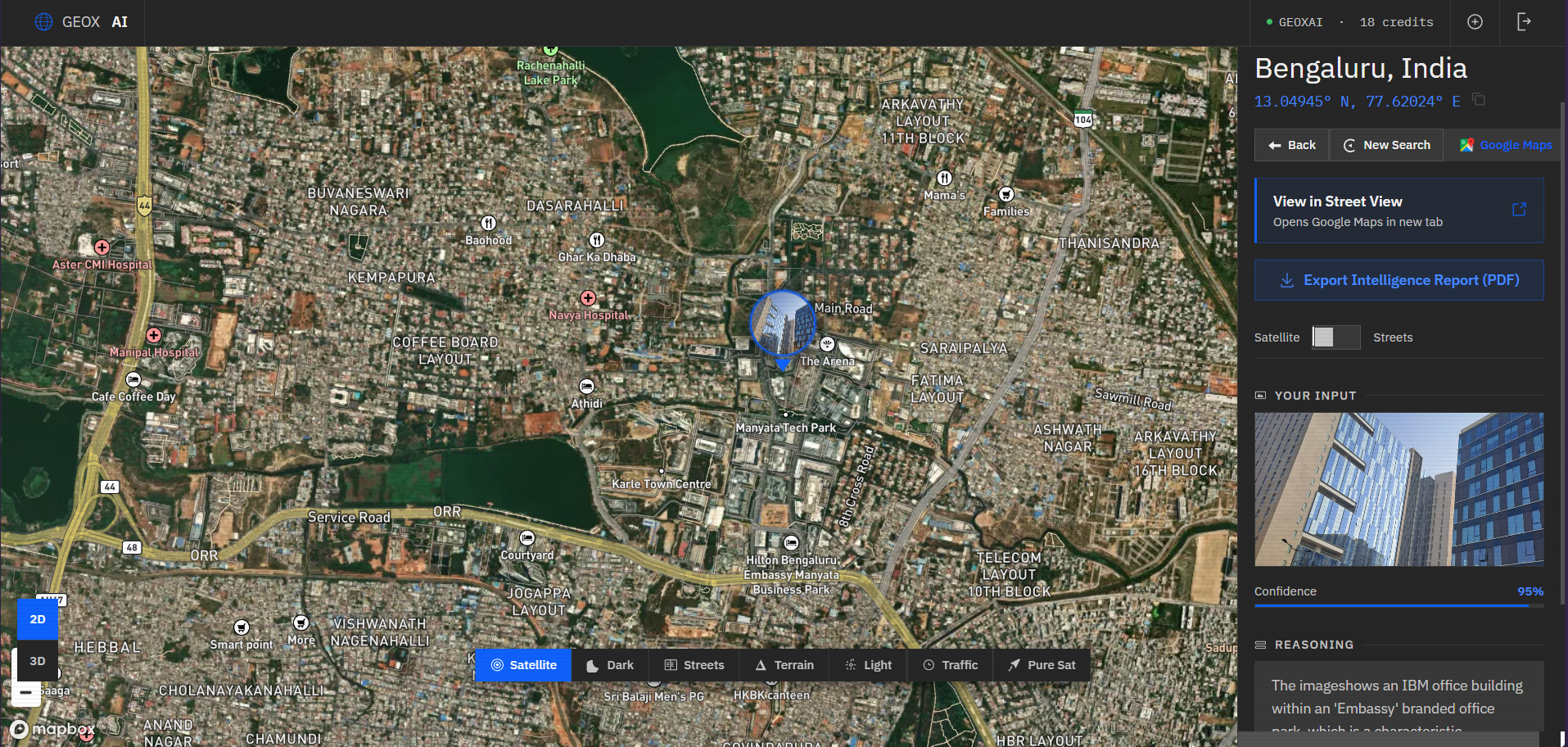
At its core, GEOX AI is built on a multi-agent AI architecture. When a user uploads an image or video frame, multiple AI models simultaneously analyze the content and compare it against vast global datasets. These models generate potential location matches, rank them based on confidence scores, and present the results through an interactive satellite map interface. The system also provides detailed reasoning behind each prediction, ensuring transparency and trust in its outputs.
What once took analysts hours—or even days—of manual investigation can now be achieved in under 10 seconds. GEOX AI not only accelerates intelligence workflows but also enhances accuracy, achieving up to 99% precision in landmark-based identification. Its ability to operate at such speed and scale makes it particularly valuable in real-time scenarios where decisions must be made instantly.
The platform offers two operational modes tailored to different needs. The Fast Mode delivers near-instant results for clear and high-context images, making it ideal for real-time decision-making in critical environments. On the other hand, the Advanced Agent Mode performs deeper, multi-step analysis for complex or low-context visuals, ensuring higher accuracy even in challenging scenarios.
GEOX AI’s impact is most profound in military intelligence and modern warfare. In traditional battlefield environments, identifying enemy positions or verifying targets required extensive reconnaissance and manual analysis. Today, GEOX AI enables military units to upload drone footage, surveillance images, or intercepted media and instantly determine precise locations. For instance, even a blurred image of an enemy vehicle can be analyzed using surrounding vegetation and road patterns to extract accurate coordinates. This capability significantly reduces operational risks while enabling faster and more informed responses.
The platform also plays a crucial role in Open-Source Intelligence (OSINT), a domain that has gained massive importance in recent years. Publicly available data from social media, news platforms, and online forums often contains valuable intelligence. GEOX AI allows analysts to verify such data by identifying the exact location where an image or video was captured. This not only strengthens intelligence networks but also helps counter misinformation and propaganda. In past global conflicts, including the Ukraine war, similar techniques have been used to confirm enemy bunker locations and troop movements—capabilities that GEOX AI now delivers in a more advanced and automated manner.
Beyond military applications, GEOX AI is proving to be equally transformative in counter-terrorism operations. Security agencies can analyze visual evidence to track hidden camps, detect operational zones, and monitor suspect movements. Even in cases where metadata has been deliberately removed, GEOX AI can uncover location clues through environmental and cultural analysis, enabling preventive action before threats escalate.
Mission planning and target verification have also evolved with the introduction of GEOX AI. Before executing operations, commanders can validate target locations, analyze surrounding terrain, and assess environmental conditions using detailed 2D and 3D map visualizations. This reduces uncertainty and minimizes collateral damage, ensuring more precise and controlled operations.
The usefulness of GEOX AI extends far beyond defense and security. In disaster response scenarios, where time is critical, the platform can analyze images shared on social media to identify affected areas, locate survivors, and assess infrastructure damage. During floods, earthquakes, or other crises, such capabilities can guide rescue teams directly to those in need, potentially saving countless lives.
Law enforcement agencies are also leveraging GEOX AI for criminal investigations. By analyzing CCTV footage or crime scene images, officers can trace locations, identify patterns, and track suspects more efficiently. Similarly, in digital forensics and cyber intelligence, the platform can analyze metadata-free media, verify deepfakes, and identify the origin of malicious content.
In journalism and fact-checking, GEOX AI serves as a powerful tool against misinformation. Reporters and analysts can verify the authenticity of viral images and videos, ensuring accurate and trustworthy reporting in an age where digital manipulation is increasingly common.
From a performance standpoint, GEOX AI stands out for its speed, scalability, and global reach. With an average response time of under 10 seconds and the ability to handle large-scale workflows, it is designed for enterprise-level operations. Its multi-location prediction system further enhances reliability by allowing cross-verification of results.
However, like all powerful technologies, GEOX AI raises important ethical and privacy concerns. Its ability to extract location data without metadata means that even seemingly harmless images shared online could reveal sensitive information. This poses potential risks for social media users, journalists, and military personnel. Recognizing these challenges, TraceX Labs is working on secure solutions such as encrypted uploads and controlled access systems to ensure responsible use of the technology.
Looking ahead, GEOX AI represents the future of geolocation intelligence. As artificial intelligence continues to evolve, platforms like GEOX AI will play a central role in autonomous systems, real-time battlefield analytics, and AI-driven investigative workflows. The shift from manual analysis to automated, intelligent systems marks a new era where unstructured visual data can be instantly transformed into actionable intelligence.
In conclusion, GEOX AI is more than just a technological innovation—it is a paradigm shift in how the world understands and utilizes geospatial intelligence. By unlocking the hidden information within images and videos, it empowers governments, agencies, and organizations to make faster, smarter, and more informed decisions. In a world where every pixel can hold critical intelligence, GEOX AI ensures that nothing remains unseen.
Frequently Asked Questions (FAQs)
1. What makes GEOX AI different from traditional geolocation tools?
GEOX AI, known as India’s first geospatial intelligence platform, does not rely on GPS, EXIF, or metadata. Instead, it analyzes visual elements like buildings, roads, vegetation, and cultural patterns to determine the exact location, making it effective even when metadata is missing or removed.
2. Who developed India’s first geospatial intelligence platform GEOX AI?
India’s first geospatial intelligence platform, GEOX AI, was developed by TraceX Labs, founded by cybersecurity researchers Kiran Singh Rajpurohit and Santhosh Kumar.
3. How fast and accurate is India’s first geospatial intelligence system GEOX AI?
India’s first geospatial intelligence system, GEOX AI, typically delivers results in under 10 seconds and can achieve up to 99% accuracy in landmark-based identification, depending on image clarity and context.
4. What are the main applications of India’s first geospatial intelligence platform GEOX AI?
India’s first geospatial intelligence platform, GEOX AI, is widely used in military intelligence, OSINT (Open-Source Intelligence), law enforcement, digital forensics, disaster response, journalism, and threat intelligence.
5. Are there any privacy or ethical concerns with India’s first geospatial intelligence platform GEOX AI?
Yes. India’s first geospatial intelligence platform, GEOX AI, can extract location data without metadata, which may expose sensitive information from images shared online. This raises privacy concerns, which are being addressed through secure access and encryption measures.