



Proof, Not Promise: The Inside Story of How COWBERRY Is Rewriting India’s Organic Food Rulebook
New Delhi [India], September 14: India’s organic food market has been on a steady climb for the better part of a decade, driven by consumers who are asking sharper questions about what actually...

New Delhi [India], September 14: India’s organic food market has been on a steady climb for the better part of a decade, driven by consumers who are asking sharper questions about what actually goes into their grain, pulses, spices, oils and everyday groceries. But that growth has run alongside a quieter, more uncomfortable question: when a product is labelled organic, is it actually organic? For most of the industry’s history, the answer has rested on trust in a label and a logo, and very little else.
It was this exact gap that gave rise to COWBERRY in April 2023. The company was founded by three people from very different backgrounds, Haresh Parvadiya, a well-known businessman and philanthropist for whom farming has always been part of his family’s legacy; Darshan Parvadiya, who studied Finance and Financial Engineering in the United States and chose to leave a comfortable life in New York and Los Angeles to return to India; and Kaushik Sonani, an IIM alumnus who came on board to give the vision strategic shape and direction. What united the three founders was a single, shared observation: India’s organic sector did not have a supply problem. It had a trust problem.
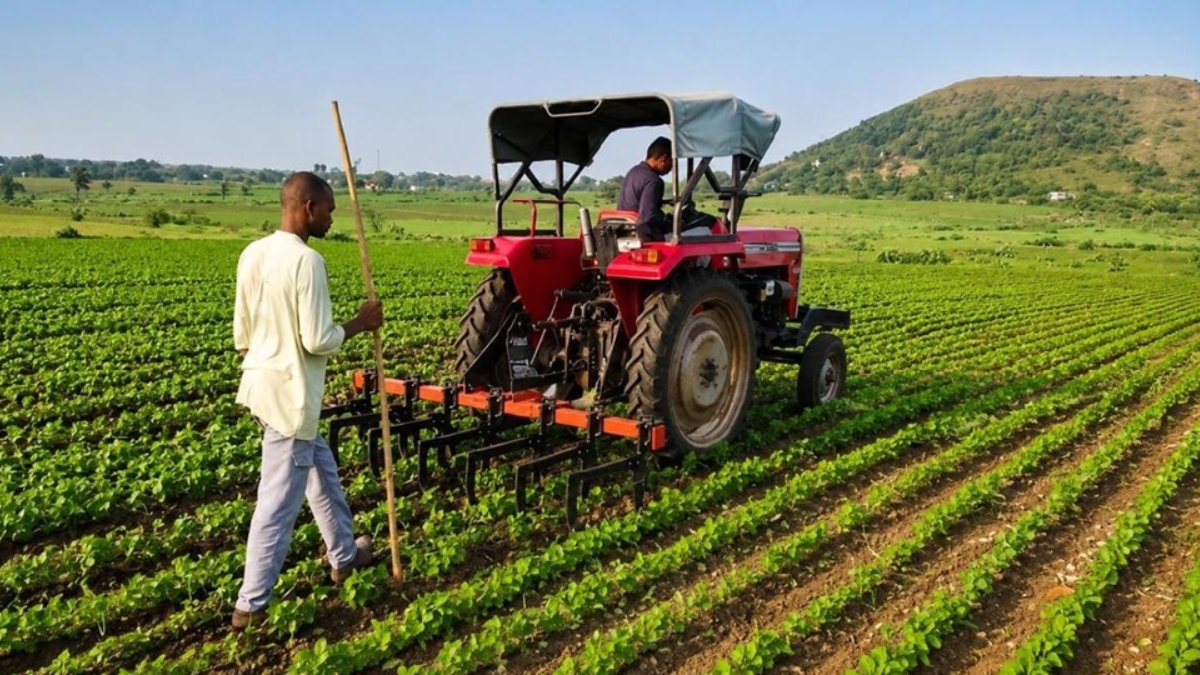
So instead of starting in a boardroom, COWBERRY’s founders started in the fields. Through 2023, they travelled to villages across Gujarat and other states, not to sign farmers up immediately, but simply to listen. What they heard was sobering. Farmers who wanted to transition to organic and natural farming were often left to face certification costs, paperwork, a lack of technical guidance, and a real dip in income during the multi-year conversion period, largely on their own. The farmer carried the risk of going organic, but rarely received a price that reflected that risk. And even when a farmer did the work honestly, that story almost never reached the customer buying the final product on a shelf hundreds of kilometres away.
That was the gap COWBERRY set out to close, by building a model that connects both ends of the chain — the farmer and the customer — instead of treating them as separate markets. On the farmer side, the company works to provide fair and transparent pricing, organic conversion support, agronomy guidance, assured offtake, and long-term support through the transition period. For a farmer weighing whether to go organic, the real question is rarely just about cultivation technique; it’s about financial survival during the years it takes to convert. COWBERRY treats that as a central problem to solve, not a side effect to manage.
On the customer side, COWBERRY has taken a more scientific route to earning trust. According to the company, every product batch is tested for 252+ banned chemical residues under organic standards, at internationally accredited laboratories, before it reaches a shelf. Every pack carries a QR code that lets a customer look up the exact lab report for that specific batch — not a generic claim about the brand, but a document tied to what is actually inside that pack. Readers can see the full scope of what gets tested for themselves at COWBERRY’s certifications and lab-testing page. The company sums up this approach in three words: ‘Proof, not Promise.’

That philosophy is backed by paperwork that goes beyond India’s borders. COWBERRY now holds triple certification — NPOP (India Organic), NOP (USDA Organic), and EU Organic — a combination that matters because it builds credibility not just domestically but in American and European markets that Indian organic exporters have historically struggled to access on equal footing. The company’s farmer network has grown to more than 150,000 certified organic farmers across nine states, and its catalogue has expanded to 25-plus categories and 150-plus SKUs spanning staples, pulses, spices, oils and specialty foods, all of which can be browsed through COWBERRY’s full product range.
What makes COWBERRY’s story worth watching, though, isn’t the size of these numbers on their own. It’s the sequencing. Most organic brands lead with the product and retrofit the sourcing story later. COWBERRY’s founders built the farmer relationships first, then the certification stack, and only then the retail product — treating the entire chain, from soil to QR code, as a single system rather than a marketing narrative bolted onto a supply chain.
The company describes itself less as an organic food brand and more as ‘organic infrastructure’ — a framework that brings farmer support, certification, lab testing, traceability, supply chain and consumer trust together under one roof. Whether that framing holds up will depend on execution over the years ahead, as the industry moves past vague terms like ‘chemical-free’ and ‘natural’ towards a harder question: can an organic company’s claims actually be verified, batch by batch, by anyone who wants to check?
COWBERRY’s answer, at least so far, is that verification is not just possible but should be the baseline. What began as an idea shared by three people in April 2023 has grown into a farmer-first, customer-transparent model that is trying to shift Indian organic food from a promise consumers are asked to take on faith into evidence they can scan and read for themselves. Readers curious to explore the model in more detail, from farmer stories to the full product catalogue, can visit www.COWBERRY.com.