



Pal Lake Could Become West Surat’s New Urban Attraction
SURAT: A decade-old feasibility study has put the spotlight on Pal Lake as a potentially significant urban attraction for West Surat, envisioning the water body as more than a landscaped lake—with...

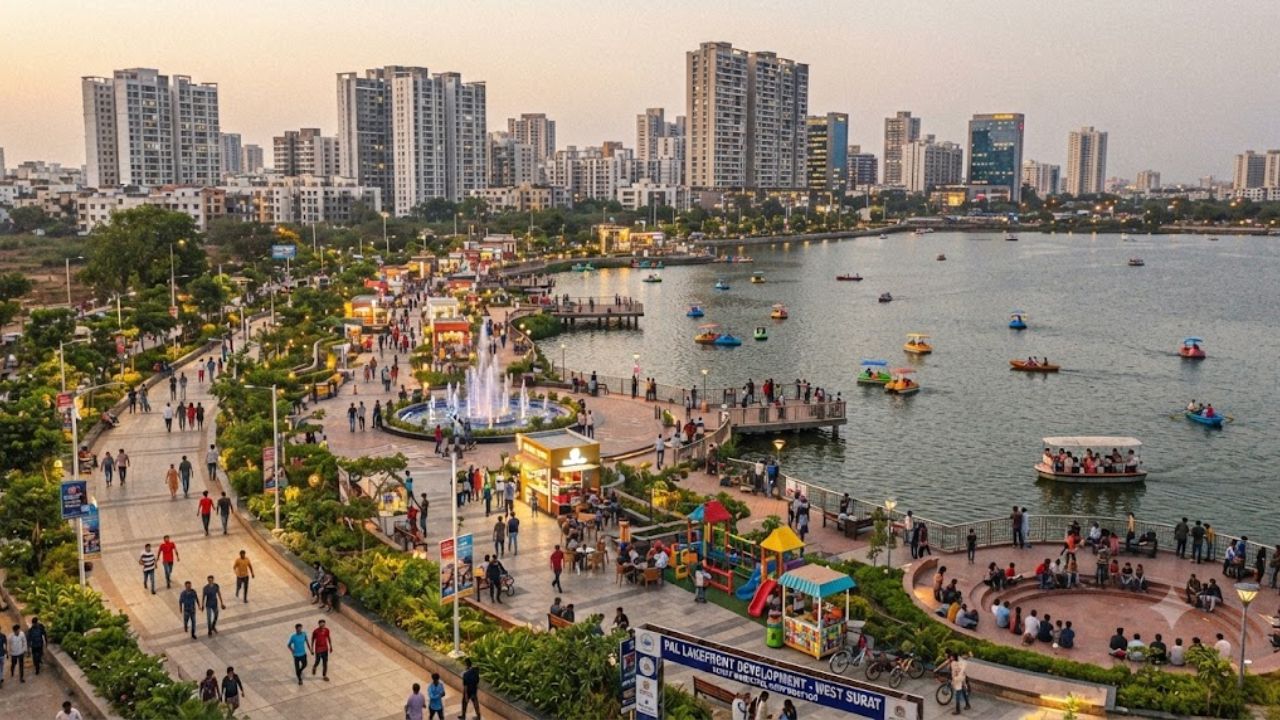
SURAT: A decade-old feasibility study has put the spotlight on Pal Lake as a potentially significant urban attraction for West Surat, envisioning the water body as more than a landscaped lake—with recreation, commercial activity, public amenities and a revenue-generating model built around it.
The study, Urban Lake Development Issues and Possibilities: A Case of Surat City, prepared by CEPT University in 2016, examined Pal Lake under its lake development assessment and feasibility component. It assessed the area’s rapid residential growth, connectivity, visitor potential, surrounding infrastructure and possible revenue streams.
Located near Pal village and covering government land and identified plots under Town Planning Schemes 14 and 15, the lake was assessed as benefiting from the rapid development of the Pal-Adajan belt. The study noted the presence of schools, hospitals, colleges, malls, restaurants and other amenities, besides improving road connectivity.
With residential projects targeting middle-income and upper-middle-income groups expanding around Pal and Hazira Road, the study projected a growing local visitor base.
The proposed development model went well beyond conventional lake beautification. It included boating, go-karting, zorbing, bowling, laser tag, music and sound shows, restaurants, food hubs, shops, parking facilities, advertising spaces and even a floating restaurant.
According to the study’s projections, average daily visitors were expected to increase from around 651 in 2016 to 2,211 by 2036.
Its financial model estimated total annual revenue at ₹3.52 crore (₹3,52,30,491.38) through entry tickets, recreational activities, food and restaurants, retail, advertising, parking and other facilities. However, the figure represents a 2016–17 projection and should not be treated as current revenue potential.
The study also examined a Public-Private Partnership model, under which a private partner could manage commercial facilities, maintenance, marketing and revenue-generating activities while the Surat Municipal Corporation developed the core lake infrastructure.
However, the study cautioned that commercial viability alone could not determine the lake’s future. Environmental compliance, operations, maintenance and risk-sharing would also need careful consideration.
Dr Pankaj Gandhi said lakes should be viewed as part of Surat’s wider urban infrastructure.
“Surat’s lakes are not merely water bodies; they can become a vital part of the city’s future urban infrastructure.”
He said future lake development should integrate recreation, flood and stormwater management, groundwater recharge and environmental conservation, rather than focus solely on beautification.