





MANTRA Develops Jute-Viscose Material for Space Acoustic application
SURAT : A traditional Indian fibre is now being explored for one of the most demanding frontiers of technology—space. Surat-based Man-Made Textiles Research Association (MANTRA) has developed an...

SURAT : A traditional Indian fibre is now being explored for one of the most demanding frontiers of technology—space. Surat-based Man-Made Textiles Research Association (MANTRA) has developed an indigenous jute-viscose spunlace nonwoven material with Waylla Enterprise for potential use in space-acoustic applications.
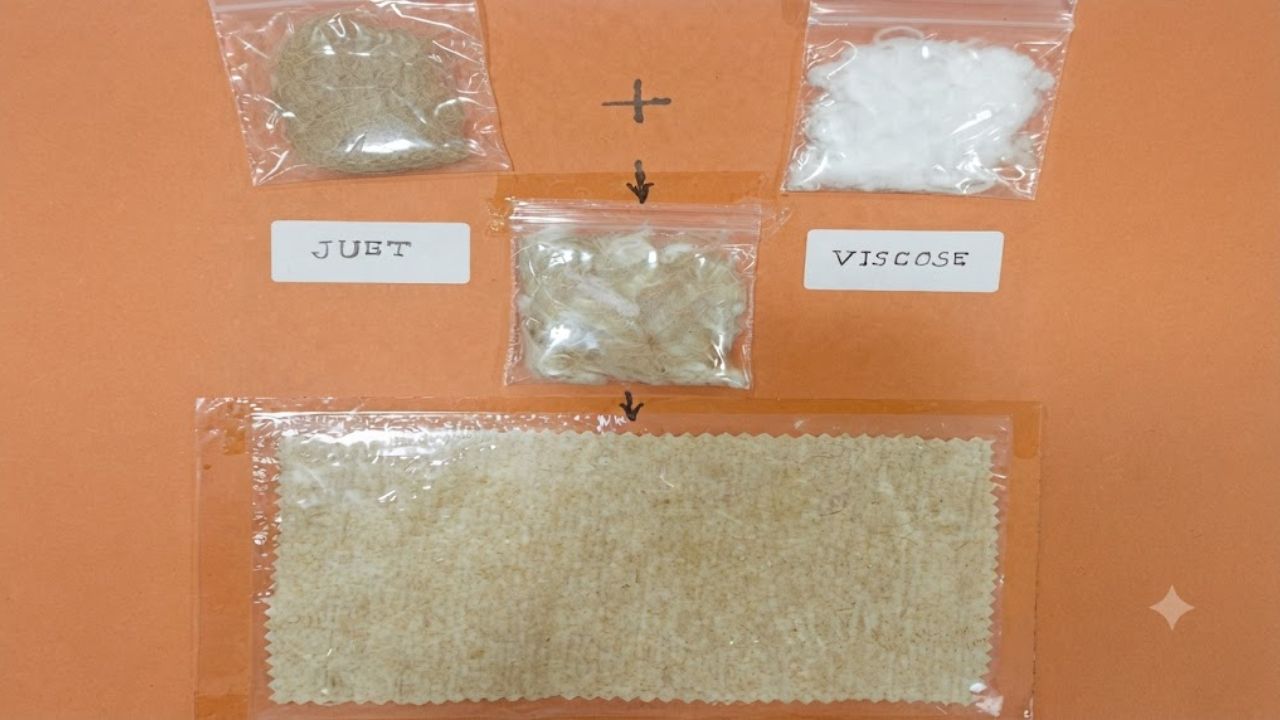
The development combines around 60% cottonized jute and 40% viscose, targeting a lightweight material of approximately 130 GSM. Waylla Enterprise approached MANTRA for pilot production and collaborative research into the material.
Samples developed by MANTRA were evaluated by Waylla Enterprise and found satisfactory in preliminary performance assessment. The two organisations now plan to continue research to optimise the material and explore its potential applications.
The initiative could open a new pathway for Indian natural fibres, taking jute beyond conventional textile applications and into advanced technical materials.
“From natural fibre to space material, this development represents a new technical textile journey from Surat to space,” said Dr. Pankaj Gandhi, director of MANTRA.
Jute’s natural fibrous and porous structure can contribute to acoustic energy dissipation, while viscose can support fibre-web formation, flexibility and processability. Through spunlace technology, researchers can study how fibre composition, thickness, density and porosity influence acoustic performance.
Acoustic control is important in space technology. Launch vehicles and spacecraft face intense acoustic noise and vibration during launch. Inside crewed spacecraft, equipment such as fans, pumps and life-support systems can also generate continuous noise.
The MANTRA-Waylla material could potentially be investigated for acoustic treatment in launch-vehicle payload fairings, spacecraft interiors, crew modules, satellites and future lunar or deep-space habitats.
However, MANTRA clarified that the material is currently an R&D/prototype development, not a space-qualified or flight-certified product. Further testing would be required for actual space applications.
Future studies may examine sound absorption, noise reduction, airflow resistivity, porosity, thermal stability, flammability, smoke and toxicity, vacuum stability, outgassing, particle generation, vibration resistance and acoustic performance.
The development also highlights a new direction for Surat’s technical textile ecosystem, connecting its established textile capabilities with advanced materials, acoustics, aerospace and space technology.
If successfully optimised and qualified, the material could also find applications in defence, railways, automobiles, marine systems, data centres, green buildings and industrial acoustics.
The MANTRA-Waylla collaboration has been communicated to the Ministry of Textiles, with further industry-research cooperation planned.