




IITGN Researchers Develops MOF Method to Clean Wastewater, Recover Rare Earths
GANDHINAGAR: What if wastewater could be cleaned while simultaneously recovering valuable metals hidden in discarded electronics? Researchers from IIT Gandhinagar, the University of Cambridge and the...

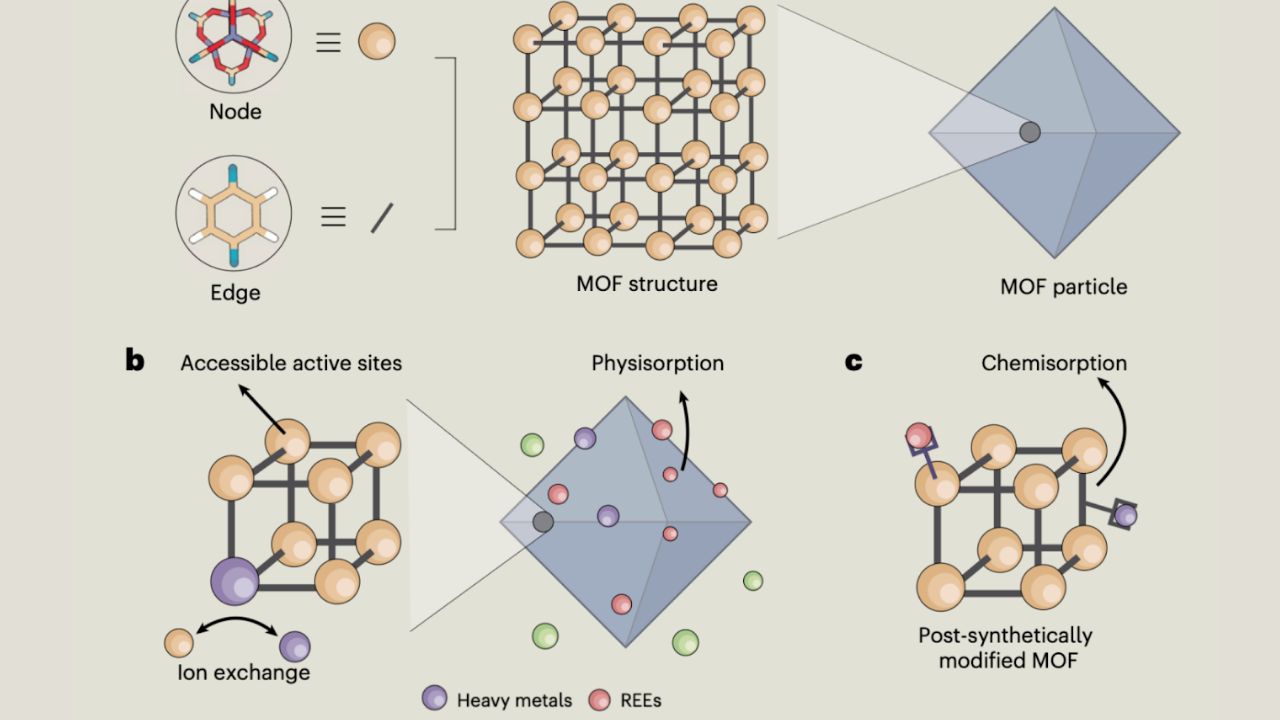
GANDHINAGAR: What if wastewater could be cleaned while simultaneously recovering valuable metals hidden in discarded electronics? Researchers from IIT Gandhinagar, the University of Cambridge and the University of Birmingham have developed a protocol that seeks to do precisely that, using highly porous materials known as metal-organic frameworks (MOFs).
Published in Nature Protocols, the study presents a methodology for designing, characterising and deploying MOFs to remove toxic metals from wastewater while recovering valuable rare-earth elements (REEs) from complex waste streams.
Discarded phones, earphones, camera components and other electronic products can contain REEs used in magnets, batteries, optics and other advanced technologies. At the same time, industrial wastewater can contain toxic metals such as lead, cadmium, nickel and manganese, creating a dual environmental and resource-recovery challenge.
The researchers describe MOFs as an “intelligent filter” because their highly porous structures can be chemically tailored to selectively capture specific metals. Some MOFs can have internal surface areas of up to 7,000 square metres per gram, giving them enormous capacity for adsorption.
Unlike conventional treatment methods such as precipitation, coagulation and flocculation, adsorption can work effectively at relatively low contaminant concentrations and potentially reduce secondary waste generation. The MOFs can also be regenerated and reused.
The protocol was tested under conditions designed to reflect real-world challenges, including alkaline and turbid wastewater with high levels of dissolved solids, artificial seawater and samples derived from e-waste.
Dhruv Menon, a BTech graduate of IITGN and currently a doctoral student at Cambridge, said the experiments demonstrated substantial metal-capture capacity.
“For me, the most interesting aspect was observing the MOF in our protocol demonstrate substantial adsorption capacities,” Menon said.
According to the researchers, one gram of the copper-based MOF captured 490 mg of lead, 264 mg of cadmium and 226 mg of manganese. It also captured significant quantities of rare-earth elements, including neodymium, yttrium, dysprosium, terbium and europium.
Prof Superb Misra, Jibaben Patel Chair Professor at IITGN, said the research highlights the need for technologies capable of addressing multiple environmental challenges simultaneously.
“There is a need for approaches that can solve multiple environmental challenges simultaneously,” Misra said, while stressing that laboratory-scale batch experiments cannot fully predict performance in complex wastewater.
He said further work is needed on large-scale fabrication, cost analysis, life-cycle assessment and regulatory testing before wider deployment.
The research also aligns with India’s efforts to develop domestic capacity for recycling critical minerals from secondary sources such as e-waste and battery waste, while contributing to broader goals around clean water, sustainable industry and responsible resource use.