




Expert Warns Gujarat’s RCC Road Plan May Threaten Water, Climate
SURAT : While the Gujarat government’s decision to replace asphalt roads with cement concrete (RCC) roads promises stronger infrastructure and fewer potholes, urban planning experts have warned...

SURAT : While the Gujarat government’s decision to replace asphalt roads with cement concrete (RCC) roads promises stronger infrastructure and fewer potholes, urban planning experts have warned that the policy could create serious environmental challenges if implemented without sustainable safeguards. Civil engineer and urban planner Dr. Pankaj Gandhi has urged the state to balance road development with groundwater conservation, climate resilience and environmental protection.
The Gujarat Cabinet recently approved the construction of RCC roads in all municipal corporations and municipalities to improve durability and reduce maintenance costs. However, Dr. Gandhi believes that building concrete roads across every urban area without complementary environmental measures could have unintended long-term consequences.
“Development should not be measured only by stronger roads,” Dr. Gandhi said. “The infrastructure of the future must conserve rainwater, replenish groundwater, reduce carbon emissions and protect cities from rising temperatures.”
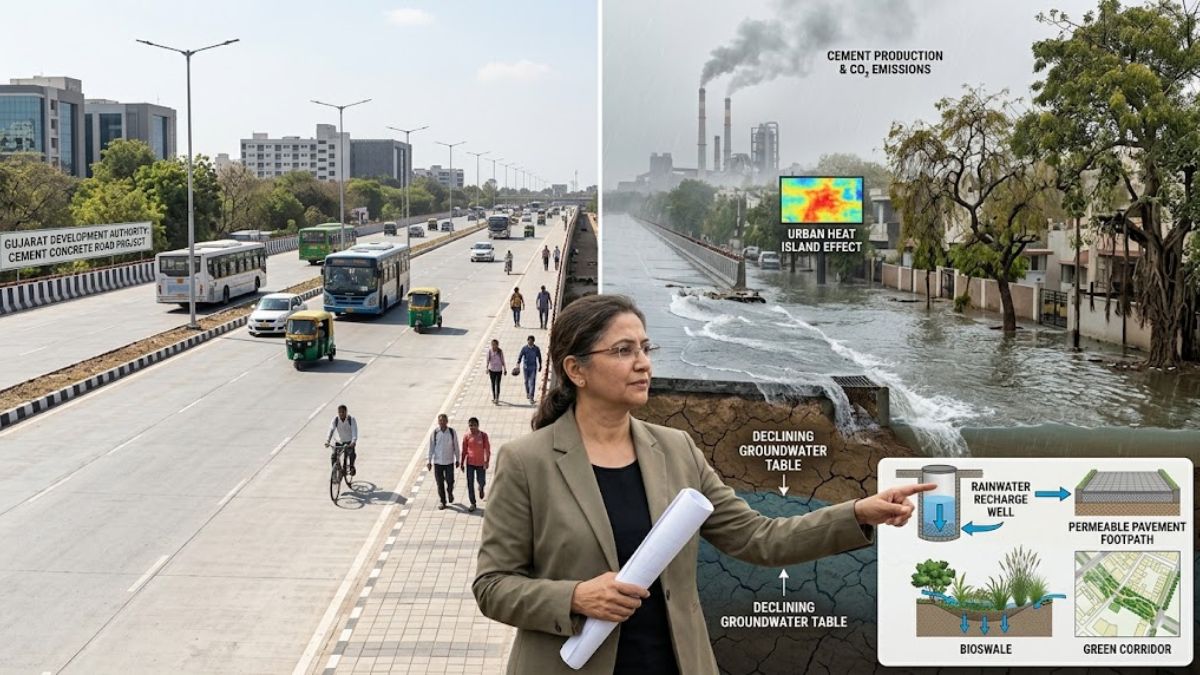
According to him, RCC roads are completely impermeable, preventing rainwater from naturally seeping into the ground. Instead, rainwater flows rapidly into stormwater drains, reducing groundwater recharge and increasing pressure on drainage systems during heavy rainfall.
He warned that many Gujarat cities, including Surat, are already witnessing declining groundwater levels. “If every road becomes a concrete surface, water scarcity may worsen in the coming years,” he said.
Dr. Gandhi also highlighted the Urban Heat Island Effect, explaining that concrete absorbs and retains heat for longer periods, increasing surface temperatures and making cities hotter. This could raise electricity consumption as more people depend on air conditioning during prolonged heatwaves.
He further noted that cement manufacturing contributes nearly 7-8% of global carbon dioxide emissions, making large-scale concrete construction a climate concern. Increased cement demand could also lead to higher emissions of nitrogen oxides, sulphur dioxide and particulate matter.
Rather than opposing RCC roads, Dr. Gandhi recommended using them selectively in heavy-traffic corridors, industrial estates, ports and BRTS routes, where their strength offers clear advantages.
He urged the government to adopt globally accepted urban planning practices such as Water Sensitive Urban Design (WSUD), Sponge City concepts, permeable pavements, bioswales, rain gardens and recharge trenches alongside RCC road construction.
“Every new concrete road should include rainwater recharge wells, permeable footpaths, green corridors and tree plantations,” he said. “The government should also conduct Life Cycle Assessments and Environmental Impact Assessments before implementing the policy statewide.”
Dr. Gandhi stressed that Gujarat’s infrastructure should not only be durable but also environmentally responsible. “True development is achieved when concrete and nature coexist. Strong roads alone cannot define progress. Sustainable cities are built by protecting water, reducing heat and preparing for climate change,” he added.