




IITGN Study Finds ‘Disorder’ Could Make Green Hydrogen Cheaper
GANDHINAGAR : What if the key to cheaper green hydrogen lies not in perfect structures, but in their imperfections? Researchers at IIT Gandhinagar (IITGN) have found that a disordered,...

GANDHINAGAR : What if the key to cheaper green hydrogen lies not in perfect structures, but in their imperfections? Researchers at IIT Gandhinagar (IITGN) have found that a disordered, one-atom-thick carbon material could offer promising sites for producing hydrogen without relying on costly metals such as platinum and iridium.
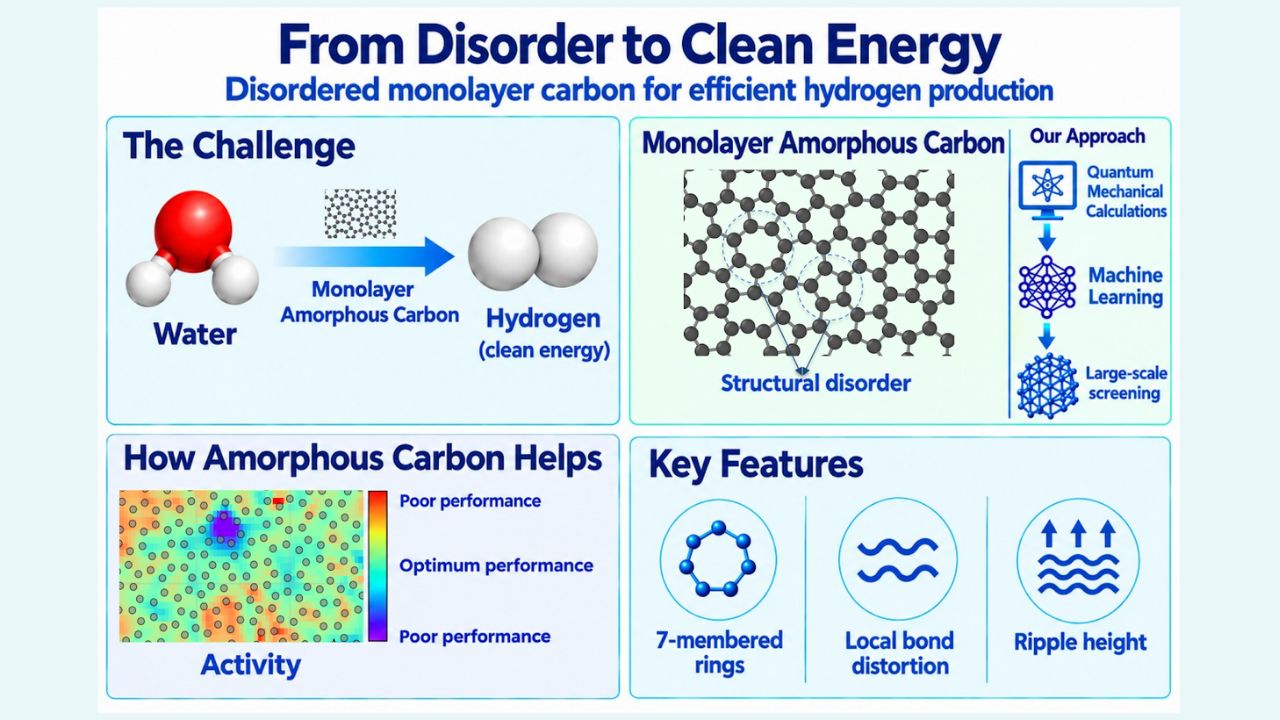
The computational study, published in npj 2D Materials and Applications, examined Monolayer Amorphous Carbon (MAC), a two-dimensional carbon material with no long-range atomic order.
Unlike graphene’s regular structure, MAC contains irregular five-, six- and seven-membered carbon rings. The researchers found that this disorder creates different atomic environments that could improve hydrogen adsorption.
“It is crucial to find the right balance,” said Sreehari M S, a third-year PhD scholar at IITGN. “If hydrogen sticks too tightly, it becomes difficult to release hydrogen molecules. If it barely sticks, the reaction cannot proceed efficiently.”
The study used Density Functional Theory (DFT) and a machine-learning model called MACE to examine hydrogen adsorption across 1,183 sites.
Ashutosh Krishna Amaram, the study’s co-author, said the predicted adsorption values ranged from −0.91 to +1.70 electronvolts. About 15% of the sites showed values below +0.25 eV, indicating potentially favourable catalytic behaviour.
The team found that bond distortion, irregular bond angles and surface ripples could create more favourable sites. This challenges the usual view that structural defects are always undesirable.
“This research provides a possible design blueprint for next-generation catalysts,” said Dr Raghavan Ranganathan, Associate Professor at IITGN. He cautioned that experimental testing is still needed.
The researchers said machine learning could help screen promising catalyst structures before laboratory testing. The work could support future efforts to develop affordable, metal-free catalysts for green hydrogen production.