




Surat Textile Industry Gets Dubai Lifeline Amid Global Trade Crisis
SURAT : As Surat’s textile industry battles rising crude oil and raw material costs, a potential new global business route has opened thousands of kilometres away—with Dubai offering Surat’s mill...

SURAT : As Surat’s textile industry battles rising crude oil and raw material costs, a potential new global business route has opened thousands of kilometres away—with Dubai offering Surat’s mill owners a chance to take their businesses closer to international markets.
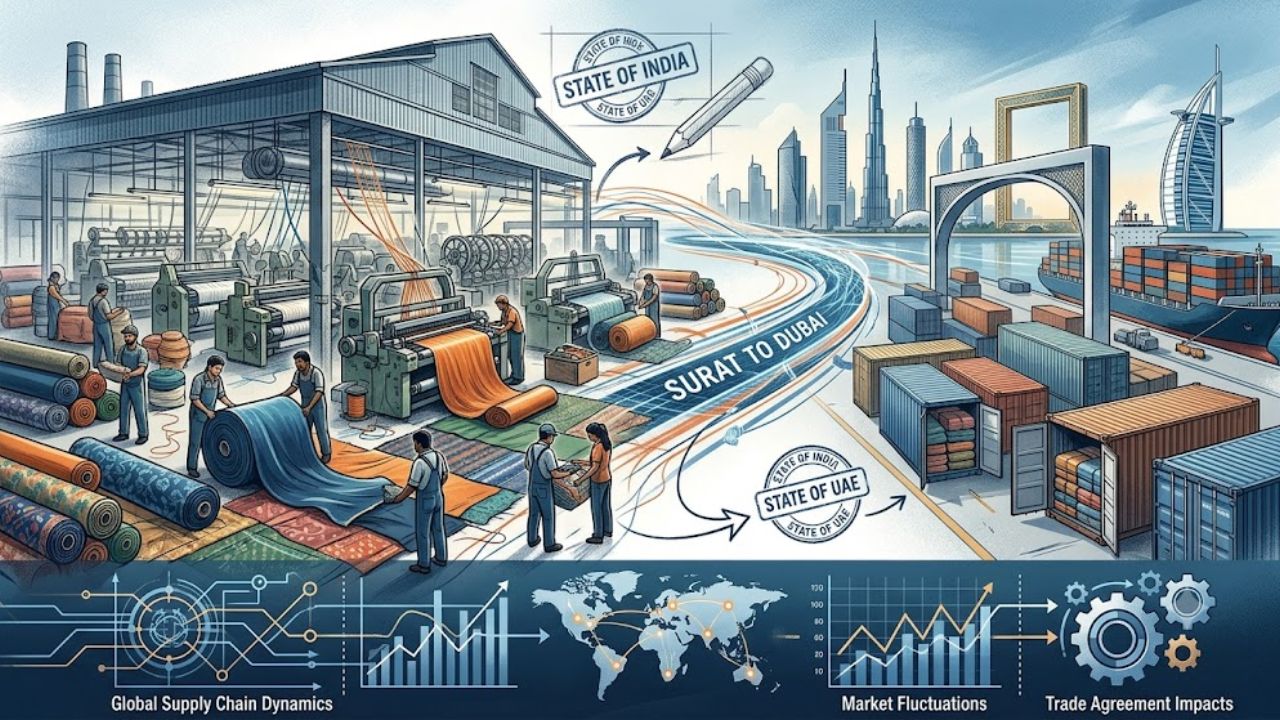
A high-level Dubai government delegation visited Surat and held discussions with more than 450 leading mill owners, pitching the emirate as a potential trading and business hub for the city’s textile sector at a time when global uncertainty is putting pressure on margins.
The delegation presented opportunities to establish units, offices and trading operations in Dubai, promising affordable land, ready-to-use office space, infrastructure and single-window government approvals. The proposed locations are also positioned close to the airport, with the delegation highlighting convenience for international business.
The biggest attraction for Surat’s exporters is the potential duty advantage.
According to industry representatives, textiles exported directly from India to markets such as the US can face duties of around 18%, while goods routed through Dubai under applicable trade arrangements may gain access to preferential or zero-duty treatment in certain markets.
South Gujarat Textile Processors Association president Jitu Vakharia said the opportunity could give Surat’s textile sector a fresh competitive edge.
“Many Indians are getting huge benefits by trading in Dubai. Indian companies like Ashok Leyland have also achieved success by setting up plants there,” Vakharia said.
Mills may stay in Surat, trading could move to Dubai
The proposal does not necessarily mean Surat’s textile manufacturing base will shift overseas.
Vakharia said processing mills are unlikely to relocate because of pollution-control requirements involving water and air emissions. Instead, textile manufacturers and traders could establish Dubai-based offices and trading operations to connect directly with international buyers.
For smaller traders who currently lack access to overseas markets, such a platform could open a new route to exports.
Can Dubai solve Surat’s overproduction problem?
Surat’s industry also faces the challenge of excess production. Vakharia estimates that around 15% to 20% of current production is surplus to local-market requirements.
“If we divert this excess production to the global market through Dubai and find new international countries other than India, then this scheme will prove to be a lifeline and a blessing for the entire textile industry,” he said.
The delegation also highlighted Dubai’s relatively simplified tax and business environment. Vakharia said the proposal includes a 5% turnover-based tax, while businesses can avoid some of the complexities associated with India’s monthly GST processes.
The association has begun studying the Dubai government’s detailed proposal and is expected to formulate its next strategy after examining the commercial and regulatory implications.
For Surat’s textile industry, struggling with rising input costs and excess inventory, Dubai could emerge not as a replacement for Surat’s manufacturing ecosystem, but as a new gateway to global buyers.