







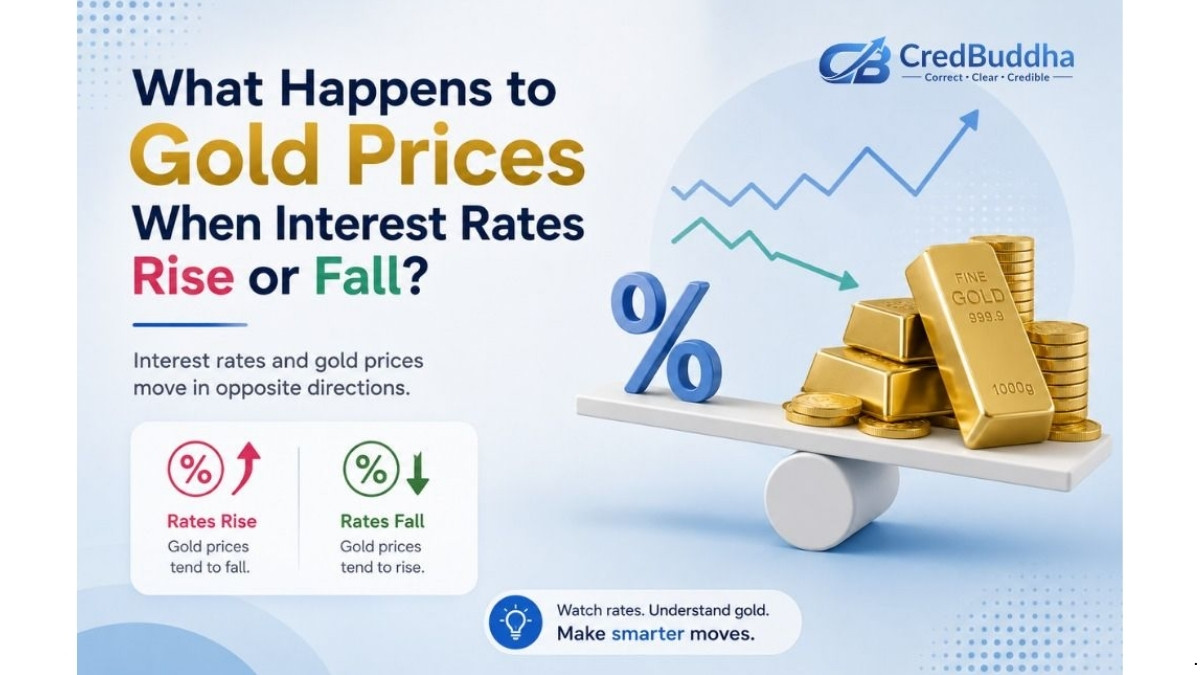
What Happens to Gold Prices When Interest Rates Rise or Fall?
What Happens to Gold Prices When Interest Rates Rise or Fall?

New Delhi [India], August 29: Global interest rates, US yields, the dollar and RBI policies all have an impact on gold prices in India. CredBuddha explains how interest rates affect gold, helping investors and gold loan borrowers understand market movements beyond the simple “rates up, gold down” view and make informed financial decisions.
Why Do Interest Rates Affect Gold Prices?
Gold prices and interest rates often have an inverse tendency because gold does not pay interest, while deposits and bonds can generate returns. When rates and real yields rise, gold carries a higher opportunity cost. When yields fall, gold can become relatively more attractive. It is a tendency, not a guaranteed rule.
What Happens to Gold When Rates Rise or Fall?
Higher interest rates can push bond yields and borrowing costs upward, increasing the attractiveness of interest-bearing investments. The opportunity cost of holding gold and the rewards on various fixed-income assets can both be decreased by decreasing rates. However, if inflation, geopolitical risks, currency weakness or central bank purchases offer support, gold can still rise during higher rates. According to the World Gold Council, real rates, the US currency, GDP prospects, central bank demand and Asian investor demand all influence gold’s reaction.
Why Do Real Rates Matter More?
Real interest rates reflect returns after inflation. A simple measure is nominal interest rate minus inflation equals real interest rate. Higher real yields can increase the opportunity cost of holding gold, while lower real yields can make gold relatively more attractive.
Recent market behaviour shows that high real rates do not always prevent gold from performing strongly. Central-bank purchases and Asian investor demand can remain important drivers alongside monetary policy and the dollar.
Why Does the Fed Matter to Indian Gold Prices?
Fed policy can influence the gold rate in India through US interest rates, Treasury yields, the US dollar, international gold prices and USD/INR. Since India imports gold, currency movements can affect domestic prices.
Gold is internationally priced in US dollars. A stronger dollar can pressure gold, while a weaker dollar can support demand. The World Gold Council reported in June 2026 that rupee depreciation lifted domestic gold prices relative to international prices.
What Happens to Gold Prices in India?
The relationship between RBI interest rates and gold prices is not one-to-one. India’s gold prices also reflect global rates, USD/INR movements, import costs and domestic demand. With the RBI repo rate at 5.25% in August 2026, changes in rates can influence borrowing costs and investment choices.
Why Can Gold Rise When Rates Are High?
Gold can remain strong even when interest rates are high. Central-bank buying, Asian investor demand, geopolitical uncertainty, inflation and expectations of future rate cuts can offset rate-related pressure. Central banks purchased 289 tonnes in Q2 2026, according to the World Gold Council, showing that rates are only one factor.
Why Can Gold Fall When Rates Are Falling?
Gold can decline after rate cuts when those cuts are already priced in, real yields remain firm, the dollar strengthens or investors take profits. Falling rates may also reflect easing inflation, reducing one source of gold demand. A gold price forecast based only on rate cuts can therefore be misleading.
What Should Gold Investors Watch?
Gold investment decisions are better informed when interest rates are assessed alongside RBI and Federal Reserve policy, US Treasury yields, real rates, the dollar, USD/INR, inflation, economic growth, central-bank purchases, ETF flows and geopolitical developments.
These factors also matter when assessing gold price today or a longer-term gold price prediction.
What Does This Mean for Gold Loan Borrowers?
For gold loan borrowers, gold prices matter because pledged gold acts as collateral. Changes in its value can affect borrowing capacity within applicable loan-to-value limits. However, a higher gold price does not automatically mean a larger loan.
Eligibility can depend on gold purity, net weight, lender valuation, applicable LTV rules, lender policies and borrower circumstances. Comparing gold loan interest rates, fees and repayment terms remains important.
Gold Loan or Personal Loan?
A gold loan is secured against eligible gold, while a personal loan is generally unsecured. A gold loan can provide liquidity against an existing asset, but the gold remains pledged until obligations are met. Personal loan eligibility depends on income, credit profile and lender assessment.
CredBuddha is a loan comparison platform that helps borrowers compare financing options from lending partners, including RBI-regulated banks and NBFCs.
Should Interest Rates Guide Gold Decisions?
Interest rates are one factor, not a standalone signal for buying gold or taking a gold loan. Rate cuts can support gold when real yields decline and currencies weaken, while rising rates can create pressure without guaranteeing a fall.
For borrowers, a higher gold valuation should not by itself justify new debt. Borrowing decisions should consider interest costs, fees and repayment capacity, while gold investment decisions should consider wider market conditions.
Gold Prices and Interest Rates: Key Takeaways
Gold prices and interest rates often move differently, but rates alone do not determine gold price in India. Real yields, the US dollar, inflation, global risks and investor demand also matter. For borrowers, changing gold values can affect collateral assessments and gold loan decisions. CredBuddha helps users compare loan options transparently, so borrowers can assess costs, eligibility and repayment terms before choosing financing.
For more information, visit our website – CredBuddha. You can also explore our Gold rate page and learn how you can use your gold to meet your financial needs.