





Surat : MANTRA Gets Telangana’s Trust for Saree Quality Testing
SURAT : Surat’s reputation as a centre of textile technology and expertise has received a major boost after the Telangana government entrusted the city-based Man-Made Textiles Research Association...

SURAT : Surat’s reputation as a centre of textile technology and expertise has received a major boost after the Telangana government entrusted the city-based Man-Made Textiles Research Association (MANTRA) with quality testing of fabric being used for its flagship Indira Mahila Shakti Saree programme.
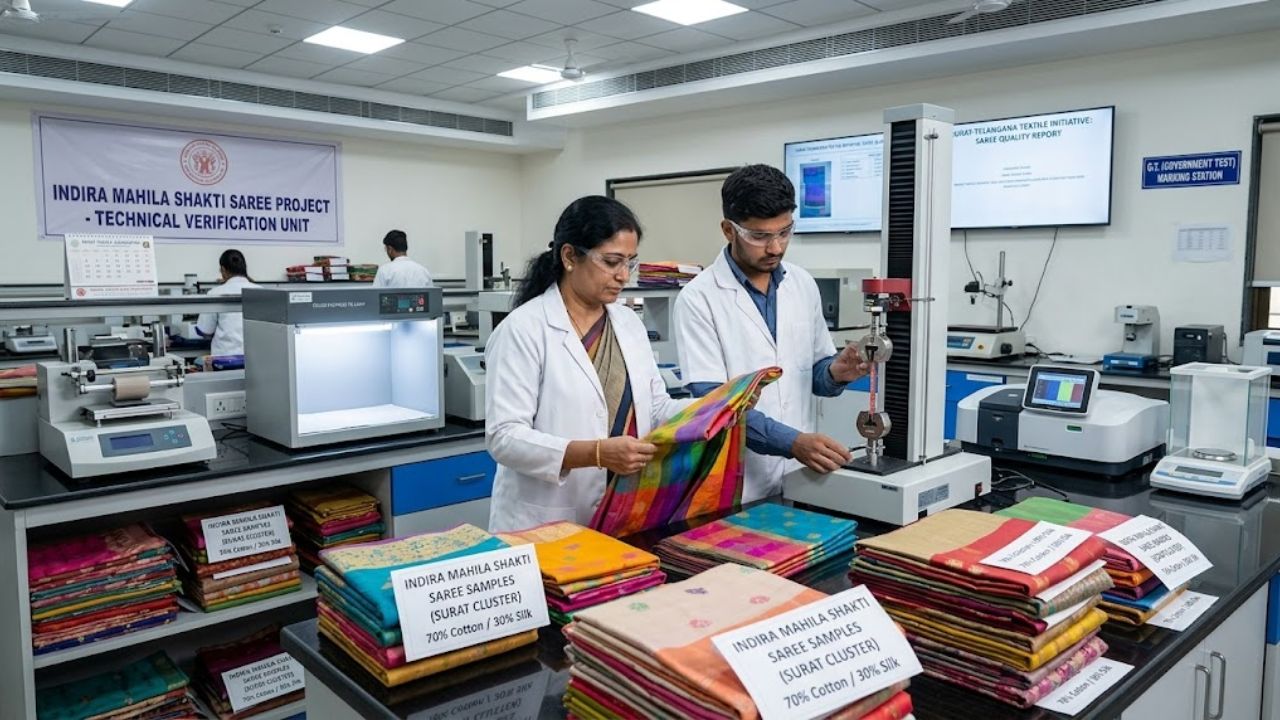
The Telangana State Handloom Weavers Co-operative Society Limited (TGSCO) has sent 1,304 grey-cloth samples from its Sirisilla Procurement Centre to MANTRA for detailed scientific testing and reporting.
The samples will be assessed on six key parameters, including warp and weft body count, EPI and PPI, zari-border denier, colour fastness to dry and wet abrasion, twists per metre in body warp and slubs per metre. The large volume of samples highlights the importance being placed on scientific and impartial quality checks for the sarees being produced on a large scale.
The Indira Mahila Shakti programme is aimed at strengthening the economic position of women associated with self-help groups. According to the Telangana government, more than 63 lakh women are part of the state’s self-help-group network.
The Indira Mahila Shakti Saree Distribution Programme was launched on November 19, 2025, with a stated objective of providing one crore sarees to one crore women. Sirisilla, a major textile centre, has emerged as an important production hub under the initiative.
The decision to use MANTRA’s facilities also highlights Surat’s growing role beyond manufacturing and trade.
MANTRA has been associated with textile research, testing and technical services for several decades. The institute provides specialised testing across mechanical, chemical and analytical parameters and has laboratory accreditation through the National Accreditation Board for Testing and Calibration Laboratories.
The testing assignment is significant because Sirisilla’s traditional weaving ecosystem is increasingly incorporating man-made fibre yarns and modern textile technology.
The collaboration therefore creates a link between Surat’s man-made textile expertise and Telangana’s traditional weaving sector.
The testing of 1,304 samples at MANTRA is also being viewed as a recognition of Surat’s emerging role as a national textile knowledge and quality-testing hub.
The development could open further opportunities for technical collaboration between textile clusters across India, strengthening quality standards while supporting large-scale programmes linked to employment, women’s empowerment and the growth of India’s textile sector.