







US Strikes Iran After Hormuz Drone Attack
The United States launched fresh military strikes against Iranian targets on Friday, just hours after US President Donald Trump accused Tehran of violating a recently agreed ceasefire following a...

The United States launched fresh military strikes against Iranian targets on Friday, just hours after US President Donald Trump accused Tehran of violating a recently agreed ceasefire following a drone attack on a commercial cargo vessel in the Strait of Hormuz.
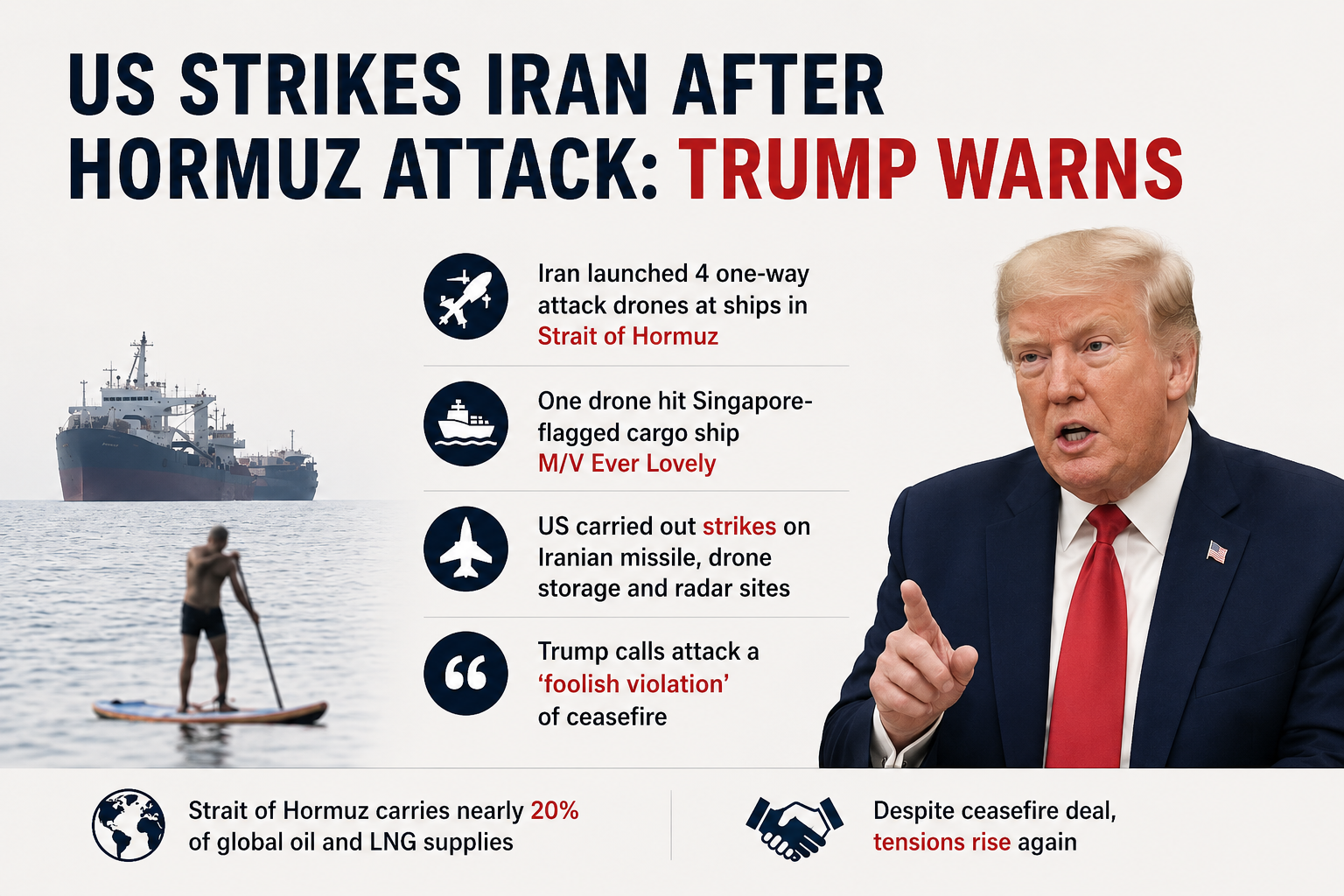
According to the US military, Iranian forces launched four one-way attack drones targeting commercial ships moving through the strategic waterway. One drone reportedly struck the Singapore-flagged cargo vessel M/V Ever Lovely, damaging its upper deck. No injuries were reported, and the ship continued its voyage along the coast of Oman.
CENTCOM confirms retaliatory operation
The US Central Command (CENTCOM) confirmed that American forces responded by carrying out precision strikes on Iranian military infrastructure, including missile storage facilities, drone depots, and coastal radar installations.
In an official statement, CENTCOM said the strikes were conducted as a direct response to the attack on the commercial vessel, describing Iran’s actions as an unacceptable escalation that endangered international shipping.
The military also accused Tehran of breaching the ceasefire by targeting civilian maritime traffic, adding that such actions threaten freedom of navigation through one of the world’s busiest trade routes.
Trump calls Iranian attack a “foolish violation”
Speaking to reporters at the White House, President Donald Trump warned that Iran would face consequences for the latest attack.
When asked whether Washington would retaliate, Trump replied, “You will find out.”
He claimed Iran launched four attack drones toward commercial ships, saying US forces intercepted three while one managed to hit a cargo vessel, causing limited damage.
Earlier, Trump criticized Tehran on Truth Social, calling the incident a “foolish violation” of the ceasefire agreement.
“The Islamic Republic of Iran launched at least four one-way attack drones at ships transiting the Strait of Hormuz,” Trump wrote, adding that although one drone struck a cargo ship, the vessel was able to continue its journey after sustaining damage.
Strait of Hormuz remains under global focus
The latest confrontation has renewed concerns over security in the Strait of Hormuz, a critical maritime chokepoint through which nearly one-fifth of the world’s oil and liquefied natural gas supplies pass.
Any disruption in the region has the potential to affect global energy markets and international shipping.
Fragile ceasefire faces fresh uncertainty
The escalation comes despite a recently signed 14-point memorandum of understanding between the United States and Iran intended to reduce military tensions and safeguard commercial shipping during ongoing diplomatic negotiations.
As part of the agreement, Iran had pledged to make its best efforts to ensure the safe passage of commercial vessels through the Strait of Hormuz while both sides pursued broader peace talks.
The agreement also established direct communication channels aimed at preventing accidental military confrontations.
However, Iranian officials have continued to insist that navigation through the Strait remains under Tehran’s authority. The Islamic Revolutionary Guard Corps (IRGC) has also maintained that vessels transiting the waterway should follow routes approved by Iranian authorities.
The latest drone strike and the subsequent US military response have now cast fresh doubt over the durability of the ceasefire and the future of ongoing diplomatic efforts between Washington and Tehran.