






Featured
CM Rekha Gupta-PNn
Delhi CM Rekha Gupta Launches Project Manobal, Marking a Historic New Era in Government School Education and Mental Health Education
Wellington
Wellington College International Pune Among India’s First K–12 Schools to Collaborate with OpenAI, Bringing ChatGPT Edu into Classrooms
DesiDhaakad
DesiDhaakad™ Unveils ‘Chronicles of Social Impact’ at NSE, Honoring 11 Women Changemakers
July 25, 2026
The Blunt Times The Blunt Times
  • National
  • City Events
  • Business Vibes
  • Education
  • Entertainment
  • Regional
    • Bharuch
    • Dang
    • Navsari
    • Surat
    • Valsad
    • Hindi
    • Gujarati
  • Health
  • Crime corner
  • Sports
  • Spotlight
Search the Site
Popular Searches:
Chatgpt Nasa Halloween
Recent Posts
Morari Bapu
Morari Bapu Begins His 981st Ram Katha in Kenya’s Tea Country
July 24, 2026
A Life Shaped by Questions: The Spiritual Journey of Acharya Nilay
July 24, 2026
Emerald Corporates
Emerald Corporates and Blue Synergy Investments Form Strategic Partnership to Jointly Develop USD 175M Sustainable Mega-Project in the Maldives
July 24, 2026
The Blunt Times The Blunt Times
  • National
  • City Events
  • Business Vibes
  • Education
  • Entertainment
  • Regional
    • Bharuch
    • Dang
    • Navsari
    • Surat
    • Valsad
    • Hindi
    • Gujarati
  • Health
  • Crime corner
  • Sports
  • Spotlight
Follow us
Ulipsu -TBT
Home/Business/A Million Projects Later, Ulipsu Emerges as a Strong Model for Industry-Ready Skill Education
Business

A Million Projects Later, Ulipsu Emerges as a Strong Model for Industry-Ready Skill Education

Bengaluru (Karnataka) [India], May 22: From a Class 6 student writing Python code in Chhattisgarh to a Grade 9 student building a predictive AI model in Tamil Nadu, Ulipsu has done something Indian...

TBT Online Desk
May 22, 2026 8 Min Read
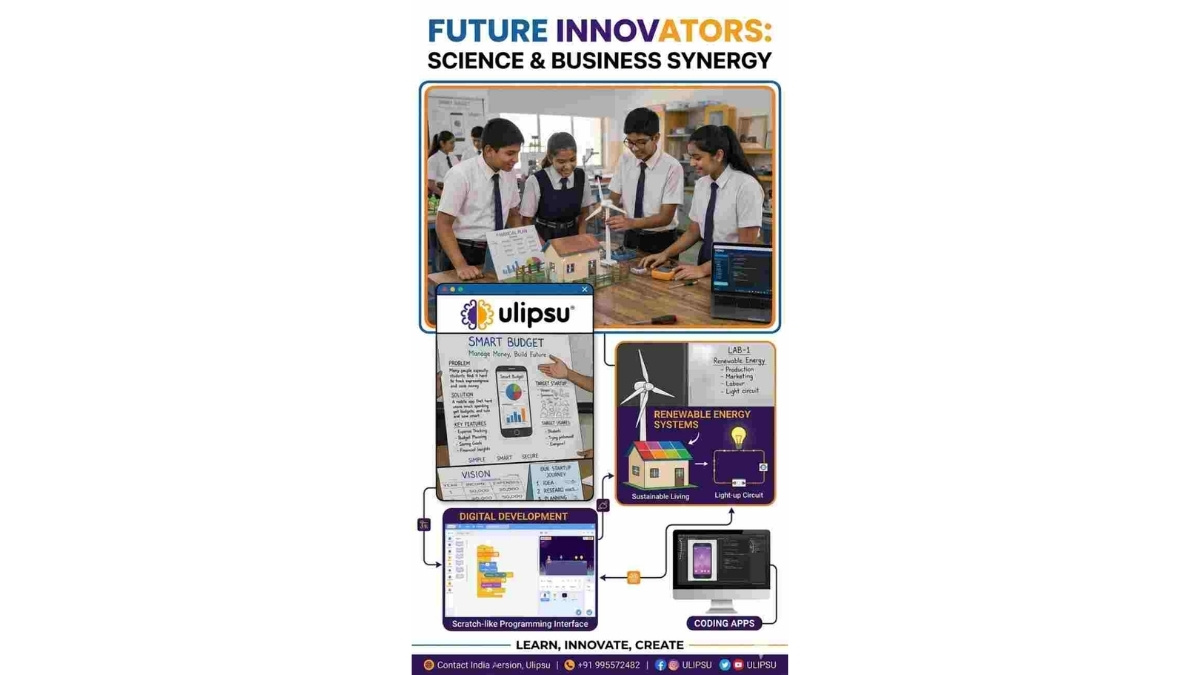
Bengaluru (Karnataka) [India], May 22: From a Class 6 student writing Python code in Chhattisgarh to a Grade 9 student building a predictive AI model in Tamil Nadu, Ulipsu has done something Indian edtech rarely achieves: it made skill education real, measurable, and embedded inside the school day — at scale. In a school in Chhattisgarh, a Class 6 student is not copying notes from a blackboard. She is writing Python code — her first programme — built from scratch, submitted through a platform, and assessed as a completed project. In Khammam, Telangana, a Class 7 student is presenting a design thinking solution to a problem she identified on the street where she lives. In Moga, Punjab, a Class 9 student is mapping cost structures, running financial simulations, and presenting outcomes to her class — not as a theoretical exercise, but as a live business model. And in Dammam, Saudi Arabia, students are following the same structured Ulipsu curriculum,  as a scheduled part of their school day. These are not pilot experiments. They are not demonstrations arranged for a visiting delegation. These are what happen on a regular school day throughout the year, in hundreds of schools, in twelve states, across three countries. Students enrolled in Ulipsu have completed a million hands-on projects. That number represents 358,072 students across 350-plus schools in 148 districts in 12 states. Behind every one of those projects is a child who did not simply sit through a lesson — a child who built something, documented it, and had it assessed.

The Problem Nobody Was Solving

India has 247 million school-going children (UDISE+ 2024–25). The National Education Policy 2020 explicitly mandates skill education across the curriculum. On paper, the direction has never been clearer. In practice, almost nothing happened. Most schools that tried to act on NEP 2020 ended up with something that looked like action but wasn’t. A single workshop. A one-term activity run by an enthusiastic teacher who left mid-year. No measurement, progression, or evidence of real change. The gap between policy intent and classroom reality remained as wide as ever. This was the gap that Sumanth Prabhu MG and Nikhil Bhaskar identified. In 2017, they founded Kidvento Education & Research Pvt. Ltd. in Mysuru with a straightforward thesis: if skill education is going to work inside Indian schools, it cannot exist as an extracurricular activity. It has to live inside the timetable, be assessed like a real subject, and be built with infrastructure sturdy enough to survive teacher turnover, academic pressure, and institutional inertia. Eight years on, the programme runs across 350-plus schools in 12 states and 3 countries.

How Ulipsu Was Built to Stay

Understanding why Ulipsu’s numbers are what they are requires understanding how the programme is actually structured. Ulipsu is not an after-school elective or a weekend enrichment activity. It is a scheduled subject embedded inside the school timetable, running from Class 1 through Class 10, with structured, grade-appropriate progression at every level. Every skill module follows the same three-stage structure. Students begin with interactive, gamified lessons that deliver real-time feedback. They move through game-based evaluations that test genuine understanding rather than rote recall. The third stage is the project — a hands-on challenge in which the student builds something, submits it through the platform, and has it reviewed by their teacher. At each stage, the platform records evidence. Nothing passes without documentation. The domain selection is not arbitrary. Students choose from 20 skill domains guided by a scientifically validated interest assessment based on the Holland Code framework — a globally recognised model for matching individuals with vocational and learning preferences. A child does not simply choose Coding because it sounds modern. The assessment surfaces genuine aptitude, which increases sustained engagement across terms and grade levels. For school leadership, Ulipsu provides live dashboards showing skill progression at the student, grade, and school level. The programme is aligned with NEP 2020 and NCF 2023, and carries international accreditation from ISTE and STEM.org. “We renewed because we could see the difference in how students approach problems — not just in Ulipsu classes but across subjects. The structured project format teaches them to think before they act, and that changes how they show up in every classroom.” — Principal Aswinni Priyaa J., Bharathiyar Hi-Tech School, Salem

What a Million Projects Actually Look Like

What does it look like  when a Grade 3 student, eight years old, builds a Scratch model to predict the outcome of a coin toss — not by luck, but by collecting historical examples, identifying patterns, and training the model on that data. That is the same underlying logic as any prediction system in industry. The difference is age and scale. The thinking is identical. Or consider a Grade 9 student in Mumbai, Maharashtra who built a predictive model that forecasts ice cream sales based on atmospheric temperature. She collected location-specific data, analysed the relationship between weather and consumer behaviour, and drew conclusions from the pattern. In Grade 8, a student in Varanasi, Uttar Pradesh trained a supervised machine learning model to classify vehicles by colour, wheel count, and size — and understands what that phrase means in practice because she built the thing herself. These are not template exercises. Students work from a brief, hit errors, and resolve them before submission. The code either runs or it doesn’t. Across the Coding domain, more than 20,000 students built functional software — games with collision detection, Python functions that convert numbers to days of the week, task manager webpages built with HTML, CSS, and JavaScript. One student in Grade 10 created a fully styled personal webpage, experimenting with layout and typography as a genuine design problem. Another, in a lower grade, wrote a Scratch game where a bow and arrow shoots at floating balloons — simple in premise, but requiring the student to programme movement, collision, and interaction logic from scratch. “My son came home one evening and explained to me what ‘collision detection’ means and why his game wasn’t working without it. I had no idea what he was talking about, but I could see he had figured something out. That is what I want from school.” — Parent of a Grade 6 student, Coimbatore, Tamil Nadu In Design Thinking, close to 13,000 students identified problems from within their own communities and designed solutions for them. One student constructed and stress-tested two types of bridges — a beam bridge and a truss bridge — to understand how structure handles load differently under pressure. Another, in Grade 9, conceptualised a wearable device addressing urban environmental issues, thinking through user experience, functionality, and real-world viability before presenting the concept to classmates as a public, assessed deliverable. The final presentation is not optional. That is the point. Perhaps the most striking domain is Finance and Entrepreneurship. Beyond the thousands who completed full business simulations, tens of thousands more submitted startup and business concept designs — each requiring a student to define a customer, articulate a value proposition, and present the idea with genuine intent. One student in Grade 9 applied SWOT analysis to a real company, then mapped it onto a full Business Model Canvas, identifying value propositions, customer segments, and revenue streams as distinct analytical tasks. Another, in Grade 8, tracked family expenses and learned to distinguish between shared household costs and individual spending — a skill most adults apply imperfectly. “When I saw her expense tracking sheet, I was surprised. She had categorised everything correctly — groceries, transport, subscriptions — and then asked me why we spent more on one category than another. I did not have a good answer. The project had made her sharper about money than I expected at her age.” — Parent of a Grade 8 student, Bengaluru Across Life Skills, more than 216,000 structured sessions were completed — a figure that represents something genuinely unusual in any school programme: measurability applied to the unmeasurable. One student designed a personalised stress-relief strategy, mapping daily triggers and building coping techniques specific to her own patterns. Another created an emotion collage as a form of structured self-inquiry. The output is modest in scale. The habit of reflection it builds is not. “Life Skills is the subject I was most sceptical about when we signed the partnership. I expected vague worksheets. What I got were students who could articulate their emotions in structured terms and reference a strategy they had designed themselves. I did not expect the rigour.” — Principal, Saihat, Saudi Arabia

Recognition, Certification, and Community

Ulipsu has issued 128,644 certifications — digital badges and formal certificates tied directly to completed, assessed project work. These are not participation trophies. Each certificate represents work that was built, submitted, reviewed, and found to meet the standard. 250 students have been recognised as Ulipsu Skill Prodigies — the top-tier recognition awarded to students whose work stands out across the full cohort. The Skill Darbar community events tell a different kind of story. Ulipsu conducted more than 500 such events this year with its partner schools. More than 200,000 parents attended. These are the moments when skill education becomes visible to families — when a parent watches their child present a project and understands, perhaps for the first time, that something real is happening inside the school day. “She walked up to the front of the room and explained her entire project — what she built, why she built it, and what she would do differently. She is twelve. I have attended many school events, but I have never seen anything like that.” — Sunita Gupta, Parent, Skill Darbar event attendee, Delhi

Why This Business Survived EdTech’s Worst Years

Between 2022 and 2024, India’s EdTech sector collapsed at speed. Companies that had raised hundreds of crores on a consumer-scale hypothesis found themselves without customers. The discretionary learner turned out to be a fragile foundation. Courses went unsold. Subscriptions lapsed. The narrative that edtech would democratise learning met the harder reality of what families actually buy when household budgets tighten. Kidvento was building a structurally different company. Its customer was never the individual student. Its customer was the school — an institution with a budget cycle, a curriculum obligation, and a management structure that makes renewal decisions based on outcomes, not marketing. The churn risk is categorically different. So is the relationship. That structural distinction is why Kidvento enters FY 2026–27 as an EBITDA-positive business, with 2.5x growth in school bookings, expanding government orders, and active international expansion. The company is growing from ₹9 crore in FY 2024–25 toward a ₹20 crore target for FY 2025–26. It has raised a total of $6 million in capital, holds a GEM portal rating of 4.7 across more than 800 government orders, and is now active in Saudi Arabia and Qatar, with Africa and Southeast Asia targeted as the next expansion markets.

The Runway Ahead

Ulipsu is in 350-plus schools today. India has 1.5 million. The next phase involves government schools and international markets — both of which represent a different order of scale entirely. For students from first-generation learner households, where after-school enrichment is simply not available, the embedded project structure is not a feature. It is the only mechanism that takes learning all the way to application. The students in Chhattisgarh writing Python code are not a talking point. They are the proof. And there are 358,072 others like them — each one the output of a programme that chose to be measured rather than merely celebrated. At a moment when India is still working out what skill education means in practice, that foundation is more valuable than any announcement or pilot could be. “We welcome CBSE’s decision to mandate Kaushalbodh and Computational Thinking & AI across schools. For Ulipsu’s 800-plus partner schools, this transition has been seamless, because we began implementing the vision of NEP and India’s national skilling agenda long before it became policy. Our schools didn’t have to scramble to comply. They were already there.” — Nikhil Bhaskar, Co-Founder, Kidvento Education & Research Pvt. Ltd. (Ulipsu) Kidvento Education & Research Pvt. Ltd. is headquartered in Mysuru, Karnataka. The Ulipsu programme is active across 350+ schools in 12 states and 3 countries.  

Tags:

Ulipsu

Share Article

Healthcare Planning & Infrastructure Conference 26 concludes in Delhi with Focus on Smart Healthcare for Viksit Bharat @2047-PNn
Previous Post

Healthcare Planning & Infrastructure Conference 26 concludes in Delhi with Focus on Smart Healthcare for Viksit Bharat @2047

Hulaboo
Next Post

Hulaboo Turns Summer Into a Global Adventure with Chance to Win Thailand Vacation

Picked
Search Router-PNn
Search Router Launches Search API in India to Help AI Agents Access Real-Time Web Information
CM Rekha Gupta-PNn
Delhi CM Rekha Gupta Launches Project Manobal, Marking a Historic New Era in Government School Education and Mental Health Education
Wellington
Wellington College International Pune Among India’s First K–12 Schools to Collaborate with OpenAI, Bringing ChatGPT Edu into Classrooms
DesiDhaakad
DesiDhaakad™ Unveils ‘Chronicles of Social Impact’ at NSE, Honoring 11 Women Changemakers
Kandla
Kandla Port Improves Fertilizer Logistics with Dedicated Berths, Enhanced Storage and Efficient Evacuation
Santiniketan
Northeast Medical Expansion Gathers Pace: Santiniketan Medical College and Hospital to Build Tripura’s Largest Private Multi-Specialty Hospital
Popular Posts
Kandla
Kandla Port Improves Fertilizer Logistics with Dedicated Berths, Enhanced Storage and Efficient Evacuation
By TBT Online Desk
Santiniketan
Northeast Medical Expansion Gathers Pace: Santiniketan Medical College and Hospital to Build Tripura’s Largest Private Multi-Specialty Hospital
By TBT Online Desk
Surat Olpad flooding, the blunt times
Congress Blames Illegal Shrimp Ponds for Olpad Flooding, Demands Immediate Action
By Times News Network
Umargam rainfall record, the blunt times
Umargam Records India’s Highest Rainfall in 22 Years as Rare Weather Systems Collide
By Times News Network
Gujarat rain update, the blunt times
North Gujarat Drenched as Monsoon Fury Shifts; Air Force, Army Intensify Rescue Operations
By Times News Network
Young Adults -opnn
Young Adults Embrace Battle for the Broken Realms: A Fresh Fantasy That Redefines Indian Young Adult Fiction
By TBT Online Desk

Read Next

Emerald Corporates
Business
Emerald Corporates and Blue Synergy Investments Form Strategic Partnership to Jointly Develop USD 175M Sustainable Mega-Project in the Maldives
July 24, 2026
2 Min Read
National Entrepreneur Awards & Conclave 2026 to be Hosted at Bharat Mandapam, New Delhi; Nationwide Nominations Now Open-TBT
Business
National Entrepreneur Awards & Conclave 2026 to be Hosted at Bharat Mandapam, New Delhi; Nationwide Nominations Now Open
July 24, 2026
3 Min Read
DesiDhaakad
Business
DesiDhaakad™ Unveils ‘Chronicles of Social Impact’ at NSE, Honoring 11 Women Changemakers
July 24, 2026
5 Min Read
US tariff on Indian jewellery exports, the blunt times
Business
US Tariff Hits Indian Jewellery Exports, GJC Seeks Immediate Government Action
July 24, 2026
1 Min Read
The Blunt Times

The Blunt Times is a 24-hour news portal from Surat and south Gujarat. It was launched by senior journalist Melvyn Thomas, who has over 21 years of experience working with the top news organizations such as The Indian Express, The Times of India, and The Economic Times.

Popular
Search Router Launches Search API in India to Help AI Agents Access Real-Time Web Information
July 24, 2026
Delhi CM Rekha Gupta Launches Project Manobal, Marking a Historic New Era in Government School Education and Mental Health Education
July 24, 2026
Wellington College International Pune Among India’s First K–12 Schools to Collaborate with OpenAI, Bringing ChatGPT Edu into Classrooms
July 24, 2026
DesiDhaakad™ Unveils ‘Chronicles of Social Impact’ at NSE, Honoring 11 Women Changemakers
July 24, 2026
Categories
City Events
National
Business Vibes
Lifestyle
Spotlight
Education
Business
Regional
Entertainment
Health
Press Release
Sports

© 2026 All Rights Reserved, The Blunt Times

  • Terms of Service
  • Privacy Policy