





Surat : Lake Gardens Run Dry, Expert Demand Scientific Revival Plan
Surat | Gujarat — The once vibrant lake gardens of Pal, Khatodara and Dindoli in Surat — developed with investments worth crores of rupees — are today staring at an alarming crisis. Vast stretches of...

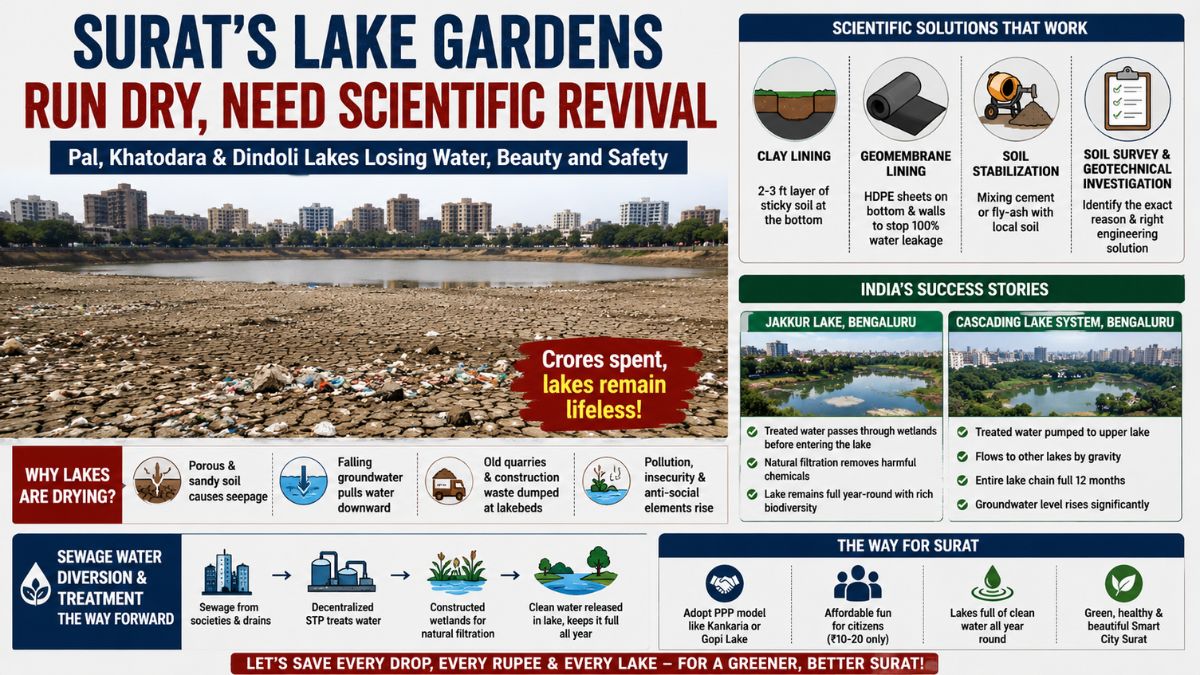
Surat | Gujarat — The once vibrant lake gardens of Pal, Khatodara and Dindoli in Surat — developed with investments worth crores of rupees — are today staring at an alarming crisis. Vast stretches of cracked lakebeds, foul surroundings, rising pollution and increasing anti-social activity have turned these urban recreational spaces into lifeless zones, raising serious questions over the sustainability of Surat’s lake development projects.
Urban planning experts and environmental observers now believe that merely pumping water into these lakes during monsoon or from external sources is no longer enough. Instead, they argue that the Surat Municipal Corporation (SMC) must urgently adopt a scientific and engineering-based restoration strategy before more public money goes down the drain.
According to technical experts, the primary reason behind the rapid disappearance of water from these lakes could be the highly porous and sandy soil found in parts of Pal, Khatodara and Dindoli. Water seeps directly into the ground due to poor retention capacity, while falling groundwater levels during summer accelerate downward absorption.
“In many cases, these sites were earlier low-lying pits or quarry areas filled with loose construction debris. Such surfaces cannot naturally hold water for long periods,” said an environmental engineer associated with urban lake restoration projects.
Experts insist that a detailed soil survey and geotechnical investigation are now essential to determine the permeability rate of the soil and identify permanent solutions. Suggested interventions include clay lining using compact sticky soil, geomembrane lining through HDPE sheets to prevent leakage, and soil stabilization using cement or fly ash mixtures.
“Without strengthening the lakebed scientifically, every litre of water added to the lake will continue to vanish underground. It becomes a recurring waste of taxpayer money,” an urban hydrology specialist warned.
Another major recommendation gaining support is the use of treated sewage water to maintain lake levels throughout the year. Experts clarified that untreated sewage cannot be diverted directly into lakes due to risks of foul smell, diseases and ecological damage. Instead, decentralized Sewage Treatment Plants (STPs) and constructed wetlands should be installed near lake zones.
Under this model, wastewater from nearby societies and drainage networks would first be purified through mini-STPs before being released into the lakes. Natural wetland filtration systems containing aquatic plants and algae can further improve water quality before it enters the main water body.
Environmental planners point to Bengaluru’s internationally acclaimed Jakkur Lake model as proof that treated wastewater can successfully revive urban lakes. Similar cascading lake systems in Bengaluru have not only kept lakes full year-round but also significantly improved groundwater levels and biodiversity.
Experts say Surat can replicate such models effectively due to its favorable climate and urban infrastructure. “If desert cities abroad can transform wastewater into thriving ecological zones, Surat can certainly revive Pal, Khatodara and Dindoli lakes through proper planning,” a civic activist said.
Many urban planners are also advocating a Public-Private Partnership (PPP) model similar to Ahmedabad’s Kankaria Lake or Surat’s Gopi Talav for long-term maintenance and revenue generation. Such a system, they argue, could reduce the maintenance burden on civic authorities while converting neglected lake gardens into affordable recreational hubs for citizens.